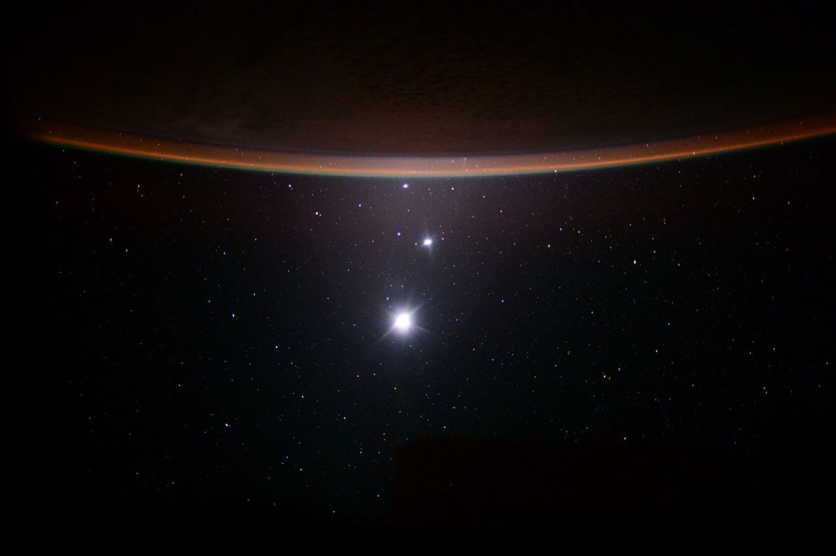
Step outside tonight, about 45 minutes after sunset, look west, and you will see the two brightest planets in the night sky appearing closer together than they will be again until November 2028. The Venus-Jupiter conjunction 2026 — the year's premier naked-eye skywatching event — reaches its peak this evening, June 9, when the two planets will be separated by just 1° 38', or roughly 1.6 degrees, computed from the Jet Propulsion Laboratory's DE440 planetary ephemeris. That gap is roughly three times the width of a full moon, easily visible without any equipment, from any city rooftop to any suburban backyard.
No telescope is required. No dark sky is required. No alarm clock is needed — the planets are visible in the evening, not before dawn. Venus and Jupiter are bright enough to cut through full urban light pollution, and you have up to two hours after sunset before the pair sinks below the horizon.
Both Planets in the Western Sky Tonight: What You Will See
Venus will appear first, blazing white and unmistakable — far brighter than any star. Jupiter hangs nearby, slightly below Venus and a little to the right, noticeably dimmer but still vastly outshining every true star in the sky. During tonight's conjunction, Venus shines at magnitude −4.0 and Jupiter at −1.9 — figures derived from the same JPL DE440 ephemeris data. In practical terms, that makes Venus roughly 7.5 times brighter than Jupiter as seen from Earth.
If you look just above and slightly left of the pair, you will spot two stars of similar brightness twinkling close together. Those are Pollux and Castor, the twin stars of Gemini — the constellation in which Venus and Jupiter are currently positioned — and they make a convenient visual anchor for finding the planets.
Look a bit lower and closer to the horizon and you may also catch a third, fainter point of light: Mercury, the innermost planet, briefly visible in the deepening twilight before it sets.
Read more: Venus and Jupiter Will Align In A Dazzling Morning Spectacle; Find out How and When to Watch!
Why Is Venus So Much Brighter Than Jupiter, a Planet 12 Times Its Size?
The size paradox is real: Jupiter's diameter is roughly 12 times larger than Venus's, and you could fit more than 1,000 Venuses inside it. Yet Venus consistently outshines Jupiter in Earth's sky. Two physical factors explain it.
First, proximity. Venus is currently about 111 million miles (180 million km) from Earth. Jupiter is roughly 560 million miles (900 million km) away — more than five times farther. Light intensity falls off with the square of the distance: Jupiter would need to be intrinsically far more luminous per unit area to compensate for that disparity, and it is not.
Second, reflectivity. Venus is wrapped in a continuous, planet-wide layer of sulfuric acid clouds that act as a nearly ideal light reflector. Its albedo — the fraction of incoming sunlight it bounces back — is approximately 0.70, meaning roughly 70% of the sunlight striking it returns to space. Jupiter's cloud layers are darker and less uniform, yielding an albedo of about 0.52. Together, Venus's superior proximity and its sulfuric acid cloud reflectivity more than offset its smaller physical size.
Venus currently displays a gibbous phase — similar to a gibbous moon, it is more than half lit as seen from Earth. This is a function of orbital geometry: Venus is an inferior planet, meaning it orbits the Sun inside Earth's orbit, and like the Moon it goes through a full cycle of phases as it moves around the Sun relative to our vantage point.
How Tonight's Planetary Conjunction Forms: Orbital Mechanics and the Ecliptic Plane
A planetary conjunction occurs when two planets share the same right ascension — the same position projected onto the celestial sphere as seen from Earth — even though they remain hundreds of millions of miles apart in three-dimensional space. The reason conjunctions happen at all is that all the major planets orbit the Sun in nearly the same flat plane, called the ecliptic. That co-planar architecture is inherited from the rotating disk of gas and dust — the protoplanetary disk — from which the solar system formed approximately 4.6 billion years ago. Because of it, planets perpetually appear to travel along the same narrow band of sky, making close encounters a predictable feature of the night sky rather than a cosmic accident.
Tonight's specific geometry is the product of diverging orbital speeds. Venus orbits the Sun in 224.7 days; Earth takes 365.25 days; Jupiter requires 11.86 years. Earth is currently pulling away from Jupiter, causing the giant planet to sink gradually toward the western horizon each evening. Meanwhile, the faster-moving Venus is climbing higher in the evening sky as it approaches its greatest elongation — its maximum apparent distance from the Sun — in mid-August 2026. The two apparent tracks converge tonight at their tightest angle: 1° 38' of arc, per JPL's DE440 ephemeris.
How to See the Venus-Jupiter Close Approach Tonight
The viewing window is approximately 45 minutes to two hours after your local sunset. Earlier in the window, the sky will still be twilight-blue; later, the planets will be closer to the horizon. The sweet spot for most locations is about one hour after sunset, when the sky is dark enough to appreciate the brightness contrast but the planets are still comfortably above the horizon.
Find a location with an unobstructed western horizon — free of buildings, hills, or trees. Venus will appear first, before the sky fully darkens. Jupiter will be the next brightest object to appear, just below and to Venus's right.
Binoculars will enhance the view significantly. Through a standard pair, both planets will fit in the same field of view, making the juxtaposition visually striking. Through a steady pair, you may also detect tiny pinpoints of light on either side of Jupiter: its four largest Galilean moons — Io, Europa, Ganymede, and Callisto — arranged in a line that bisects the planet. A telescope will reveal Venus in its current gibbous phase.
For precise local timing and sky positioning, the free Stellarium web app renders an accurate star map for any location on Earth.
While tonight, June 9, is the peak, near-peak views continue through June 10 and 11 — the planets will still be close enough to fit within binoculars' field of view for the next couple of evenings, gradually widening apart afterward.
After the Conjunction: Where the Planets Go Next
Once tonight's peak passes, the gap between Venus and Jupiter will widen each evening. Jupiter will continue sinking toward the western horizon and will enter the Sun's glare in late July 2026. Venus will do the opposite, climbing higher in the evening sky through the summer, reaching its greatest elongation — its widest apparent separation from the Sun — on August 14–15, 2026, then eventually dropping back toward the Sun in October.
On June 16, a thin waxing crescent moon will form a triangle with Jupiter and Mercury low in the western sky. On June 17, the crescent will float beside Venus, and binoculars pointed between the moon and Venus may reveal a bonus object: the Beehive Cluster (Messier 44), a star cluster of several hundred stars that lies in the neighboring constellation Cancer.
The next Venus-Jupiter conjunction will not occur until November 10, 2028, and it will be a morning conjunction — visible before dawn rather than in the evening sky. The current evening pairing, visible for anyone with a clear western horizon, is the closer and more accessible of the two events.
Frequently Asked Questions
Where should I look to see Venus and Jupiter tonight?
Look low in the western sky, beginning about 45 minutes after local sunset. Venus will appear first — it is the brightest star-like object in the sky, blazing white and impossible to miss. Jupiter will be just below and slightly to Venus's right, noticeably dimmer but still far brighter than any actual star. The pair will be visible for up to two hours before setting.
Why is Venus brighter than Jupiter in the night sky?
Two factors combine to make Venus outshine Jupiter despite Jupiter's enormous physical size advantage. Venus is currently about 111 million miles from Earth, while Jupiter is more than 560 million miles away — over five times farther. Additionally, Venus is covered by sulfuric acid clouds with an albedo of approximately 0.70, meaning about 70% of the sunlight hitting it bounces back. Jupiter's cloud layer is less reflective, with an albedo of about 0.52. The combination of superior proximity and higher reflectivity gives Venus a magnitude of −4.0 tonight versus Jupiter's −1.9, a difference that makes Venus roughly 7.5 times brighter in the sky.
When is the next Venus-Jupiter conjunction after June 2026?
The next Venus-Jupiter conjunction will occur on November 10, 2028, and it will be a morning conjunction — visible before dawn, not in the evening sky. That event will actually be closer at 0.6 degrees of separation, but requires an early wake-up. The current evening pairing is the most accessible version of this event for the next two-plus years.
Do I need a telescope to see the Venus-Jupiter conjunction?
No telescope is required. Venus and Jupiter are the two brightest planets in the night sky and are easily visible to the naked eye even from brightly lit cities. Binoculars improve the experience — both planets fit in the same field of view and you may detect Jupiter's four Galilean moons. A telescope will additionally reveal Venus's gibbous phase. But a clear western horizon and the ability to look up are the only equipment the event demands.
ⓒ 2026 TECHTIMES.com All rights reserved. Do not reproduce without permission.


