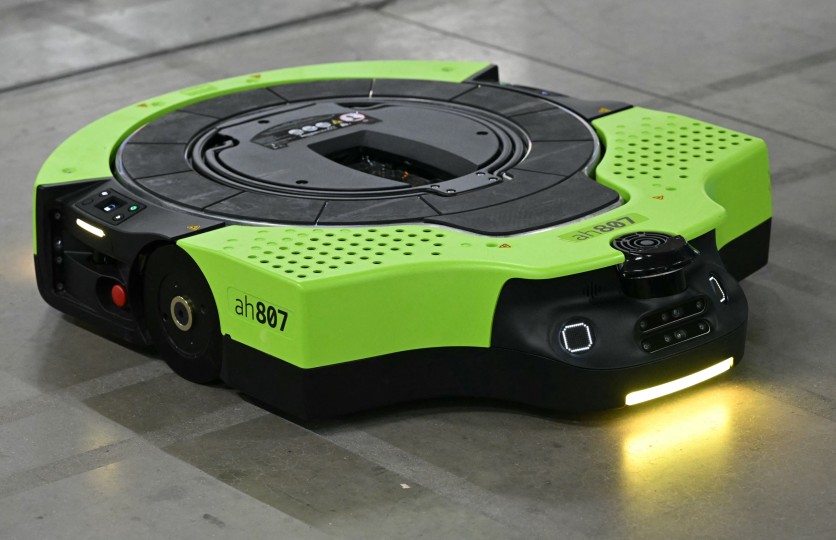
Amazon has given its warehouse robots something they did not have before: the ability to be told what to do in plain language. At its "Delivering the Future" event in London on June 4, the company unveiled a next-generation, conversational version of its autonomous Proteus robot, as part of a plan to invest more than €10 billion modernizing its European fulfillment network and to add 25,000 jobs in the region.
The announcement matters to more than logistics insiders. Amazon is one of the world's largest employers, and how it automates its warehouses shapes both the price and speed of deliveries customers receive and the nature of the jobs hundreds of thousands of people do. A robot you can instruct by talking to it is a meaningful step in that story.
What is new about this Proteus
The original Proteus was a dock-only machine, useful but confined to specific zones and tasks. The new model, by Amazon's account, works anywhere across fulfillment and delivery sites and accepts plain-language instructions rather than rigid programming. As Amazon Robotics vice president Scott Dresser described it, the robot figures out "the priority, the route, the timing" on its own once given a goal.
That is a shift in how warehouse robots are controlled. Traditional automated guided vehicles follow fixed paths and pre-programmed routines; telling one to do something new means reprogramming it. A robot that takes a natural-language instruction and works out the execution itself moves the human role from programming to directing, the same change that large language models brought to software, now applied to a machine that moves physical carts. The current Proteus already runs at 25 US fulfillment centers and moves carts weighing close to 400 kilograms, so this is an upgrade to a system operating at real scale, not a lab curiosity.
The technology underneath
The conversational interface sits on top of a broader push Amazon describes as a robotics "foundation model", an AI trained to generalize across many robotic tasks rather than being hand-coded for each one. The aim is for a single underlying model to power different behaviors and different machines, so capabilities improve across the fleet rather than one robot at a time. Amazon says it has now deployed more than a million robots across its operations, which gives it an unusually large base of real-world data to train such a model, and a strong incentive to make the robots more flexible rather than more specialized.
The London event showcased the wider fleet too: STARK, a tote-handling robot piloted in Barcelona and slated for 15 European sites, and Vulcan, described as Amazon's first robot with a sense of touch, now running in Hamburg. Touch sensing matters because gripping and handling varied, delicate items has been one of the hardest problems in warehouse robotics, the kind of task where rigid machines fail and humans still excel.
Read the timeline carefully
The enthusiasm should be tempered by the schedule. The new conversational Proteus is being piloted in Amazon's labs, with European deployment planned for the first half of 2027, not now. That gap between a polished unveiling and working deployment is common in robotics, and it is where ambitious demonstrations often meet the friction of real operations. The €10 billion investment and the 25,000 jobs are forward commitments; the robot taking spoken orders on a live warehouse floor is still ahead.
The jobs question Amazon's framing sidesteps
Amazon presents the European expansion as job-creating, and at the level of headline numbers it is adding roles. But the relationship between warehouse automation and employment is more complicated than a single figure conveys. More capable, free-roaming robots that handle routine movement and, increasingly, handling tasks change the mix of work humans do, can raise the pace and intensity of remaining roles, and over time shift the ratio of robots to people on a floor. A company can add jobs in absolute terms while automating away specific tasks and altering working conditions. The honest reading is that automation at this scale reshapes work rather than simply adding or subtracting it, and the 25,000-job pledge is one true fact within a larger, more nuanced picture.
Bottom line
Amazon unveiled a conversational, free-roaming version of its Proteus warehouse robot alongside a €10 billion European investment and a 25,000-job pledge, with the robot built on a robotics foundation model and slated for European deployment in early 2027. The natural-language control and touch-sensing fleet point to where warehouse automation is heading: more flexible machines directed rather than programmed. The unresolved part is the human one, how robots this capable change the work of the people who share the floor with them.
Frequently Asked Questions
What is the new Proteus robot? A next-generation version of Amazon's autonomous warehouse robot that can roam freely across fulfillment and delivery sites and accept plain-language instructions, unveiled June 4, 2026, in London.
How is it different from the old one? The original Proteus was confined to dock areas and specific tasks. The new model works anywhere in a facility and figures out the route, priority and timing of a task from a spoken instruction rather than fixed programming.
When will it be deployed? Amazon says it is being piloted in its labs, with European deployment planned for the first half of 2027. The current-generation Proteus already runs at 25 US fulfillment centers.
Will it cost jobs? Amazon frames its €10 billion European plan as adding 25,000 jobs, but more capable robots also change the tasks humans perform and the pace of work. Automation at this scale tends to reshape jobs rather than simply add or remove them.
ⓒ 2026 TECHTIMES.com All rights reserved. Do not reproduce without permission.


