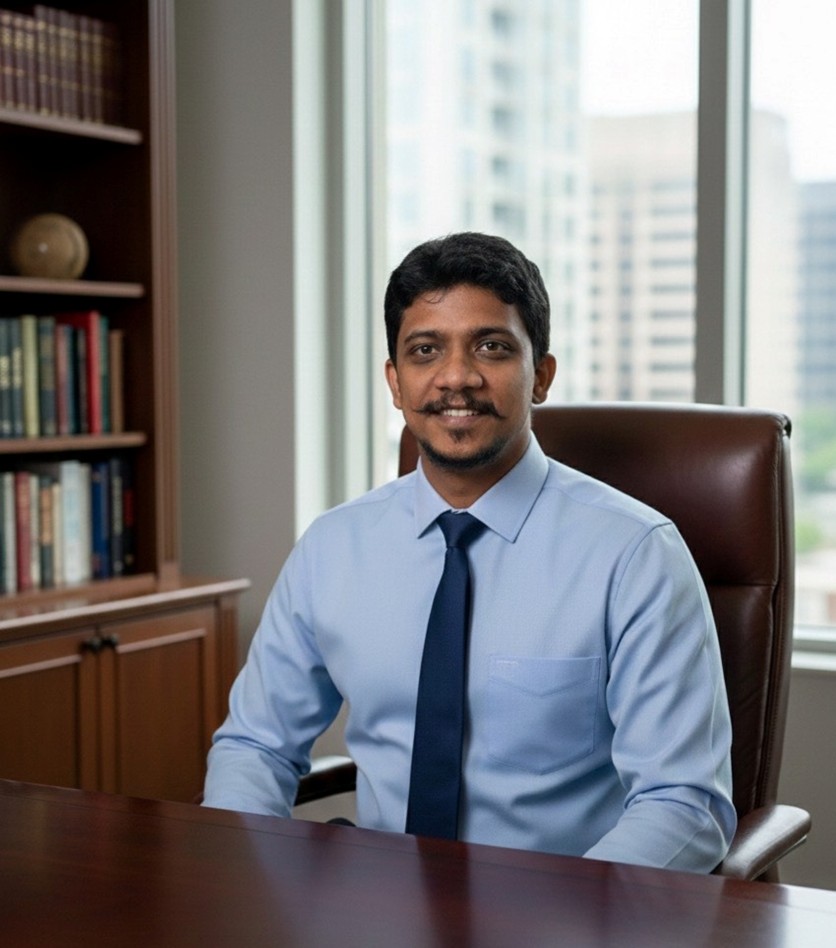
Every computation in a modern data center depends on a fragile balance between physics and precision. When millions of processors synchronize, even the smallest deviation inside a single chip can ripple across vast systems, slowing algorithms and disrupting intelligence models. Deepak Musuwathi Ekanath built his career on mastering that balance. He turned statistical discipline into a science of reliability, ensuring that the machines driving artificial intelligence, research, and automation operate without hesitation.
"It's never just about building faster chips," he says. "It's also about building predictable ones. Speed is only valuable when it's stable."
The Precision of 3nm and 2nm Engineering
At the frontier of semiconductor development, Deepak's work has shaped how advanced processing cores are tested, analyzed, and improved. He played a crucial role in characterizing extremely large-scale processing cores built on 3-nanometer and 2-nanometer technologies, the smallest, most complex architectures ever commercialized. These cores form the computational backbone of modern System-on-Chip (SoC) platforms, including Graphic Processing Units (GPUs) that support large-scale Machine Learning and Artificial Intelligence applications.
The task was formidable. At these scales, a single atom can alter the flow of current, and traditional testing methods fail to predict long-term reliability. Deepak led efforts to quantify the precise performance margins within these cores, how temperature, voltage, and manufacturing tolerances influence performance and yield. His models revealed measurable gaps for improvement and, more importantly, defined where those improvements originated.
He devised a statistical methodology that decoupled performance gains from design enhancements and process refinements, a breakthrough that allowed engineers and manufacturing partners to pinpoint whether changes were coming from smarter design or better fabrication. This distinction gave both design teams and semiconductor foundries a clear path forward, allowing optimization at every stage without misallocating resources.
"When you separate design from process," Deepak explains, "you can finally tell where progress is real and where it's just noise. That's when engineering becomes strategy."
His framework became a cornerstone for collaboration between chip design groups and foundries. It reduced redundant testing, cut characterization costs, and established a new layer of transparency across global production lines.
Quantifying the Invisible
The challenge of modern data infrastructure lies in prediction, knowing how billions of transistors will behave before they are ever deployed. Deepak's work pushed semiconductor reliability into the realm of statistical foresight. He applied advanced data analytics to detect correlations invisible to standard testing: minute variations in silicon geometry, fluctuations in current leakage, and subtle timing drifts that influence large-scale system behavior.
His extensive experience across several semiconductor environments enabled him to connect nano-level physics to macro-level reliability. He built predictive models for Static current (IDD) testing at ARM that replaced months of retesting with precise mathematical forecasts. His defect metrology systems at Micron shortened inspection timelines from months to hours and prevented large financial losses.
As Deepak explains, "At small geometries, complex architecture makes leakage catastrophic. It is no longer only a manufacturing flaw. The engineering design itself is hitting theoretical scientific limits. Accurate leakage modeling is critical to safeguard yield, quality, and reliability."
At NXP, his Six Sigma Black Belt qualification positioned him as a final reviewer of statistical soundness across engineering projects. Each role deepened his understanding of how to quantify what cannot be seen.
At Google, those principles evolved into the validation standards governing the company's hyperscale computing systems. Every GPU and SoC that enters production must meet measurable benchmarks for stability, reliability, and thermal endurance. His models detect weak points long before deployment, allowing predictive corrections that prevent failure across entire fleets of servers.
What distinguishes Deepak's method is precision over perception. He rejects intuition in favor of pattern recognition derived from data. Each model, each curve, and each probability distribution reflects his belief that consistency is engineered, not assumed.
Building Reliability at Scale
Deepak's influence runs deep through the hardware that sustains artificial intelligence. His predictive frameworks and characterization methodologies have defined a new standard for how high-performance computing systems are qualified for reliability. In 3nm and 2nm architectures, where transistor densities reach billions per square centimeter, his statistical rigor provides the stability required for training trillion-parameter models.
He introduced adaptive clock characterization techniques that turned voltage instability into resilience. Instead of crashing during voltage dips, processors slow down and recover, extending yield and product lifespan. That single intervention reshaped how chipmakers treat reliability under electrical stress. Within Google's infrastructure, such systems form the invisible armor that protects uptime across data centers handling vast machine workloads.
Deepak's colleagues describe him as an engineer who treats mathematics like a language, precise, unforgiving, and endlessly explanatory. He sees quality as measurable logic, not assumption. "Precision doesn't mean perfection," he says. "It means knowing exactly how far you are from it, and closing that gap methodically."
Every major contribution he has made, from predictive current modeling to process-decoupling frameworks, builds toward a singular vision: a computing ecosystem where failure is statistically improbable.
A Legacy of Measurable Certainty
Deepak Musuwathi Ekanath's work rarely headlines public discussions, but its effects are global. The systems that train artificial intelligence, map genomes, or process global transactions depend on the invisible reliability of his frameworks. He has made precision a language that engineers and machines share a common reference for trust at scale.
His legacy is not written in code or patents but in the silent stability of systems that never fail. Each equation, model, and methodology he refined strengthened the foundations of computation itself.
When asked what drives his pursuit of flawless reliability, his answer is measured and calm: "Data never lies. It only waits to be read correctly."
That philosophy now underpins the world's most advanced data centers, where confidence is engineered, measured, and proven one transistor at a time.
ⓒ 2026 TECHTIMES.com All rights reserved. Do not reproduce without permission.


