
For decades, organizations have believed that better execution is a matter of discipline. Better meetings. Better tools. Better people.
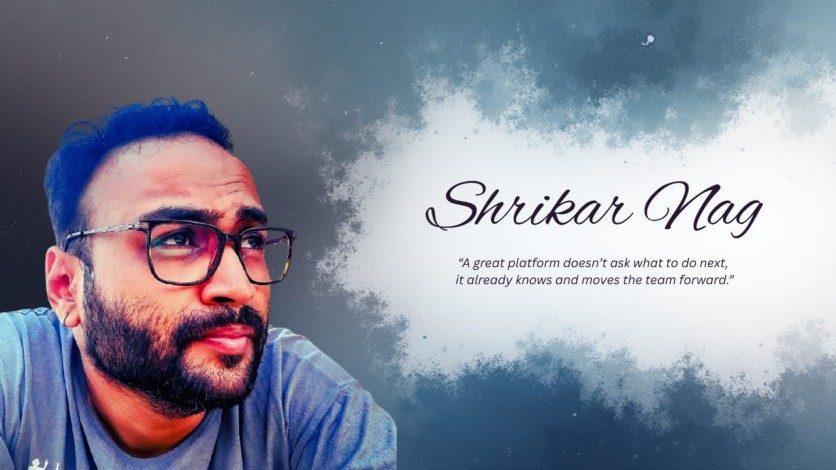
Shrikar Nag believes that assumption is outdated.
In his view, execution problems persist not because humans are failing, but because modern organizations have outgrown the cognitive limits of human-only coordination. The systems have become too complex, too fast, and too interdependent to be understood through static reports and periodic reviews.
That belief now shapes the work of Shrikar Nag, founder and chief executive of Tymeline Inc., and the architect of what he defines as Autonomous Organizational Intelligence, a framework that reframes how enterprises observe, understand, and adapt their own behavior.
It is a quiet idea with disruptive implications: organizations should not merely be managed. They should be able to reason about themselves.
When Information Stops Becoming Intelligence
Most enterprises are rich in data and poor in understanding.
They can tell you how many tasks were completed last quarter, how many employees logged overtime, and how budgets shifted across departments. What they cannot tell you—at least not reliably is why execution broke down, where risk is accumulating, or what will likely fail next.
Shrikar Nag encountered this limitation repeatedly across engineering, product development, and leadership environments. Strategy was rarely the issue. Talent was rarely the issue. The failure point was always somewhere between intent and outcome.
Execution knowledge lived in fragments. No system could see the organization end-to-end.
"Organizations generate enormous amounts of signal," Shrikar Nag has observed. "But very little of it is converted into usable intelligence."
That gap became the starting point for his work.
Autonomous Organizational Intelligence Is Not Automation
Autonomous Organizational Intelligence is often misunderstood as another automation layer. It is not.
Automation follows rules. AOI learns from behavior.
Shrikar Nag's framework treats the organization as a dynamic system, one that produces patterns over time. By analyzing historical execution data across people, projects, and finances, AOI systems can begin to recognize which combinations lead to delay, overload, or failure long before those outcomes become visible.
In practical terms, this means artificial intelligence does not merely summarize activity. It participates in planning, monitors deviations, forecasts risk, and recommends corrective action in real time.
The shift is subtle but fundamental. Intelligence moves from retrospective reporting to continuous reasoning.
Why Tymeline Was Built Differently
Shrikar Nag founded Tymeline Inc. in Austin, Texas, with a deliberate constraint: it would not become another productivity tool competing for attention inside organizations.
Instead, Tymeline was designed as an intelligence layer, a system that sits above operational tools and learns how an organization actually functions over time.
The platform unifies execution planning, workforce analytics, and financial intelligence into a single adaptive model. Its strength lies not in what it tracks, but in what it remembers.
By learning from historical execution patterns, Tymeline enables predictive visibility. Leadership teams can see emerging delivery risks, coordination breakdowns, and capacity strain before those issues manifest as missed commitments or burnout.
Under Shrikar Nag's leadership, Tymeline has secured institutional venture investment, been selected into highly competitive international accelerator programs, and received government-backed innovation grants. Each recognition followed a technical and innovation review rather than a commercial promotion.
Original Work at the System Level
What distinguishes Shrikar Nag's contribution is its architectural depth.
He is the primary inventor on multiple U.S. provisional patent applications covering autonomous organizational intelligence frameworks, AI-driven project orchestration, and predictive workforce analytics. These filings do not focus on user interfaces or incremental efficiency gains. They define how self-adjusting organizational systems can be constructed.
Parallel to this, Shrikar Nag has published peer-reviewed research and widely cited working papers exploring how artificial intelligence and blockchain can support auditable, adaptive execution environments.
One line of research examines AI-driven detection of burnout and cognitive overload using longitudinal performance signals. It reflects a broader thesis: organizational intelligence should improve sustainability, not merely output.
This balance between performance and human impact has become increasingly rare in enterprise AI discourse.
Testing the Framework Where Failure Is Expensive
The credibility of any organizational theory lies in its application.
Tymeline's systems are currently being piloted and evaluated by enterprise and semiconductor organizations in contexts where execution errors have immediate financial and operational consequences.
These are environments intolerant of abstraction. Systems must explain themselves, adapt quickly, and deliver measurable value.
That AOI is being tested in such settings suggests it is not a speculative idea. It is a response to a real operational ceiling enterprises are encountering.
Why Enterprises Are Rethinking Control
The last generation of management assumed that tighter control produced better outcomes. More oversight. More reporting. More escalation.
That model is breaking.
As organizations become more distributed and interdependent, control creates latency. By the time humans intervene, conditions have already changed.
Shrikar Nag's work proposes a different orientation: a shift from control to awareness.
When organizations can sense their own patterns and anticipate consequences, leadership can focus on direction rather than damage control. Decisions become proactive rather than corrective.
"The problem is not that leaders make poor decisions," Shrikar Nag has said. "It's that decisions arrive too late."
A Founder Focused on Structure, Not Visibility
Shrikar Nag does not position himself as a futurist. He works like a systems engineer.
His focus is not on predicting how organizations should behave, but on designing intelligence systems that allow organizations to observe how they do behave and adjust accordingly.
In an era crowded with AI claims, this restraint is notable. Autonomous Organizational Intelligence does not promise perfection. It promises learning.
And in complex systems, learning is the difference between collapse and adaptation.
The Implication Few Are Naming
If organizations can reason about themselves, the role of leadership changes.
Management becomes less about monitoring activity and more about setting intent. Less about reacting to failure and more about shaping trajectories.
That shift will not happen overnight. But the infrastructure is beginning to form.
Shrikar Nag is not arguing that organizations should surrender control to machines. He is arguing that without embedded intelligence, control is already slipping quietly, inefficiently, and at great human cost.
Autonomous Organizational Intelligence offers an alternative path. One where organizations grow not just larger, but wiser.
And that may be the most consequential enterprise shift of the coming decade.
ⓒ 2026 TECHTIMES.com All rights reserved. Do not reproduce without permission.


