

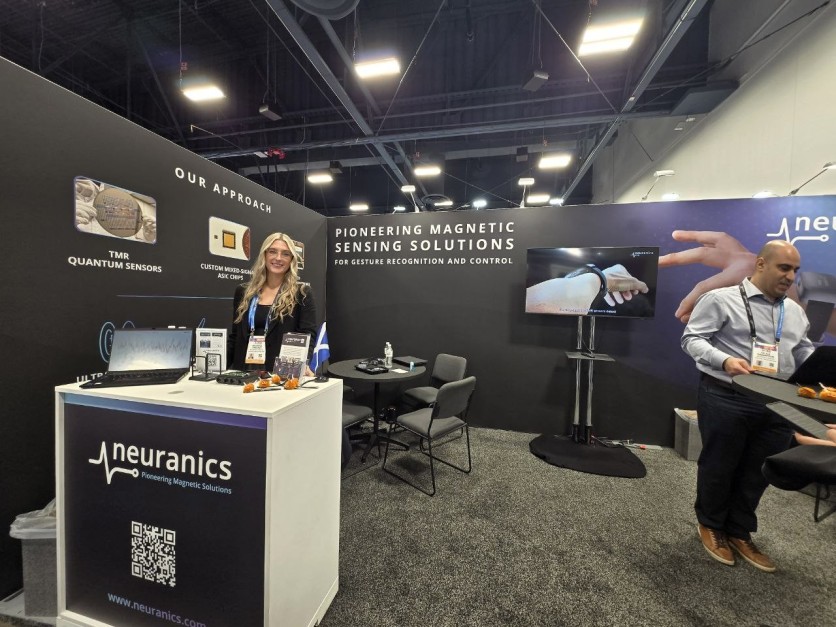
LAS VEGAS — In the high-energy gaming halls of CES 2026, where the latest virtual reality headsets and haptic vests compete for attention, a quiet breakthrough from Scotland is promising to change how humans interact with machines forever. Neuranics, a magnetic sensor company born from the research labs of two of the United Kingdom's largest universities, has unveiled a technology that can "read" the human body without ever making physical contact.
By moving away from traditional electrodes and toward ultra-sensitive magnetic detection, Neuranics is opening the door to a future where our intentions are captured through our clothing, seamlessly translating muscle contractions into digital actions.
The Science of the Pico-Tesla: Precision at a Distance
The core of Neuranics' innovation lies in its TMR (Tunnel Magnetoresistance) sensors. While traditional medical and gaming sensors rely on electrical signals that require skin-to-skin contact, Neuranics detects the incredibly faint magnetic fields generated by muscle contractions and heartbeats.
"We make TMR sensors that are capable of pico-Tesla level detection," a company representative explained. To put that into perspective, a pico-Tesla is a trillionth of a Tesla—a measurement of magnetic flux density so minute that it was previously almost impossible to capture outside of heavily shielded laboratory environments.
- The Single-Digit Breakthrough: In the six months leading up to CES 2026, the company achieved its most significant technical progress to date. They are now operating in the "single-digit pico-Tesla range at 1 Hz."
- Signal Clarity: This leap in sensitivity means that their "true MCG (magnetocardiography) and MMG (magnetomyography) signals" are clearer and more robust than anything they have experienced before, allowing for high-fidelity gesture recognition and health monitoring.
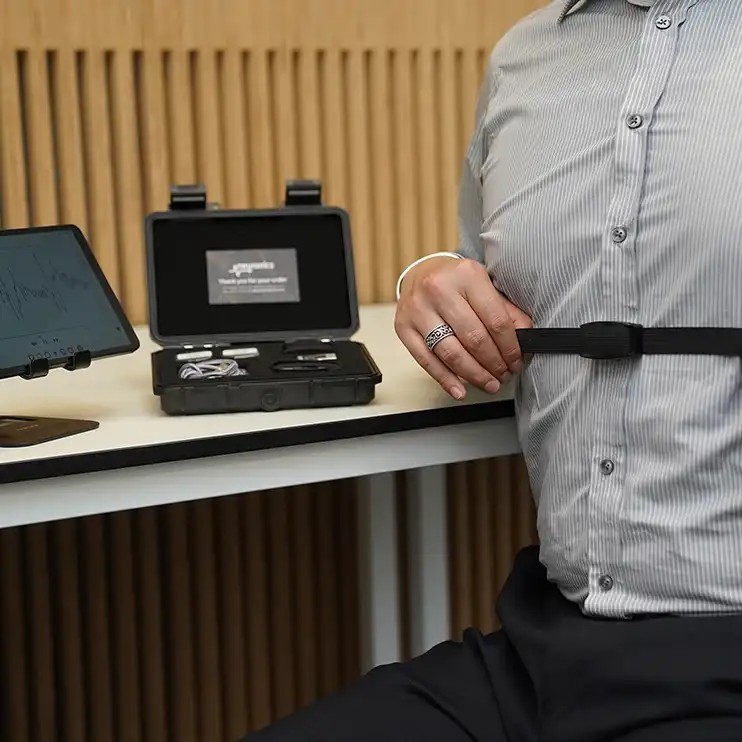
- No Skin Required: Unlike electrodes, which require firm skin contact and often conductive gels to reach heart or muscle signals, Neuranics' sensors can read these signals through clothing without touching the skin.
Redefining the Gaming and AR/VR Experience
While the technology has clear medical implications, Neuranics chose the gaming hall at CES 2026 to showcase its potential for gesture recognition. In an era of augmented and virtual reality, the industry is searching for more natural ways to control digital environments.
- Muscle-Driven Gestures: By detecting muscle contractions in the arm or wrist, the sensors can identify specific hand movements. This allows players to "interact" with a game world simply by moving their hands, without needing to hold a bulky controller or wear a camera-tracked glove.
- Ultra-Low Power and Size: The hardware is remarkably efficient and compact. Each sensor is roughly 1.6mm by 1.6mm, and the entire system operates with "extremely low power consumption," making it ideal for integration into smartwatches or the frames of AR glasses.
Positively Critical: The Noise Floor and the World
Neuranics' technology is a masterpiece of miniaturized physics, but its transition to the mass market faces the classic hurdles of "field-ready" hardware.
- Environmental Interference: Because the sensors are so sensitive to magnetic fields, they must be able to filter out the "noise" of the modern world—from the magnetic pull of a nearby smartphone to the hum of the electrical grid. Neuranics' recent success in reaching the single-digit pico-Tesla range suggests their filtering algorithms are maturing, but maintaining that precision in a chaotic consumer environment is the ultimate test.
- The Adoption Curve: For the public to benefit, major hardware manufacturers must be willing to swap established (and cheaper) electrode or camera-based tracking for this new magnetic approach. Neuranics is banking on the "contactless" advantage to win over developers who are tired of the limitations of skin-dependent sensors.
Looking Toward 2027: From the Lab to the Living Room
The journey for Neuranics has been one of steady, purposeful growth. Now in its third year at CES, the company has successfully transitioned from the "Eureka Park" startup zone to the main stage of the gaming hall.
"Next year, I want to be in one of the products that you see on TV," the representative shared, outlining an ambitious roadmap for CES 2027. "I want people to say, 'Oh my gosh, you're using a Neuranics sensor, that's amazing!'"
As the company moves from a "parts supplier" to a well-known name in the tech ecosystem, they are focused on ensuring their sensors become a standard component in the next generation of wearable tech. If they can maintain their trajectory, the days of sticky electrodes and clunky controllers may soon be a relic of the past, replaced by the silent, invisible, and incredibly precise reading of the human body.
ⓒ 2026 TECHTIMES.com All rights reserved. Do not reproduce without permission.


