
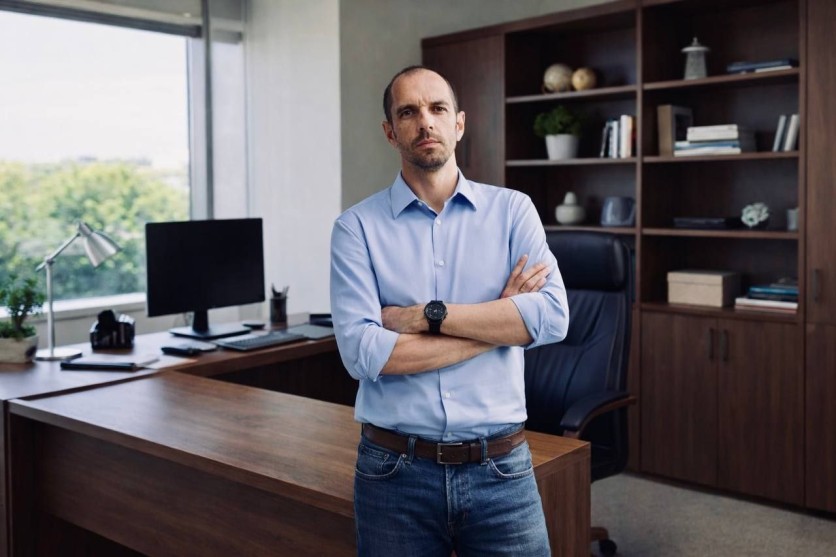
As the construction technology market surges, we sit down with the structural engineering expert behind some of the world's most complex steel structures to discuss the future of industrial design.
The global construction landscape is undergoing a radical transformation. According to the latest Construction Technology Market Research Report released in January 2026, the industry is estimated to grow at a CAGR of 12.58% through 2031, driven by a desperate need for precision in an era of acute labor shortages. At the heart of this digital revolution are the engineers who bridge the gap between complex architectural visions and the reality of steel fabrication.
To understand how digital-twin technology, precision detailing, and human intuition are converging to redefine industrial efficiency and solve the global labor crisis, we turned to Pavlo Tkachenko, Chief Structural Engineer at "Steel Project." Pavlo brings over 20 years of specialized expertise to the global stage, having evolved from shop-floor engineering at major fabrication plants to leading high-stakes international design operations. Currently a member of the prestigious Institution of Engineering and Technology (IET), he has become a pivotal figure in high-precision BIM detailing and KMD drawings, managing multidisciplinary teams of up to 20 engineers to deliver structures for projects that define modern industry. His portfolio is headlined by the massive $11 billion Amiral Petrochemical Complex in Saudi Arabia, where his innovative approach to cost-optimization ensures that the world's most complex industrial puzzles are realized with millimetric accuracy.
Pavlo, as Chief Structural Engineer, leading BIM-based steel detailing and KMD delivery, you're accountable for whether fabrication and site assembly work without surprises. In 2026, what has changed in your role in this data-driven era?
We have moved far beyond simple blueprints. Today, we are managing "Digital Twins." My focus is on the development of highly detailed 3D models for steel buildings, specifically what we call KMD drawings. In 2026, the industry doesn't just want a drawing; it wants a data-rich model where every bolt and weld is optimized for production. My role is to ensure that these massive industrial puzzles fit together perfectly the first time, reducing waste and cost.
At the Amiral Petrochemical Complex, a project that is currently a global benchmark, you helped produce fabrication-ready packages that reduced site rework. What were the specific challenges of a world-scale facility like this?
The Amiral project is a world-scale facility integrated with the SATORP refinery, designed to produce 1.65 million tons of ethylene per year. The sheer scale is staggering. When you are dealing with a, say, $1 billion investment, even a 1% error in steel detailing can lead to millions in losses during on-site assembly. Our task involved using advanced BIM tools like Tekla Structures to coordinate complex steel geometries. We focused on creating a seamless workflow where the design data fed directly into automated fabrication lines.
Speaking of software, you are a known expert in Tekla Structures. You use the tool to coordinate models and lock down connections before steel fabrication, avoiding late changes, rework, and schedule slippage. Why is this specific tool so critical for the "Industrial Boom" we are seeing?
Tekla allows us to build constructible models. In my practice at "Steel Project," we use it not just for visualization, but for life-cycle management. It enables real-time collaboration between teams of 4 to 20 engineers, which I manage. By using these innovative methods, we can find solutions that significantly cheapen the construction and production process without sacrificing structural integrity.
Detailed steel engineering is often a "hidden" phase. How does your work on KMD drawings directly impact the sustainability goals of projects like Amiral?
Sustainability in 2026 is about efficiency and the reduction of carbon intensity. By providing high-precision KMD drawings, we eliminate the need to modify steel on-site. Every ton of steel that doesn't need to be scrapped or remade saves a massive amount of energy. Furthermore, precise detailing allows us to optimize the weight of the structure. If we can maintain safety while using 5% less steel through better engineering, that is a huge win for the environment on a multimillion-dollar project.
You've led multidisciplinary detailing teams of up to 20 engineers across regions. What controls do you use to maintain quality and engineering judgment when automation increasingly handles checks and coordination?
Technology is a tool, but the "philosophy of metal" remains human. While we use AI-driven modeling to catch inconsistencies, the lead engineer must understand the physical reality of the material. My mission is to bridge this gap. I personally spend a lot of time retraining university graduates. We teach them that a digital line in Tekla is actually a physical beam that has to withstand real-world loads. You can't automate the experience of 20 years in the field; you can only use technology to amplify it.
One of your missions is training the next generation: you've trained and mentored more than 15 engineers who now work on major projects. With the labor shortages reported in early 2026, how are you addressing the skill gap?
As reports show, the industry must attract nearly 350,000 new workers this year alone to keep pace with demand. We are addressing this by creating a culture of upskilling. We don't just hire for skills; we hire for potential and then provide intensive training in modern BIM standards. This allows us to scale quickly for large contracts while maintaining the high cost-value of our consulting services.
After more than 20 years working at the intersection of design, fabrication, and site assembly, what tech trend in 2026 will most reshape how structural engineers work day to day?
The integration of Digital Twin technology with real-time site monitoring. We are seeing growth in digital twin integrations this year. This means that after I finish the design, the model lives on to help the owner manage the building's entire lifecycle. My goal is to continue pushing the boundaries of what's possible in steel, making projects not just possible, but sustainable and efficient for decades to come.
ⓒ 2026 TECHTIMES.com All rights reserved. Do not reproduce without permission.


