
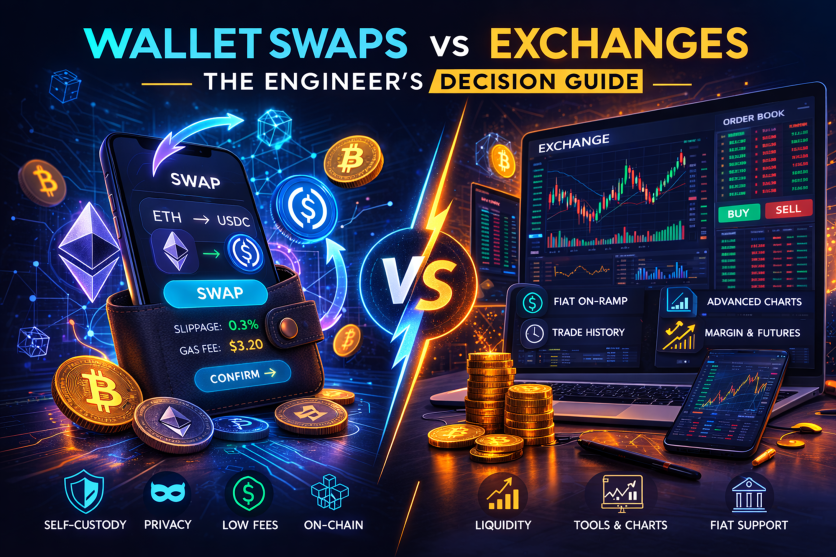
Wallet swaps and centralized exchanges both convert assets, but the plumbing is different. Wallet swaps (Uniswap, 1inch) execute on-chain through smart contracts via wallets like MetaMask or Rabby. Centralized exchanges (Binance, Coinbase) match orders off-chain and only use the blockchain for deposits/withdrawals.
This difference shows up fast when you're moving into assets that don't sit neatly in common on-chain liquidity paths—like Monero (XMR). If you're holding ETH in self-custody and want a direct conversion without first parking funds on a CEX, a route like swap eth to xmr can fit that "stay in control of keys" workflow. Either way, treat it like an engineering change: verify the XMR receiving address, do a small test amount, and account for network fees and timing.
DEX = more control, but gas/slippage/MEV and smart-contract risk. CEX = more convenience and liquidity, but KYC, custody risk, and potential withdrawal limits.
When Wallet Swaps Make Sense
Switch to a different wallet when it gives you materially faster confirmations, wider application coverage, and tighter self-custody controls. Not someday—today.
Chasing speed? Choose chain-optimized wallets. Solana-first wallets excel at high throughput, while Layer 2 native wallets using zk-rollups or Optimistic rollups offer low RPC latency. Private relays help you reduce MEV extraction and failed transactions. Looking for smoother access? Account abstraction wallets using ERC-4337 with gas sponsorship, session keys, and granular permissions beat the clunky experience of traditional seed-based wallets.
Need independence? Go non-custodial. Pair your wallet with hardware security, or use multi-party computation (MPC) with social recovery. That way, losing a single seed phrase isn't fatal. Built-in bridging and fiat ramps? Facing region blocks or KYC walls? That's when you swap. If you prefer open-source, auditable code without telemetry tracking, wallet swaps deliver that transparency.
The risks are real, though. Watch out for derivation-path mismatches when migrating wallets. Built-in swap features can have higher slippage than aggregators. Some closed-source wallets ask you to "trust me" without verification. Migration periods also attract phishing attacks. On the plus side, proof-of-stake and Layer 2 solutions significantly reduce your energy footprint compared to Layer 1 chains.
When Centralized Exchanges Win
Centralized exchanges dominate when you need immediate depth, large ticket sizes, and seamless fiat connectivity.
Moving a serious size? You want a central limit order book with thick market depth, minimal slippage, and deterministic execution. Need to move between crypto and traditional currency? ACH, SEPA, wire transfers, and card ramps beat the complexity of bridging and waiting for blockchain confirmations. Trading perpetual futures with cross-margin, fast liquidations, and portfolio margin? CEX matching engines handle latency and risk management in milliseconds. Executing block trades or over-the-counter deals? Aggregators and internal crossing reduce your market footprint versus broadcasting trades across multiple DEX pools.
But understand the tradeoffs. KYC and AML compliance, surveillance, and jurisdictional risk come with the territory. Custody risk, potential rehypothecation, and withdrawal freezes happen. Demand proof-of-reserves and segregated accounts. Maker-taker fees might be lower than Layer 2 gas plus MEV, yet you sacrifice independence.
The smart approach? On-ramp through a CEX for fiat conversion, withdraw to self-custody, then route swaps through DEX protocols when size and fiat access aren't bottlenecks.
Understanding Fees, Slippage, and Total Cost
Total cost often converges between platforms, but how you get there differs completely.
On automated market makers, you pay protocol and liquidity provider fees (typically 0.05–0.30%), gas costs (cheap on Layer 2 rollups, expensive on Layer 1), and price impact based on pool depth. Route aggregators split your order across venues to minimize slippage. Still, MEV and failed transactions are real risks. For a $10,000 ETH to USDC swap on a Layer 2? Expect roughly 0.05% in fees, around $0.50 in gas, and 0.05–0.15% price impact when liquidity is adequate.
Order-book exchanges charge maker-taker fees (0–0.4%), plus hidden spread costs and usually a fixed withdrawal fee that can dwarf spot trading fees on small amounts. Perpetual futures also carry funding rates. The question becomes: Is convenience worth sacrificing custody and submitting to KYC?
Rule of thumb: Small, frequent trades favor DEX on Layer 2. Large trades in deep pairs often see cheaper execution on CEX. Long tail tokens only exist on DEX, but watch slippage carefully. Value autonomy and global access? DEX delivers freedom with fewer gatekeepers and lower barriers to participation. Moving between chains? Bridge and withdrawal costs will dominate your expense calculation.
How Routing and Execution Work
Best execution depends entirely on how your order gets routed. AMMs expose price curves directly. Request-for-quote (RFQ) and intent-based systems outsource pricing to market makers and algorithms. Aggregators combine both approaches to optimize for net price and gas costs.
- Automated Market Makers (Uniswap v2/v3): Constant product formulas or concentrated liquidity ranges set prices using x*y=k mathematics. You trade directly against a pool. Your price impact equals your size relative to available liquidity. This creates slippage risk and vulnerability to sandwich attacks through MEV.
- Request for Quote (0x, Hashflow): Market makers provide off-chain quotes, either firm or indicative. You get lower slippage and tighter spreads on size, but quotes expire, and counterparty selection matters.
- Aggregators (1inch, Matcha, Paraswap): These split your order across pools and RFQ sources to achieve the best effective price, including gas. Smart routing helps, but more hops mean higher gas costs and potential transaction reverts.
- Intents and CoW Protocol: You sign an intent describing what you want, not how to execute it. Solvers compete in batch auctions, match coincidence of wants, and minimize MEV extraction. Fewer failed transactions and better net outcomes on correlated pairs, though solver centralization remains a concern.
Want freedom from MEV? Intents help. Need certainty on a large size? RFQ shines. Seeking simplicity? AMMs deliver. Hunting for the best net price? Aggregators optimize.
Security and Risk Tradeoffs
Owning your keys means maximum control. Delegating custody trades control for convenience with hidden liabilities. MEV extraction is an unavoidable tax. Token approvals create a silent attack surface.
Self-custody through externally owned accounts (EOA) plus hardware wallets or smart contract wallets (account abstraction/ERC-4337) gives you sovereignty. You also shoulder key loss risk, phishing vulnerability, and signing errors. Social recovery mechanisms, multisig setups, and multi-party computation help—at the cost of user experience complexity. You get freedom. You also get responsibility.
Counterparty custody through exchanges, lending platforms, and "earn" products trades private key risk for bankruptcy exposure, rehypothecation, and censorship risk. Proof-of-reserves helps, but doesn't prove liabilities.
MEV involves frontrunning, sandwiching, and backrunning that extract value from your swaps. Use RFQ or intent-based routers, private mempools like Flashbots Protect, and tight slippage guards. Layer 2 solutions reduce gas costs, but not MEV—sequencer policy matters significantly.
Token approvals present risks, too. Infinite ERC-20 allowances attract malicious contracts. Prefer per-transaction spend limits, session keys, or permit signatures. Revoke unused approvals regularly using tools like revoke.cash. Gasless approvals through Paymasters offer a great user experience but introduce new trust dependencies.
Chain and bridge risks—validator centralization, blockchain reorganizations, and bridge compromises—can undermine even perfect operational security.
Chains, Bridges, and Cross-Chain Swaps
Choose blockchains where bridging risk matches your threat model. Prefer native swaps like THORChain over wrapped token approaches when custody and system uptime matter most.
Bridges enable state and asset movement across chains. Cross-chain swaps let you trade without wrapping via external liquidity pools. THORChain uses native vaults plus threshold-signature multi-party computation. Its on-chain AMM sets prices. No wrapped tokens. Slashing mechanisms back good behavior. Wormhole uses message-passing with Guardian validators—fast and composable, but often mints wrapped assets that rely on validator set security.
Why does this matter? Do you need exit rights if a bridge pauses? Can you accept wrapped assets as counterparty risk?
THORChain waits for finality on both chains—slower but sovereign. Wormhole achieves near-instant transfers at lower cost but adds trust assumptions. Cross-domain relays create new attack surfaces for MEV and censorship. The opportunity? Aggregate liquidity across chains without surrendering your keys. The social angle? Permissionless exits empower users facing capital controls.
ⓒ 2026 TECHTIMES.com All rights reserved. Do not reproduce without permission.


