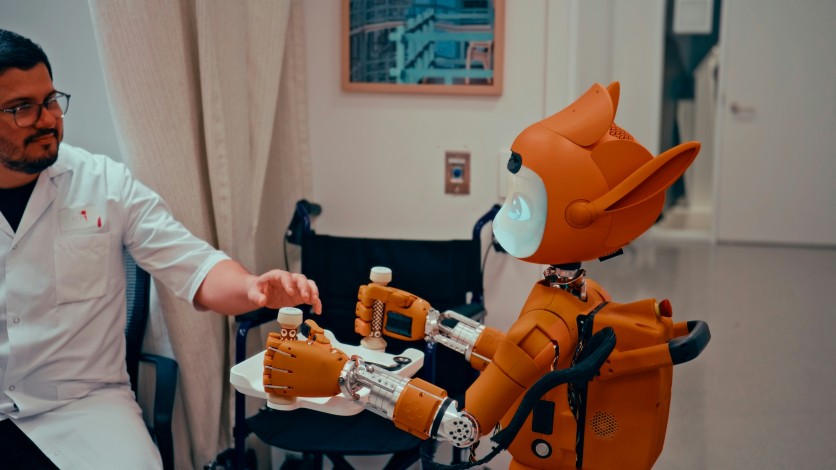
Medical robots are transforming modern medicine, bringing unprecedented precision to surgical procedures and advanced capabilities to diagnostics. Healthcare robotics enhances patient care through AI-powered imaging analysis, automated monitoring systems, and robotic-assisted surgery. These systems reduce human error, optimize workflow efficiency, and allow complex procedures to be performed with higher accuracy.
The da Vinci surgical system exemplifies how medical robots improve outcomes in minimally invasive surgery, offering tremor filtration, 3D visualization, and millimeter-level control. With a growing global need due to aging populations, surgeon shortages, and rising demand for precision medicine, the medical robots market is projected to expand from $18 billion in 2026 toward $50 billion over the next decade. Healthcare robotics is not just a technological marvel—it is becoming an essential component of patient-centered, efficient care worldwide.
What Are the Main Types of Medical Robots Used in Healthcare?
Medical robots in healthcare are designed to enhance patient care, streamline workflows, and improve clinical outcomes. Each type of robot addresses specific needs, from precision surgery to rehabilitation, diagnostics, and medication management. By combining advanced robotics with AI, these systems reduce errors, accelerate recovery, and support both patients and medical staff effectively.
- Surgical systems – Devices like da Vinci and Mako provide up to ten times human precision with wristed instruments offering seven degrees of freedom. These systems reduce incision sizes, lower complication rates, and shorten recovery times by approximately 15–40%.
- Rehabilitation and mobility robots – Exoskeletons such as ReWalk assist stroke patients or individuals with mobility challenges using neural-controlled movements.
- Automated pharmacy robots – Dispense medications with 99.9% accuracy, significantly reducing human errors in high-volume hospital settings.
- AI diagnostic companions – Analyze CT scans, MRIs, and pathology images, detecting conditions like breast cancer with up to 94% accuracy. Companion robots also provide social support, reducing elderly isolation and hospital readmissions by around 30%.
How Do Surgical Robots Improve Patient Outcomes?
Surgical robots dramatically enhance patient safety and precision by enabling procedures with up to 40% improved accuracy. Tumor resections, implant placements, and other delicate surgeries benefit from real-time imaging and AI guidance, minimizing damage to healthy tissue. These systems also reduce surgeon fatigue by filtering tremors, providing 3D HD visualization, and allowing longer, more focused procedures, which improves workflow efficiency by approximately 20%.
Robotic-assisted surgeries also lead to fewer complications and faster recovery times. Studies show intraoperative errors are reduced by 18%, and complication prediction improves by 25%. Complex procedures can be shortened by around 30 minutes, allowing patients to recover more quickly while hospitals benefit from increased efficiency and safer outcomes.
What Role Does AI Play in Healthcare Robotics Diagnostics?
AI plays a transformative role in healthcare robotics, enhancing diagnostics and patient care beyond traditional automation. By integrating machine learning and deep learning algorithms, medical robots can analyze data faster and more accurately than humans. These systems not only streamline routine tasks but also provide personalized insights, improving outcomes and efficiency across clinical settings.
- Rapid data analysis – Medical robots can analyze millions of medical records in seconds, identifying abnormalities undetectable to human eyes.
- Deep learning guidance – AI assists intraoperative planning, training, and treatment optimization, achieving pathology detection rates as high as 94%.
- Task automation – Medication dispensing, supply transport, fall detection, and continuous vital signs monitoring are automated, freeing medical staff to focus on complex care.
- Personalized care – AI systems develop tailored treatment algorithms and provide predictive insights, enhancing overall patient outcomes.
Market Growth and Training Challenges
Healthcare robotics is experiencing accelerated growth, with funding surpassing $8.5 billion in 2025. Investments from AI-focused venture capital and Series C rounds are fueling the expansion of minimally invasive surgical specialties and precision medicine applications. The adoption of medical robots is spreading rapidly across hospitals worldwide, improving both efficiency and patient satisfaction.
Despite technological advancements, medical robots face challenges in training and implementation. Surgeons require 20–40 hours of certification to operate systems like da Vinci safely. Ethical concerns, data privacy, and strict regulatory approvals must be balanced with innovation. Hospitals must carefully plan adoption strategies to maintain patient safety while leveraging robotics to enhance outcomes.
Future Medical Robots and Healthcare Robotics Impact
Medical robots and healthcare robotics continue to reshape medicine, offering higher precision, efficiency, and improved patient care. Surgical robots reduce human error, accelerate recovery, and enhance procedural outcomes, while AI diagnostics provide rapid, accurate analysis for early intervention. Automation in pharmacies, patient monitoring, and rehabilitation improves efficiency, allowing medical staff to focus on critical decision-making.
As technology evolves, healthcare robotics will integrate AI-driven predictive analytics, robotic-assisted surgeries, and fully autonomous monitoring systems. Hospitals adopting these innovations can expect fewer complications, shorter hospital stays, and better long-term outcomes. The future of medical robots in healthcare represents a sustainable, patient-centered approach to treatment, combining human expertise with advanced technology for safer, more effective care.
Frequently Asked Questions
1. What are the main advantages of surgical robots in hospitals?
Surgical robots improve precision and accuracy, allowing for smaller incisions and less tissue damage. They reduce surgeon fatigue during lengthy operations and provide 3D visualization for better depth perception. Robotic-assisted surgery decreases complication rates and accelerates patient recovery. Hospitals also benefit from higher procedural efficiency and workflow optimization.
2. How does AI improve diagnostic imaging in healthcare robotics?
AI analyzes medical images faster than humans, detecting subtle abnormalities often missed by radiologists. Deep learning algorithms enhance accuracy and predictive insights for treatment planning. AI can monitor vital signs continuously and alert staff to emergencies. This integration allows for personalized care and improves overall patient outcomes.
3. Are rehabilitation robots effective for mobility-impaired patients?
Yes, rehabilitation robots like exoskeletons provide neural-controlled support for stroke or mobility-impaired patients. They enable repetitive, precise movements, improving motor function and recovery. Therapy can be extended safely without overstraining human staff. Patients benefit from faster functional improvements and increased independence.
4. What challenges do hospitals face when implementing healthcare robotics?
Training is a major challenge, requiring surgeons to complete certification programs. High upfront costs and maintenance expenses can strain budgets. Ethical, regulatory, and data privacy concerns must be addressed. Hospitals must balance technology adoption with patient safety and operational workflows.
ⓒ 2026 TECHTIMES.com All rights reserved. Do not reproduce without permission.


