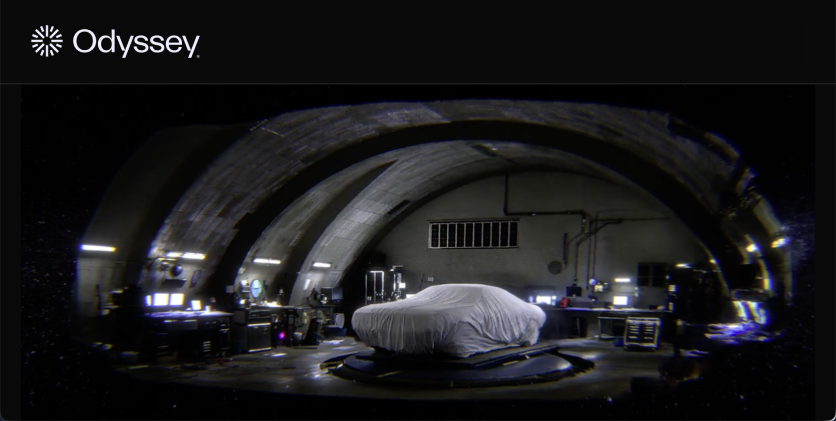
Odyssey, the AI startup founded by self-driving veterans, released Agora-1 on Monday, describing it as the first in a planned series of "multi-agent world models" — neural systems that generate an interactive 3D environment on the fly, but, unlike every prior public world model, allow several participants to occupy and act inside the same generated world simultaneously.
To demonstrate it, the company rebuilt a multiplayer deathmatch from GoldenEye 007, the 1997 Nintendo 64 shooter. Up to four players are matched into a single shared simulation; every frame each of them sees is generated by Agora-1 in real time, with the model tracking each player's actions, maintaining one shared world state, and streaming pixels to all participants at once. In the company's framing, Agora-1 "functions as a learned game engine" — no hand-coded gameplay logic, no traditional renderer.
The technical claim
The substantive contribution is architectural. Most world models, including Google DeepMind's Genie line, fuse simulation and rendering into one network that predicts the next frame from prior frames and user input. That works for a single player but degrades when multiple participants must stay mutually consistent — especially, as Odyssey notes, when players move out of each other's sight.
According to the announcement, Agora-1 instead decouples the two functions. One model learns the game's underlying dynamics directly from the internal state of GoldenEye — how the world evolves in response to player actions. A second, a diffusion-transformer (DiT) world model, learns to render that shared state visually, conditioned on the game state itself rather than on prompts or images. Because the two are separated, Odyssey says the system can produce consistent views of one shared world from multiple independent viewpoints, and — because the state can be edited directly — generate entirely new levels while preserving the original game's mechanics. Odyssey positions this against prior multi-agent approaches it names directly: Multiverse, which concatenates players into a single "split-screen" world state; Solaris, which extends a single autoregressive transformer along the sequence dimension but scales poorly as players are added; and MultiGen, which, like Agora-1, keeps an explicit shared state but models dynamics and rendering differently.
These claims come from Odyssey's own blog post and have not been independently benchmarked; there is no technical paper or peer review attached, and the company itself calls Agora-1 "an early research preview." The demonstration is live at agora.odyssey.ml.
Who Odyssey is
The company is not a newcomer to the space. Odyssey was founded in late 2023 by Oliver Cameron and Jeff Hawke, both from autonomous driving — Cameron co-founded Voyage (acquired by Cruise, where he became VP of product) and Hawke was a founding researcher at the UK self-driving company Wayve. It raised a $9 million seed round led by Google Ventures in 2024, followed by an $18 million Series A led by EQT Ventures, bringing total funding to about $27 million; Pixar co-founder Ed Catmull is among its backers. The company's earlier work included a backpack-mounted camera rig for capturing real-world 3D data and a general-purpose world model, Odyssey-2. The lineage matters: Odyssey's founders come from the part of AI — self-driving simulation — where world models are training infrastructure, not entertainment, and Agora-1's announcement leans heavily on that framing.
Why the use cases point away from games
Despite the GoldenEye demo, Odyssey is explicit that games are the test environment, not the goal. The post argues multi-agent world models matter for reinforcement learning: as participants increase, the joint interaction space grows combinatorially, and passively collected data covers an ever-smaller fraction of meaningful events — collisions, coordinated movement, contested objectives. Multi-agent RL inside a generated world, Odyssey argues, is a scalable way to manufacture that missing experience, with agents and the world model "co-evolving" into harder regimes. It ties this to its earlier system, PROWL, an adversarial RL framework that probes a world model for failures and turns them into new training data. The named ambitions — collaborative robotics, multi-view simulation, agents trained entirely inside generated worlds that transfer to unseen environments — are squarely the self-driving-simulation playbook applied to a broader class of problems, including, per the post, defense.
The IP question the demo raises
The most journalistically notable choice is the test bed itself. GoldenEye 007 is a licensed property entangling Nintendo, the developer Rare (now owned by Microsoft), and the James Bond rights holders — and Odyssey trained Agora-1 directly on the game's internal state.
That lands in a field already colliding with intellectual property. When Google opened Project Genie to subscribers in January 2026, testers immediately generated playable knockoffs of Super Mario 64, Metroid Prime, and Breath of the Wild before Google restricted Nintendo content; Disney had already sent Google a cease-and-desist over AI training on its characters. Genie 3's public debut was disruptive enough that, on the day Project Genie launched, Unity fell roughly 24%, Roblox about 15%, and Take-Two and CD Projekt also dropped. Odyssey's announcement does not address licensing or whether it has rights to the GoldenEye material it trained on — a silence that is itself part of the story, because the legal status of training generative models on specific copyrighted games is unsettled and actively litigated.
Where it sits
The world-model race is now crowded: DeepMind's Genie 3 and consumer-facing Project Genie; Fei-Fei Li's World Labs and its Marble product; NVIDIA's Cosmos for robotics; Meta's V-JEPA 2 for abstract world understanding; Decart; and Runway. Within that field, Agora-1's specific contribution — a working multi-agent system that keeps a shared world coherent across separate viewpoints by separating state from rendering — is a real and non-trivial step, distinct from making single-player worlds prettier or longer.
The honest read is that Agora-1 is a research demonstration with a sharp idea and unverified claims, dressed in 1997 nostalgia to make an abstract advance legible. Its importance, if the architecture holds up under scrutiny, is not that AI can now generate a multiplayer shooter. It is that shared, persistent, multi-participant simulated worlds are becoming a plausible substrate for training robots and agents that have to operate around each other — which is the use case Odyssey, given where its founders come from, was always really aiming at.
ⓒ 2026 TECHTIMES.com All rights reserved. Do not reproduce without permission.


