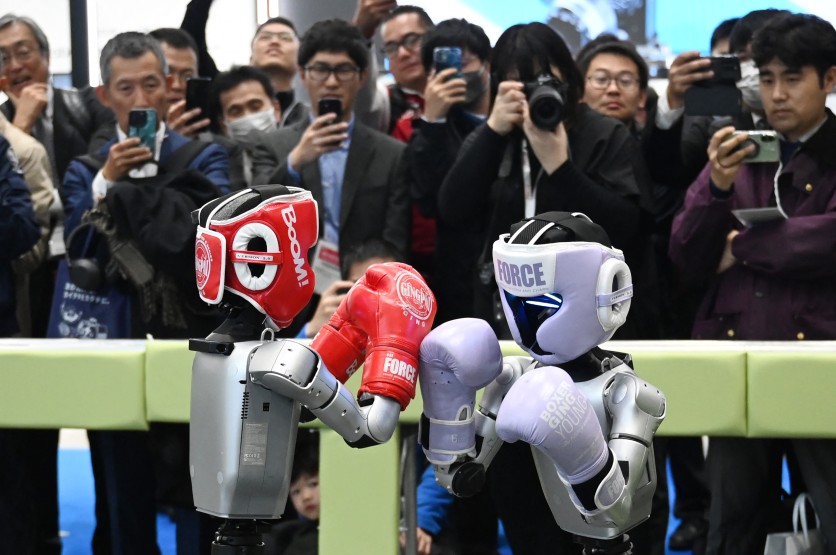
Japan Airlines began deploying humanoid robots for live ground operations at Tokyo Haneda Airport this month, making it the first commercial airline in the world to run a multi-year operational trial of bipedal, human-form robots in active aviation service. The robots — leading with Unitree G1 units built in Hangzhou, China — are already on the tarmac, handling cargo containers and preparing for cabin cleaning duties. The trial, conducted with GMO AI & Robotics Corporation, a subsidiary of Tokyo-based GMO Internet Group, runs through 2028.
No country currently has a dedicated airside safety standard governing the use of autonomous humanoid robots alongside live aircraft and human crew.
Why Japan's Labor Math Made This Inevitable
The trial is not an experiment in curiosity. Japan's working-age population is projected to decline 31 percent between 2023 and 2060, according to the Organisation for Economic Co-operation and Development's 2025 Employment Outlook. Haneda handles approximately 85.9 million passengers annually, making it one of the most throughput-intensive airports on Earth. JAL Ground Service Co. — the JAL subsidiary running the trial — employs around 4,000 ground handling staff, a pool that management acknowledges cannot grow fast enough to absorb sustained demand. Japan recorded 42.7 million inbound tourists in 2025, a national record, and the country is targeting 60 million arrivals by 2030.
Ground operations are the pressure point. Baggage loading, cargo container transport, and cabin turnarounds are physically punishing, time-sensitive jobs performed in spaces — aircraft holds, cabin aisles, tarmac gangways — that were designed for humans. Wheeled and tracked automation systems have failed in these environments for decades, unable to navigate the low ceilings, uneven floors, and variable geometry of different aircraft types. JAL Ground Service President Yoshiteru Suzuki said deploying robots for such tasks would "inevitably reduce workers' burden, providing significant benefits to employees."
What the Unitree G1 Actually Does — and Where It Stops
The primary hardware on the tarmac is the Unitree G1, which stands 132 centimeters tall and weighs 35 kilograms. Its joints offer between 23 and 43 degrees of freedom depending on configuration, giving it the articulation needed to crouch into cargo holds and maneuver through standard aircraft doors without structural modification to the airport. It navigates using onboard 3D LiDAR and depth cameras, and its motion is generated through a Vision-Language-Action architecture — meaning it interprets environmental context and generates movement in response, rather than following a fixed programmed path. Unitree trained the G1 using simulated airport environments built in Nvidia's Isaac Simulator before physical deployment, a technique called sim-to-real transfer.
Two constraints define the current operating envelope. Battery life is approximately two hours per charge — meaning the robots require either battery swaps or relay scheduling during extended turnarounds. Maximum walking speed is 7.2 kilometers per hour, adequate for hold operations but limiting on open tarmac where time pressure is highest. JAL told CNBC that "feasibility studies and risk assessments" are ongoing, confirming the current phase is structured as data collection, not full operational substitution.
The three-phase roadmap illustrates how carefully JAL is proceeding. Phase 1, underway now, maps safe operating zones and analyzes workflow in real conditions. Phase 2 will run repeated operational simulations alongside live operations. Phase 3, targeted for 2028, aims at sustained, scalable deployment. Safety management remains under human control throughout.
The Unitree Question: A Chinese Supplier Under Congressional Scrutiny
The G1 is manufactured by Unitree Robotics, headquartered in Hangzhou, China. That fact has attracted significant attention in Washington, though none of it yet extends to the specific Haneda trial.
In March 2026, the House Homeland Security Subcommittee on Cybersecurity and Infrastructure Protection held a hearing titled "DeepSeek and Unitree Robotics: Examining the National Security Risks of PRC Artificial Intelligence, Robotics, and Autonomous Technologies." Every member of the House Select Committee on the Chinese Communist Party — Republicans and Democrats alike — signed a letter urging that Unitree be added to the Department of Defense's list of Chinese military companies, the Commerce Department's Entity List, and the Federal Communications Commission's Covered List. As of publication, none of those designations have been made.
The committee's letter identified a software feature called "CloudSail" — a built-in remote-access channel — as a surveillance and cybersecurity risk. Independent cybersecurity researchers separately published findings in September 2025 showing that Unitree humanoid robots can be accessed via Bluetooth and that the company transmits audio and visual data to servers in China. Unitree said it does not collect private or sensitive data without user authorization and offered to work with researchers on identified vulnerabilities. China's National Intelligence Law requires Chinese companies to cooperate with state security agencies on demand — a structural legal obligation that applies to Unitree regardless of its stated policies, and one that no independent audit of the specific G1 platform deployed at Haneda has publicly addressed.
None of this has deterred JAL. GMO AI & Robotics, the Japanese partner managing motion programming and software optimization for the trial, operates the GMO Humanoid Lab — a Physical AI research facility on the 11th floor of the Cerulean Tower in Shibuya, Tokyo, opened in April 2026. The lab currently displays ten human-shaped robots of four types, all made by Chinese manufacturers. The extent to which GMO's software modifications affect Unitree's CloudSail architecture is not publicly known.
What a Three-Year Dataset at Haneda Would Mean for the Industry
If the trial runs to completion and generates reliable performance data, the implications reach well beyond Japan Airlines. BMW's deployment of Figure AI's Figure 02 humanoid at its Spartanburg, South Carolina plant — where two units contributed to over 30,000 vehicles and logged approximately 1,250 operational hours over 11 months — demonstrated that humanoids can sustain industrial workloads in manufacturing. Haneda represents a categorically different environment: variable weather, multiple aircraft types, jet fuel proximity, and co-habitation with thousands of travelers rather than a controlled factory floor.
The robotics industry consensus, summarized in KraneShares' May 2026 analysis, places 2026–2028 as the window for broader industrial pilots with semi-autonomous execution — and 2028–2032 for early commercial deployments in logistics and specialized service roles. JAL's three-year runway lands exactly at that threshold. The data on battery degradation cycles, Vision-Language-Action performance in unstructured environments, and human-robot coordination patterns generated on a live tarmac at one of the world's busiest airports would constitute a uniquely valuable real-world dataset — one the entire humanoid robotics industry is watching for.
For airports, hospitals, and public transit infrastructure worldwide — all of which share constrained physical environments, chronic labor shortages, and safety-critical operations — the question JAL is now running a three-year experiment to answer is the most consequential one in commercial humanoid robotics: can a human-form robot, trained on simulations, hold up in the chaos of a real-world operation? The answer is expected in 2028.
ⓒ 2026 TECHTIMES.com All rights reserved. Do not reproduce without permission.


