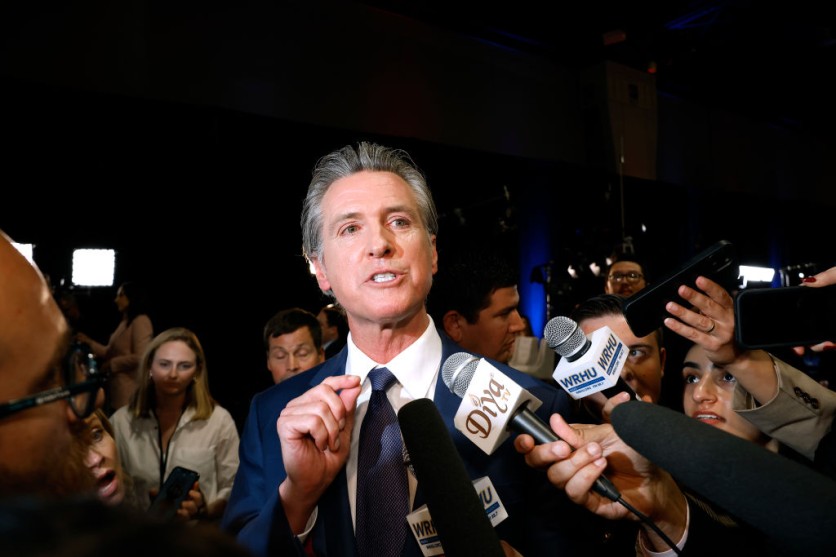
California workers whose jobs are at risk from artificial intelligence have no new legal protections today — and they will not until at least the fall. That is the most important thing to understand about Governor Gavin Newsom's executive order signed May 21 — one day after Meta began executing the largest single round of AI-attributed tech-sector layoffs of 2026. The order is a series of diagnostic mandates, not enforceable rules. It directs state agencies to study AI's workforce impact and submit recommendations. Whether any of those recommendations ever become law is the open question the next six months will answer.
The signing came as independent trackers reported more than 114,000 tech-sector job losses across 150 companies in 2026, averaging roughly 825 per day — a pace 33 percent above the same period in 2025. TrueUp, a broader industry tracker, counted approximately 143,000 workers affected across 339 tech-company layoff events. Roughly half of tracked layoffs this year have been explicitly attributed to AI by the companies making cuts, though analysts including OpenAI CEO Sam Altman and Deutsche Bank researchers have disputed that figure as inflated by companies using AI as a convenient cover story for cuts driven primarily by pandemic-era overhiring and margin pressure.
What Executive Order N-6-26 Does — and Doesn't Do
The text of Executive Order N-6-26 is a sequence of study mandates with specific deadlines. Within 90 days, the Labor and Workforce Development Agency (LWDA), the Governor's Office of Business and Economic Development (GO-Biz), and the Department of Finance must return an analysis of AI's potential workforce impact, including its disproportionate effects on specific demographic groups. Within 180 days, the LWDA must produce recommendations to revise California's Worker Adjustment and Retraining Notification (WARN) Act so it functions as an early warning signal for AI-driven workforce disruption, rather than a generic mass-layoff trigger. A separate October 15, 2026 deadline requires the LWDA to review how collective bargaining and existing workforce training programs are adapting to AI.
On the operational side, the order creates an Employment Development Department dashboard tracking AI's impact by sector, an "AI playbook" to modernize job training, a single online portal for state services, and new business-feedback inputs into California's monthly jobs report. Agencies are also directed to evaluate severance standards, employment insurance, transition support, worker-ownership structures, and what Newsom's office describes as "universal basic capital concepts" — framed in the order's text more concretely as employee-owned company structures and equity-like compensation designed to let workers share in the productivity gains AI generates.
What the order does not create is any immediate restriction on employers. There is no minimum severance requirement, no AI-specific layoff notice obligation, no restriction on automated hiring or firing decisions. Those policies, if enacted at all, would come out of the 90- and 180-day agency reports.
California Labor Federation Called It a Start, Not a Solution
The timing of the order reflected months of escalating pressure from organized labor. In February, AFL-CIO president Liz Shuler joined California Labor Federation president Lorena Gonzalez and labor leaders from Iowa, Nevada, North Carolina, and Georgia at a Sacramento press conference and publicly warned Newsom that his 2028 presidential ambitions would be evaluated on whether he backed stronger AI worker protections. The leaders conditioned their support — including for any presidential run — on Newsom meeting labor's demands. Gonzalez named Newsom's October 2025 veto of the predecessor to what is now called the No Robo Bosses Act as a grievance. Iowa AFL-CIO head Charles Wishman warned he would follow Newsom to campaign events like the Iowa State Fair if he did not act.
The signed executive order was Newsom's most concrete response to that pressure to date. He previewed it Tuesday at the Center for American Progress IDEAS Conference in Washington, arguing that "businesses are going to make a fortune, and that's why you cannot continue to have a payroll tax system that taxes jobs and then subsidizes automation."
Organized labor's reaction was, by design, measured. Gonzalez told CalMatters that "it's not enough to just study the issue, we have to take action now," adding that "catastrophic job loss from AI is not inevitable, it's a political choice." She identified one area of genuine agreement: the order's emphasis on collective bargaining as a protective mechanism. The Alphabet Workers Union-CWA Local 9009 issued a parallel statement noting "it's hard not to feel anxiety and fear when we can see more and more tech companies cutting huge portions of their workforce both in anticipation of replacing them with AI, and to fund their multi-billion-dollar bets on AI."
SB 951 Offers Enforceable Standard the Executive Order Doesn't
Running alongside the executive track is a legislative one that would create actual legal obligations. State Senator Eloise Gómez Reyes has introduced SB 951, dubbed the "AI Job Killer Notice Act," which would amend California's WARN Act to require employers to give 90 days' advance notice — rather than the current 60 — before AI- or automation-attributed layoffs affecting 25 or more workers or 25 percent of a workforce, whichever is less. Employers with 100 or more employees would be prohibited from discharging workers without reasonable cause during the notice period, and affected employees would have the right to bid on other open positions within the company.
The bill, introduced in February and amended for the third time in April, would additionally require the EDD to submit quarterly reports to the Legislature detailing data on AI-attributed layoff events. Noncompliant employers would face liability for back pay and benefits, civil penalties of up to $500 per day, and potential lawsuits from workers, local governments, or worker representatives. The executive order signed this week explicitly directs agencies to study revisions to the WARN Act — a mandate that runs parallel to what SB 951 would impose by statute.
Stanford Data Shows Entry-Level Roles Already Narrowing
The order's framing treats AI workforce disruption as a future problem to be studied. The Stanford Human-Centered AI Institute's 2026 AI Index, released in April, documents that it has already arrived for at least one demographic. Employment for software developers ages 22 to 25 has fallen nearly 20 percent from 2024, even as headcount for older developers in the same companies continued to grow. One-third of organizations surveyed for the index expected AI to reduce their workforce in the coming year. The pattern repeats across other high-AI-exposure occupations including customer service and accounting, with the disruption concentrated in entry-level roles that AI can perform most readily.
The Salesforce example offers the clearest documented corporate case. CEO Marc Benioff confirmed in September 2025 that the company had cut its customer support agent headcount from roughly 9,000 to 5,000 — eliminating 4,000 roles — as its AI agent platform handled growing volumes of consumer interactions. "I've reduced it from 9,000 heads to about 5,000, because I need less heads," Benioff said.
Capex Surge Frames Structural Contradiction California Now Names
The financial structure underlying this moment is what makes the executive order's diagnostic approach notable as a policy statement, if not yet as a policy remedy. Google, Amazon, Microsoft, and Meta are collectively on track to spend approximately $725 billion on capital expenditure in 2026 — up roughly 77 percent from $410 billion in 2025 — almost all of it earmarked for AI infrastructure. Meta's own Q1 2026 earnings call made the internal logic explicit: CFO Susan Li described the company's upcoming headcount reduction as enabling "a leaner operating model" that would "help offset the other investments we are making." That is roughly 8,000 jobs framed, in management's own words, as a line item offsetting AI capital spending.
California is simultaneously the state most exposed to this pattern and the one best positioned to name it. The state hosts 33 of the world's top 50 privately held AI companies and is associated with roughly 25 percent of all AI patents, conference papers, and company formations, per a March 2026 executive order supplemented by this week's action.
Hard Decisions Deferred to Fall Deadlines
The enforceable choices — whether to mandate AI-specific layoff notice, revise severance baselines, restrict automated termination decisions, or implement any form of universal basic capital — have been assigned to the 90- and 180-day agency reports. Whether labor unions accept those timelines, and whether SB 951 advances in the Legislature in the meantime, will determine how much of the order's "first-of-its-kind" framing translates into rights workers can actually invoke.
What the order does accomplish, as a matter of legal and administrative record, is formally direct California state agencies to treat AI-attributable workforce disruption as a distinct policy problem — separate from ordinary tech-sector cyclicality. The state has named the problem. The 90-day clock started May 21.
ⓒ 2026 TECHTIMES.com All rights reserved. Do not reproduce without permission.


