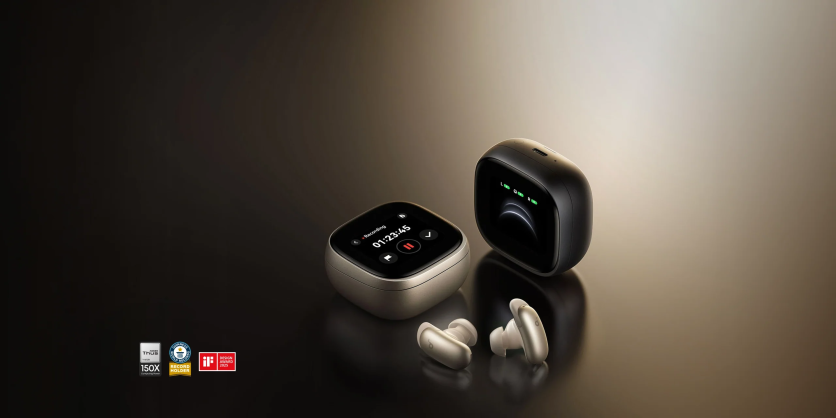
On May 22, 2026, at its Anker Day event in New York City, Anker Innovations launched two true-wireless earbuds — the soundcore Liberty 5 Pro ($170) and soundcore Liberty 5 Pro Max ($230) — built around a custom chip called Thus, which the company says is the first neural-net Compute-in-Memory (CIM) AI audio processor ever shipped in a consumer device. The Liberty 5 Pro had already earned a Guinness World Records certification in April 2026 for the highest objectively measured speech quality score among true-wireless earbuds, a result Anker attributes directly to the Thus chip's architecture. Both models are available for purchase today.
The launch matters beyond earbuds. On-device AI in milliwatt-class devices has long been constrained by the same fundamental physics: the energy cost of moving data between a processor and its separate memory. Thus attempts to solve that problem at the silicon level, and if its architecture performs in independent testing as claimed, it opens a new design space for wearables and IoT hardware well beyond audio.
What the Von Neumann Bottleneck Has Cost Earbud AI
Every chip designed since mathematician John von Neumann formalized the stored-program computer architecture in 1945 separates memory from processing: the processor fetches instructions and data from memory, executes them, and writes results back. In a laptop, that round-trip is an engineering cost. In a device powered by a battery the size of a fingernail, it is a hard ceiling. Anker says more than 90% of available power in a conventional chip is consumed by data movement before a single calculation begins.
Neural-network inference makes this worse. Unlike sequential rule-based algorithms, a neural network must consult millions or billions of learned parameters simultaneously on every inference pass. Each pass requires every parameter to travel between memory and processor. The result is a familiar compromise in consumer audio: manufacturers run smaller, weaker neural networks on earbud chips to keep battery life acceptable, which limits how much AI-driven processing they can credibly offer.
Thus: Computation Moves Into Memory
Thus sidesteps the bottleneck by embedding computation directly inside NOR Flash memory cells. Rather than shuttling model parameters to a processor, Thus keeps the model stationary and performs calculations where the data already lives.
The practical consequence is twofold: less energy wasted on movement, and a smaller physical footprint. Per Anker, NOR Flash-based CIM requires approximately one-sixth the physical space of SRAM-based alternatives — a critical dimension for devices constrained by both milliwatts and millimeters. The architecture also enables a roughly 10x increase in on-device model scale: from the hundreds of thousands of parameters that conventional earbud chips can support to several million, according to Anker's technical documentation and independent reporting from The Verge.
"Every AI chip built until now stores the model on one side and does the computation on the other," said Steven Yang, founder and CEO of Anker Innovations. "Thus puts the computation where the model already lives. The model never has to move again."
The Thus chip was developed through a strategic partnership with an unnamed global compute-memory technology company and is manufactured in Germany. Anker holds an exclusive license to the architecture.
The 150x performance figure in Anker's marketing materials requires a precise reading: it reflects peak AI computing power on the environmental noise cancellation task specifically, comparing neural-net inference on Thus to rule-based DSP processing on the previous-generation chip. It is not a comparison against Apple's H2 or any other competitor's hardware, and Anker does not claim it as a general-purpose benchmark.
Clear Calls: How 10 Sensors and a Neural Net Work Together
The showcase application for Thus in both Liberty 5 Pro models is Clear Calls, a voice isolation system that fuses signals from eight MEMS microphones and two bone conduction sensors. Most earbuds use microphone arrays alone for voice isolation, where both voice and ambient noise travel through the same medium — air — making clean separation increasingly difficult as the acoustic environment grows louder. Bone conduction sensors add a second signal path: they detect mechanical vibration from the speaker's skull, a signal physically coupled to the voice and independent of airborne ambient noise. The Thus chip cross-references both streams simultaneously through an on-device neural network, producing a more precise isolation than microphone-only systems can achieve on conventional audio DSPs.
The Guinness World Records certification awarded in April 2026 — for "Highest speech quality score (G-MOS) for TWS earbuds (objective test)" — was measured in third-party testing against 14 unnamed global flagship models. Reviewers noted that Soundcore did not disclose the rival model names, and that the Liberty 5 Pro's margin of victory was not overwhelming. Independent long-term testing will provide the clearer verdict.
Liberty 5 Pro Max: When the Case Becomes a Peripheral
Both models share identical earbud hardware. The $60 premium of the Liberty 5 Pro Max buys a meaningfully different case. Where the base Pro carries a 0.96-inch TFT touchscreen, the Max ships with a 1.78-inch AMOLED display and AI Note-Taker functionality: the case records meetings independently of a connected phone, then generates transcripts with speaker identification and action items through the Soundcore app. Onboard storage runs to 512 MB, supporting up to 12 hours of local recording. Cloud transcription deletes audio immediately after processing; local files are encrypted with AES-256, and all data transmission uses TLS 1.3.
The Soundcore app itself carries a SOC 2 Type I certification from an independent auditor, and the Pro Max complies with EN 18031, NIST IR 8425, and EN 303 645 security baselines.
The Liberty 5 Pro's case touchscreen handles playback control, device switching, ANC adjustment, and battery status display without opening an app.
ANC and Audio Specs
Both models include Adaptive ANC 4.0, which samples external and in-ear noise at 384,000 times per second and adjusts cancellation in real time across low-, mid-, and high-frequency noise types. Anker rates it at up to twice the cancellation depth of the Liberty 4 Pro. Battery life runs to 6.5 hours with ANC active, extending to 28 hours total with the charging case — unchanged from the Liberty 4 Pro, which launched at $130 in 2024.
Bluetooth 6.1, IP55 water and dust resistance, three-device Multipoint connectivity, Apple Find My, Google Fast Pair, and HearID 5.0 personalized EQ are standard across both models. The Liberty 5 Pro supports AI-based voice translation on-device; the Pro Max extends translation to the case as well.
Anker's China Domicile and Data Law Exposure
Anker Innovations is headquartered in Changsha, Hunan, China, and publicly listed on the Shenzhen Stock Exchange. China's National Intelligence Law requires Chinese companies to cooperate with state intelligence agencies on demand. No confirmed government data access incident involving soundcore audio products has been documented. The Thus chip is manufactured in Germany, and the Liberty 5 Pro's AI processing runs on-device rather than through cloud servers for its core functions, per Anker's technical documentation. Anker has not published an independent third-party security audit of the Thus chip or the Liberty 5 Pro series.
A Platform, Not a Product
Anker has indicated that Thus is intended as a long-term AI platform across its broader product ecosystem — mobile accessories, IoT devices, and consumer hardware beyond earbuds. The Liberty 5 Pro and Pro Max are, in that framing, the first deployment of an architecture Anker expects to iterate on as production volumes grow.
The price step-up from the Liberty 4 Pro ($130 at launch) to the Liberty 5 Pro ($170) reflects the silicon investment. Whether the Thus chip's on-device AI delivers a meaningful performance advantage over competitors using conventional DSPs — particularly Apple's H2 in the AirPods Pro series — remains a question for independent reviewers. What is measurable today is a Guinness-certified speech quality record and a chip architecture that academic CIM research has identified as a theoretically sound approach to breaking the energy ceiling on wearable inference. The gap between that theoretical promise and independent real-world validation is where the Liberty 5 Pro series now sits.
ⓒ 2026 TECHTIMES.com All rights reserved. Do not reproduce without permission.


