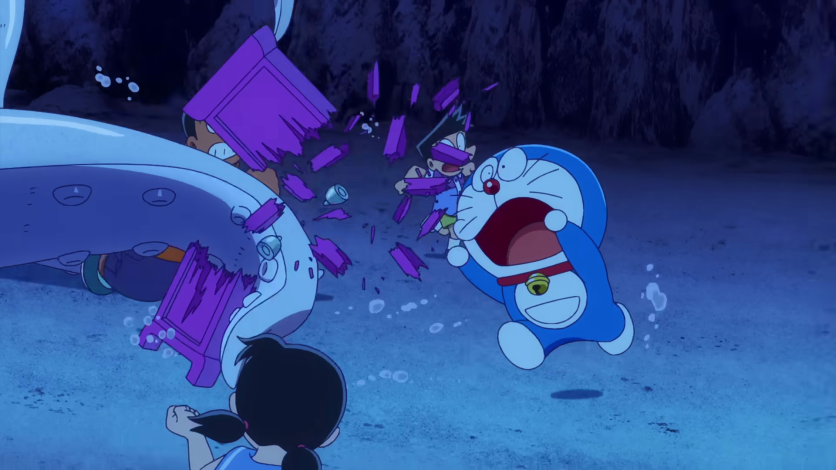
Doraemon the Movie: Shin Nobita and the Castle of the Undersea Devil began screening in Vietnam today via Lotte Cinema, marking the film's first confirmed Southeast Asian theatrical run after a dominant Japanese release. Directed by Tetsuo Yajima from a screenplay by Isao Murayama, the 102-minute film opened in Japan on February 27, 2026 — the first Doraemon theatrical film to debut outside March — and held the top spot at the Japanese box office for six consecutive weekends. Opening-weekend ticket sales reached 621,000, with nearly ¥780 million grossed in the first three days. Total box office has surpassed $23 million.
The 2026 entry is the franchise's 45th theatrical film and remakes the classic 1983 original. It also introduces something new to the franchise itself: it is the first Doraemon film to screen in 4DX format, with synchronized motion seats, water spray, wind, simulated scents, vibrations, and lighting effects built into both the MX4D and 4DX versions of the theatrical experience.
Tekio-tou: Doraemon's Inversion Principle Meets Real Biomedical Research
The film's central gadget is the Tekio-tou — the Adaptation Light — a device that rewrites human biology to function underwater. Rather than enclosing the characters in a submarine or pressurized suit, the Adaptation Light reconfigures the human body itself: it grants underwater breathing, neutralizes the crushing pressure of the deep ocean, and adapts sensory function to the marine environment. The franchise's official exhibition documentation describes the design logic explicitly — instead of building technology to contain a human environment, the gadget inverts the problem by transforming the human to suit the hostile environment.
That inversion principle has a real-world research counterpart. In 1966, biochemists Leland Clark and Frank Gollan demonstrated in the journal Science that mammals could survive breathing perfluorocarbon liquid — a synthetic fluid that dissolves oxygen roughly 20 times more readily than saline — for sustained periods and return to normal air breathing without permanent harm. The experiment established the biological viability of liquid respiration as a concept.
Sixty years later, that research crossed into human subjects. In October 2025, a team led by Takanori Takebe, MD, PhD, of Cincinnati Children's Hospital Medical Center and the University of Osaka published the first-in-human safety trial of perfluorocarbon-based enteral ventilation in the journal Med. Twenty-seven healthy male volunteers in Japan held oxygenated perfluorocarbon liquid rectally; the study confirmed the procedure's safety tolerance at volumes up to 1,500 ml with no serious adverse events. The next phase will test whether the technique meaningfully raises blood oxygen levels. The gap between the Tekio-tou's fictional instant full-body transformation and today's clinical research is large — but the biological principle is the same: oxygen-carrying liquid as a substitute for air.
Challenger Deep Pressure: What the Film's Threat Mechanic Gets Right
The film's tagline places the action at Mariana Trench depths — approximately 10,000 meters below the surface. At that depth, the water column above exerts roughly 1,086 bar of pressure, equivalent to about 1,072 times standard atmospheric pressure at sea level. Unprotected human tissue would not survive beyond a few hundred meters; the thoracic cavity collapses under ambient pressure well before reaching the abyssal zone.
The film uses this physics accurately as a plot device. Its central threat — the "environment gun" that protects the characters running out of energy — is the fictional equivalent of a saturation diving suit losing integrity. The physics of the consequence is correct: exposure to hadal-zone pressure without protection is immediately lethal. Real deep-diving vessels such as James Cameron's Deepsea Challenger and the HOV Alvin achieve survivable conditions through titanium pressure spheres and syntactic foam — engineering solutions that externally contain the human environment rather than adapting the human to it. The Tekio-tou's fictional approach — internal adaptation rather than external containment — is exactly the gap that liquid breathing research is attempting to close, albeit incrementally and for medical rather than deep-sea applications.
Mu Federation: Geothermal Civilisation Has Scientific Precedent
The film's hidden underwater civilization, the Mu Federation, draws on the 19th-century "Mu continent" hypothesis — a pseudo-scientific theory of a sunken Pacific supercontinent definitively refuted by plate tectonics. Oceanic crust cannot produce a foundered landmass of the scale proposed; the Pacific floor has never been continental.
The 2026 screenplay sidesteps this geological problem by making Mu a civilization that chose to go subsurface — not a sunken landmass, but an engineered deep-sea society. That framing is scientifically defensible. In 1977, researchers aboard the submersible Alvin discovered thriving biological communities clustered around hydrothermal vents at the Galápagos Rift — life drawing energy not from sunlight but from heat and chemistry rising from Earth's interior. A civilization drawing geothermal energy from Pacific vent fields, as the Mu Federation implicitly does, requires no geological miracle: the energy source exists and supports complex ecosystems.
The film adds a second worldbuilding layer the 1983 original lacked. The 2026 screenplay asks why the Mu civilization independently developed the same Adaptation Light as Doraemon's future technology. The answer implied invokes real convergent evolution: when two independently developing intelligences face the same physical environment and the same survival problem, they tend to arrive at structurally similar solutions. The same logic produced flight independently in birds, bats, and insects; it produces analogous sonar in dolphins and bats. The film uses it to argue that deep-sea physics is universal enough to generate the same biological-adaptation solution twice.
4DX Closes the Conceptual Loop
The franchise's first 4DX release is an unusually coherent match between content and delivery format. Standard theatrical presentation shows an audience an underwater world from outside it. The 4DX version — water spray, motion seats replicating pressure shifts and submarine movement, wind, haptic vibration from simulated sonar — brings the sensory properties of the underwater environment into the theater space.
That is precisely the Tekio-tou's philosophical move, applied to cinema. The gadget transforms the human to inhabit the hostile environment rather than building a container to protect the human from it. 4DX transforms the theater to approximate the hostile environment rather than asking the audience to imagine it. The format choice is not incidental: the franchise built its identity around gadgets that invert the human-environment relationship, and its first immersive theatrical release does the same thing at the level of audience experience.
ⓒ 2026 TECHTIMES.com All rights reserved. Do not reproduce without permission.


