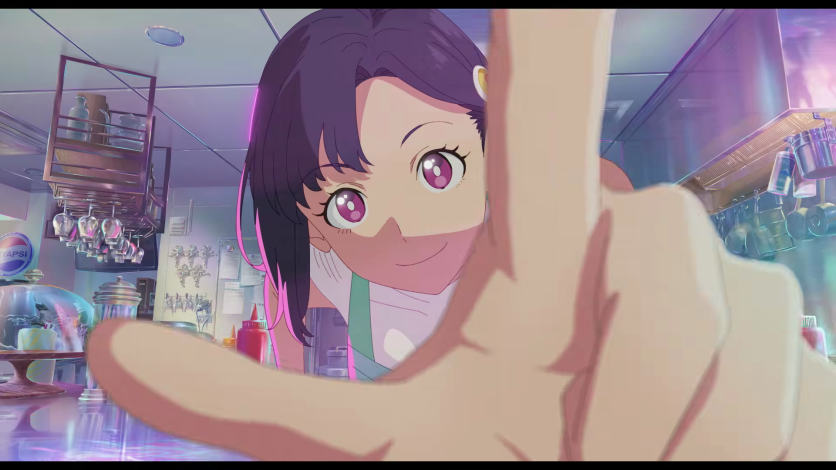
KADOKAWA Animation and Studio CLAP released the first full teaser trailer for Wasted Chef on May 31, 2026, at a Tokyo stage event marking the fifth anniversary of Pompo: The Cinéphile — unveiling director Takayuki Hirao's first entirely original feature film in full for the first time. The project, carried under a code name since 2023, sets a young Tokyo chef loose in a civilization where the sense of taste has been permanently extinguished. The premise sounds fantastical. The neuroscience beneath it is not.
Taste perception operates through a multi-stage electrochemical cascade rooted in specialized taste receptor cells on the tongue, which carry G-protein–coupled receptors that bind sweet, umami, and bitter compounds. The signal travels through cranial nerves into the brain's medulla, then upward through the thalamus, and arrives finally at the posterior orbitofrontal cortex — the region that does not merely register a flavor but generates the subjective sense that something is pleasurable, worth eating again, worth remembering. What Hirao calls a world without taste is, in neurological terms, the disconnection of an entire reward computation system from its sensory input.
The COVID-19 pandemic confirmed that this disconnection is not science fiction. A systematic review and meta-analysis of 138,015 COVID-19-positive patients found that roughly 37 percent experienced taste dysfunction during infection, with some cases persisting for months. For hundreds of millions of people worldwide, the world of Wasted Chef was not imagined — it was briefly, involuntarily lived.
Pompo: The Cinéphile Director Builds First Original Story Around Sensory Science
Hirao directed Pompo: The Cinéphile at Studio CLAP in 2021, a film that used the technical mechanics of filmmaking — shot selection, the philosophy of editing — as the scaffolding for questions about creativity and sacrifice. The film grossed approximately ¥200 million in Japan and earned broad critical praise before GKIDS released it in the United States in April 2022. Wasted Chef applies the same creative method to a different technical system: gustatory neuroscience replaces filmmaking craft, and the question of what gives food — and by extension, experience itself — meaning replaces the question of what makes a film worth cutting.
The announcement confirmed that the full Pompo creative team has returned. Shingo Adachi, who directed Lycoris Recoil and designed characters for Sword Art Online Seasons 1 and 2, handles character design. Kenta Matsukuma, who composed the Pompo score, returns for music. The original concept and screenplay are credited to Hirao. The film is targeted for completion in 2027, with a runtime of 119 minutes, according to Variety and the official Marché du Film listing. No theatrical release date has been announced.
Before the May 31 full reveal, the film was selected for the Annecy Animation Showcase at the 79th Cannes Film Festival, which ran May 15–17 as part of the "Marché du Film" marketplace — a program that presents works-in-progress to sales agents, distributors, and festival programmers worldwide. Japan served as the 2026 Country of Honor at the Marché du Film, and the showcase featured five animated projects from around the world.
Taste Loss Becomes Civilization-Scale Crisis: How Does the Premise Work Neurologically?
The film's official tagline — "That day, 'you' and 'taste' vanished from the world" — pairs gustatory loss with the disappearance of personal identity. The neuroscience supports this pairing more literally than it first appears. The orbitofrontal cortex that evaluates whether food is pleasurable is the same structure involved in evaluating aesthetic experience, social reward, and the assignment of value more broadly. Clinical patients who sustain damage to this region have been documented to eat mechanically — consuming food without deriving any reward — and in severe cases to undergo significant weight loss as feeding loses its motivating function entirely.
Scaling that condition across a civilization produces consequences that reach beyond restaurants. Food safety systems rely on bitterness as the primary sensory warning signal for most naturally occurring toxins. Agricultural economies are built on flavor preference. The social and cultural rituals constructed around cuisine — every shared meal, every tradition of hospitality, every cuisine that carries national or ethnic identity — lose their affective foundation when the orbitofrontal cortex can no longer evaluate whether anything on the table is worth experiencing.
Variety's synopsis describes the film's central character as a young chef who arrives in a ruined city and, through cooking, begins to awaken forgotten memories in its inhabitants. A character named Kasumi appears as a key figure. The story's central question — the one KADOKAWA's press release calls "contemporary" — is: what is value? In light of the neuroscience, that is not an abstract philosophical question. It is the question of what remains when the brain's reward evaluation system can no longer confirm that anything anyone creates is worth experiencing.
What Does the Wasted Chef Teaser Trailer Show?
The teaser opens on a brief encounter between a young man and a young woman in the rain, outside a diner whose sign reads "THE DAY." A sequence follows depicting a rendered hamburger — lettuce, tomato, onion, a meat patty inside a soft bun — that reads as an act of mourning as much as appetite. The footage closes on an image of mysterious towering structures and unsettling lights filling the sky over the city, suggesting the world-altering event that stripped humanity of taste was neither gradual nor natural.
A companion manga drawn by Aero05 is scheduled to begin serialization in KADOKAWA's seinen magazine Young Ace on June 4, 2026. The manga's premiere falls four days after the trailer release, giving readers an immediate way to follow the story while the film remains in production.
Frequently Asked Questions
What is Wasted Chef anime about?
Wasted Chef is an original science-fiction anime film directed by Takayuki Hirao, set in a world where the entire human population has permanently lost the sense of taste. The story follows a young chef navigating this civilization as he attempts to understand what food — and value itself — can still mean in the absence of the sensory system that made cuisine worth creating.
Who is the director of Wasted Chef and what is his previous work?
Takayuki Hirao directed the 2021 anime film Pompo: The Cinéphile, which received strong critical reception and a limited US theatrical release by GKIDS in April 2022. Wasted Chef is his first fully original work, with Hirao writing both the original concept and the screenplay. The full creative team from Pompo — character designer Shingo Adachi and composer Kenta Matsukuma — has returned for the new film.
When does the Wasted Chef manga come out?
The Wasted Chef manga adaptation, drawn by artist Aero05, is scheduled to begin serialization in KADOKAWA's Young Ace magazine on June 4, 2026. No theatrical release date for the film itself has been announced; Variety and the official Marché du Film listing report a 2027 completion target and a runtime of 119 minutes.
Is the Wasted Chef premise scientifically accurate?
The film's premise maps directly onto documented sensory neurobiology. Taste perception is processed through G-protein–coupled receptors in the tongue's taste receptor cells, relayed through the brainstem, and evaluated in the orbitofrontal cortex, which generates the subjective sense of pleasurable flavor. COVID-19 research found that roughly 37 percent of patients experienced taste dysfunction, with some cases persisting for months — providing real-world precedent for the kind of mass taste-loss event the film depicts.
ⓒ 2026 TECHTIMES.com All rights reserved. Do not reproduce without permission.


