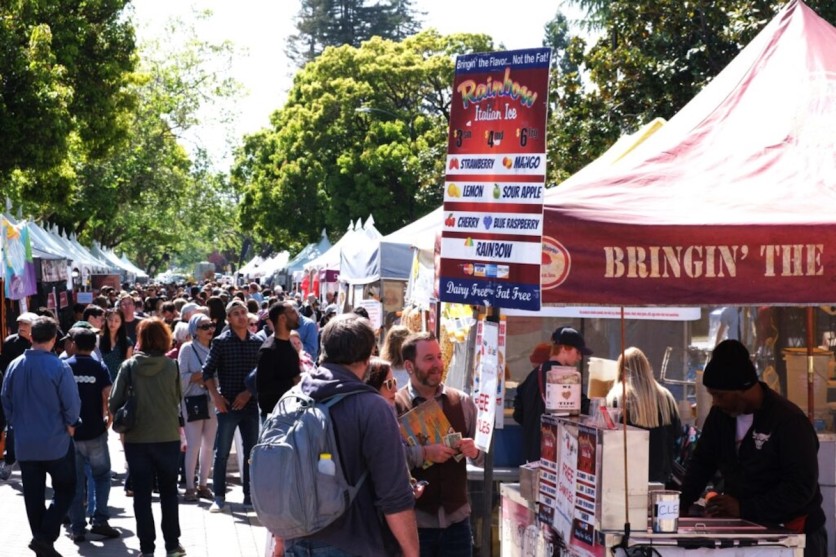
The Locus Science Fiction Foundation announced all 18 category winners of the 2026 Locus Awards on Saturday, May 30, at Hotel Shattuck in Berkeley, California — the first time the ceremony was held in partnership with the Bay Area Book Festival — with Nnedi Okorafor's AI-authorship novel Death of the Author taking Best Science Fiction Novel and Cory Doctorow's platform-decay analysis Enshittification: Why Everything Suddenly Got Worse and What To Do About It winning Best Nonfiction. Okorafor, a guest of honor at the ceremony, became the rare author to both win and headline the same awards show.
The annual Locus Awards are voted entirely by readers — subscribers count double, but any member of the public may participate — placing them alongside the Hugo and Nebula Awards in prestige while making them uniquely democratic. Bay Area Book Festival Executive Director J.K. Fowler described the partnership as a meeting of shared missions: both organizations, he said, are dedicated to celebrating the breadth and brilliance of contemporary literature.
Okorafor's AI-Authorship Novel Sweeps Reader Ballots
Death of the Author, published in January 2025 by William Morrow, operates as a book-within-a-book. Its protagonist, Zelunjo "Zelu" Onyenezi-Onyedele, is a disabled Nigerian-American writer whose science fiction novel Rusted Robots — set in a post-human Africa where an android named Ankara traverses collapsed civilizations to preserve human stories — becomes a global sensation before the boundary between the fictional world and the real one begins to blur. The novel won the 2026 NAACP Image Award and was a finalist for the 2025 Nebula before Saturday's Locus win.
The title invokes Roland Barthes's 1967 essay arguing that meaning is constructed by readers, not authors, once a text is released — a claim Okorafor extends into a live engineering problem: who owns a story that an artificial intelligence constructs from the corpus of human writing? Ankara, trained on the sum of human narrative to preserve civilization's stories after humanity perishes, cannot be called a mere retrieval engine — but whether it qualifies as an author is the novel's central, unresolved question. Princeton's Chika Okeke-Agulu, Robert Schirmer Professor of Art and Archaeology and African American Studies, engaged that question directly with Okorafor in a 2025 public conversation organized by Princeton's Center for Digital Humanities, billed as "The Future of Storytelling in the Age of AI."
Okorafor coined the term Africanfuturism in 2019 to describe fiction rooted specifically in African culture, history, mythology, and point of view, as distinct from Western-defaulted science fiction. In Death of the Author, Ankara is not a Cartesian rationalist android but something closer to a griot — an oral historian whose function is relational and communal, accumulating and transmitting the stories of a civilization rather than optimizing for a task. George R.R. Martin called the novel "her best work yet — about fame, culture, the power of story, the writer's life... and robots."
Harrow's Time-Loop Fantasy and Jones's Indigenous Horror Win Top Genre Prizes
Alix E. Harrow took Best Fantasy Novel for The Everlasting, published in October 2025 by Tor. The novel follows scholar Owen Mallory, who discovers that an immortal queen has been repeatedly sending historians back through a time-loop anchored by a living yew tree to enforce a politically convenient version of history — keeping the founding myth of her nation intact across a thousand years. The loop is internally consistent with the Novikov self-consistency principle in general relativity, which holds that only self-consistent events can occur within a closed timelike curve. Rather than a paradox engine, Harrow's device is causality's extreme enforcement: the past does not change because it cannot change, and the queen's power lies in ensuring no one realizes it.
Stephen Graham Jones, a member of the Blackfeet Nation, won Best Horror Novel for The Buffalo Hunter Hunter, published in March 2025 by Saga Press. The novel crosses three time periods, following Good Stab, a Pikuni warrior infected by a white vampire in the aftermath of the Marias Massacre of 1870 — in which U.S. soldiers killed at least 173 Blackfeet civilians, the overwhelming majority of them women, children, and elderly — and who devotes his long undead existence to hunting the buffalo hunters whose deliberate near-extermination of the bison herds constituted the destruction of the Blackfoot Confederacy's food supply. Jones's Nachzehrer — a German-Slavic revenant tradition linked historically to plague transmission and misunderstood decomposition — transforms through contact rather than predatory choice, a structural parallel to zoonotic spillover under ecological stress, which is precisely the condition the Blackfoot faced after 1870. Jones was a guest of honor at Saturday's ceremony alongside Okorafor and Tananarive Due.
Free-to-Read Short Fiction Sweeps: Ihezue and Ha Win From Clarkesworld
The short fiction categories were dominated by work published in Clarkesworld magazine, which also won Best Magazine. Somto Ihezue's "We Begin Where Infinity Ends," from Clarkesworld #221 in February 2025, took Best Novelette. The story follows three young engineers in near-future Africa who modify neighborhood LED streetlights to emit wavelengths that protect firefly reproductive signaling — a solution grounded in real spectrally-tuned outdoor lighting research that adjusts LED spectral output to reduce harm to nocturnal wildlife. Artificial light at night disrupts firefly bioluminescence-based mating signals, and a 2020 study in BioScience by Lewis et al. identified light pollution as one of three primary drivers of global firefly population decline.
Thomas Ha swept Best Short Story for "In My Country," from Clarkesworld #223 in April 2025, and Best Collection for Uncertain Sons and Other Stories (Undertow Publications). The short story — told in second person — depicts a surveillance state interested not in explicit dissent but in narrative ambiguity: a network of trained listeners stationed in every neighborhood, tasked with detecting what might be meant rather than what is stated. Ha's apparatus is purely social, with no described technology, mapping precisely onto what security researchers call chilling effects — the self-censorship that emerges when people know they are potentially observed, without requiring active surveillance to sustain it. Both Ihezue's and Ha's prize-winning stories remain free to read at the Clarkesworld website.
Doctorow's Enshittification Framework Wins Nonfiction: A Reader Signal Worth Taking Seriously
Cory Doctorow's Enshittification: Why Everything Suddenly Got Worse and What To Do About It, published by Verso in October 2025, won Best Nonfiction. The word "enshittification" — which Doctorow first used in 2022 and formalized in a January 2023 essay — was named word of the year in the United States, United Kingdom, and Australia by several major dictionaries. The book formalizes a three-stage platform lifecycle model: platforms first attract users by being genuinely useful; then degrade user experience to extract value for business customers; then degrade business customers to maximize shareholder returns before eventual collapse. Doctorow applies this framework to Facebook, Amazon, the iPhone ecosystem, and Twitter/X, then prescribes structural remedies centered on mandating "adversarial interoperability" — the legal right to build software that works with a platform without that platform's permission.
That Locus's readership — disproportionately composed of working scientists, engineers, and technologists — voted this the best nonfiction work of the year is a meaningful signal. These are readers who can evaluate Doctorow's technical claims directly, and their verdict constitutes a form of peer review that few nonfiction books receive. The book was longlisted for the Financial Times and Schroder Business Book of the Year 2025.
Other Notable Winners
Amal El-Mohtar took Best Novella for The River Has Roots. The Best Translated Novel went to Solvej Balle's On the Calculation of Volume III, translated by Sophia Hersi Smith and Jennifer Russell (New Directions), the third volume of Balle's Danish experimental series in which the same day recurs indefinitely for protagonist Tara Selter. We Will Rise Again, edited by Karen Lord, Annalee Newitz, and Malka Older (Saga Press), won Best Anthology. Thomas Ha's double win — Best Short Story and Best Collection — made him one of the night's standout honorees.
The Special Award for Supporting the Speculative Writing Community went to The Submission Grinder, a free database of science fiction and fantasy markets maintained by David Steffen and a team of volunteers, which helps emerging writers identify publication opportunities without a paid subscription.
What Is the Locus Award, and Why Does It Matter?
The Locus Awards have been presented annually since 1971 and are administered by the Locus Science Fiction Foundation, a 501(c)(3) nonprofit based in Oakland, California. Unlike the Hugos, which require a paid Worldcon membership to vote, or the Nebulas, which are voted by professional members of the Science Fiction and Fantasy Writers Association, the Locus ballot is open to anyone — with Locus magazine subscribers receiving double-weighted votes. That structure makes the results a reasonably faithful reflection of what engaged, self-selected SF/F readers across a broad spectrum of the field actually chose to spend their attention on. The ceremony has been held annually for 56 years; this year's edition was the first co-presented with the Bay Area Book Festival, which draws around 25,000 visitors annually, 95% of whose programming is free.
❓
Frequently Asked Questions
Who won the 2026 Locus Award for Best Science Fiction Novel?
Nnedi Okorafor won Best Science Fiction Novel for Death of the Author (William Morrow, January 2025). The novel follows a disabled Nigerian-American writer whose science fiction story about a post-human Africa becomes a global phenomenon, raising questions about AI authorship and whether a system trained on human stories can be considered a genuine creative author.
What does enshittification mean, and who coined it?
Cory Doctorow coined the term in 2022 to describe the predictable three-stage decay of online platforms: first becoming useful to attract users, then degrading that experience to extract value for advertisers and business partners, then degrading those business partners to maximize shareholder returns. His 2025 Verso book formalizing the concept was named word of the year in the United States, United Kingdom, and Australia, and won the 2026 Locus Award for Best Nonfiction.
What is Africanfuturism in science fiction?
Africanfuturism is a term coined by Nnedi Okorafor in 2019 for speculative fiction specifically rooted in African culture, history, mythology, and point of view — as distinct from Afrofuturism, which she argued positioned the West as the default civilizational center. In Africanfuturist work, technology is treated as continuous with ancestral, ecological, and communal systems rather than framed within a Western post-Enlightenment progress narrative.
Where can I read the 2026 Locus Award-winning short fiction for free?
Both award-winning short fiction pieces are freely available online. Thomas Ha's "In My Country" (Best Short Story) and Somto Ihezue's "We Begin Where Infinity Ends" (Best Novelette) were both published in Clarkesworld magazine — which also won the 2026 Locus Award for Best Magazine — and remain free to read at the Clarkesworld website.
ⓒ 2026 TECHTIMES.com All rights reserved. Do not reproduce without permission.


