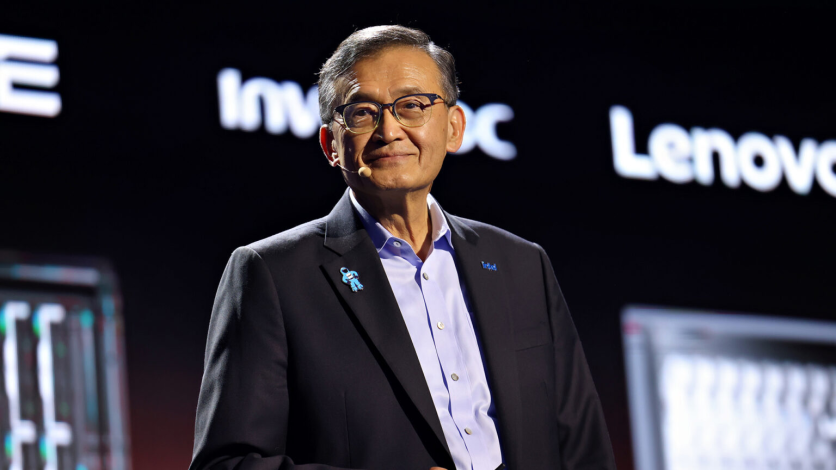
Intel CEO Lip-Bu Tan used Tuesday's Computex 2026 keynote in Taipei to deliver the most detailed public accounting yet of Crescent Island, a data center GPU that makes a deliberate bet against the prevailing AI hardware playbook: maximum memory capacity, no High Bandwidth Memory, and a 350W power envelope that fits standard air-cooled servers. The product targets the AI inference market — the layer of infrastructure where trained models answer real queries at scale — at a moment when enterprises that need more inference capacity cannot get it because the HBM supply chain that powers Nvidia's accelerators is sold out through at least 2027.
Intel Crescent Island GPU: What the Xe3P Architecture Delivers
Crescent Island is built on Intel's Xe3P architecture, a performance-optimized variant of the Xe3 design that also runs inside Intel's Panther Lake laptop processors. The chip supports up to 480 gigabytes of LPDDR5X memory — a figure that reflects the maximum partners can configure on board, not the reference spec, which starts at 160GB. The choice of LPDDR5X over HBM is the card's defining engineering decision. LPDDR5X is a commodity memory technology used at enormous scale in mobile devices and laptops; it is substantially cheaper per gigabyte than HBM and is not subject to the same concentrated supply chain that runs through SK Hynix and Samsung's advanced packaging lines.
What LPDDR5X does not offer is bandwidth. Analysis based on a likely 640-bit memory interface running LPDDR5X at 10.7 Gbps suggests Crescent Island would deliver roughly 684 GB/s of memory bandwidth — well under 1 TB/s and a meaningful step down from the 4.8 TB/s of bandwidth in Nvidia's H200. For training workloads, that gap would be disqualifying. For inference, Intel and its prospective customers are betting it is not.
The architecture spans a wide range of data types, from FP4 — a compressed format used in high-throughput AI inference — all the way up to FP64, which covers scientific computing use cases such as climate modeling and fluid simulation. Intel has described the chip as "built for agentic AI," signaling a design priority around the multi-step, long-context inference patterns that enterprise AI agents generate. The card operates as a standard PCIe device, meaning it can be installed in conventional 4U or 5U server chassis without the specialized cooling or power infrastructure that Nvidia's top-tier accelerators require.
Why the HBM Shortage Makes This Argument Right Now
The timing of Crescent Island's detailed reveal is not accidental. The global market for high-bandwidth memory has reached a condition that Samsung's memory chief described as a "significant shortage" expected to last through at least 2027. Every unit of Nvidia's HBM-equipped H100, H200, and Blackwell accelerators requires stacked DRAM dies bonded directly to the compute die through through-silicon vias — a manufacturing process so resource-intensive that a single gigabyte of HBM consumes roughly three times the wafer capacity of standard DDR5. SK Hynix, which holds approximately 57 percent of global HBM revenue, and Samsung together control the chokepoint.
Micron Technology put the downstream consequence in concrete terms at Computex, where Sumit Sadana, the company's executive vice president and chief business officer, stated that AI context lengths are growing 30 times per year while memory content per server has doubled in three years. That trajectory means demand for memory capacity in inference deployments is accelerating precisely as HBM supply is committed years forward. Intel's LPDDR5X approach sidesteps the bottleneck by using commodity memory that is manufactured at scale for the phone and laptop markets — memory that, unlike HBM, is not allocated exclusively to Nvidia's supply contracts.
The Bandwidth Trade-Off Intel Has Not Yet Quantified
The central question Crescent Island leaves unanswered is the one enterprise procurement teams will need answered before they can write a purchase order. Intel has not published raw throughput benchmarks. As Tom's Hardware noted, the company has withheld performance figures that would allow direct comparison with Nvidia or AMD accelerators. That absence is itself informative: LPDDR5X bandwidth is structurally lower than HBM, and the strongest case Intel can make before benchmarks arrive is a capacity-per-dollar argument rather than a tokens-per-second argument.
The practical question for inference operators is whether LPDDR5X delivers enough bandwidth to keep the GPU's compute units fed during autoregressive decoding — the step-by-step token generation that drives large language model outputs. At small batch sizes, inference performance is dominated by memory bandwidth, not compute throughput. A card with 480GB of LPDDR5X but insufficient bandwidth could sit underutilized during latency-sensitive inference runs while a lower-capacity HBM card finishes first. Intel's counter-argument is that operators constrained by model footprint rather than throughput — those trying to run a 200-billion-parameter model on a single card without quantization — would find the capacity advantage decisive.
The software question is equally open. Intel is building Crescent Island's software stack on oneAPI, an open, standards-based programming environment grounded in SYCL, a C++-based model controlled by open industry specifications rather than a single vendor. Tom's Hardware notes that oneAPI is "far less widely adopted than CUDA or ROCm," Nvidia's and AMD's respective frameworks. Intel describes the software as "open, upstreamed, and Day 0 ready" for Crescent Island, and the company has been using its Arc Pro B-Series GPU products as a proving ground for software stack maturity ahead of Crescent Island's sampling window.
Read more: AI Memory Shortage: AMD's Lisa Su Identifies High-Bandwidth Memory as AI Chip Supply's Next Cap
Intel's Broader Computex Data Center Agenda
Crescent Island was not the only data center announcement Tan brought to Computex. Intel confirmed that Xeon 7 "Diamond Rapids", the company's next-generation data center CPU, is on track for a 2027 launch on its 18A-P process node — a refined version of Intel's 18A fabrication technology. Diamond Rapids will support PCIe 6.0, pack approximately 50 percent more cores than the current Xeon 6 generation, and double the memory bandwidth. The chip uses a chiplet architecture with four compute tiles and two I/O dies, following a design approach similar to AMD's EPYC Venice lineup.
Tan framed the data center announcements within a consistent "open ecosystem" argument — the thesis that enterprises and cloud providers want flexibility to mix hardware from multiple vendors rather than committing to a vertically integrated AI stack dominated by a single supplier. The argument is aimed squarely at Nvidia, whose CUDA software environment, 15 years of library development, and proprietary NVLink interconnect create switching costs that have so far made most buyers reluctant to migrate to alternatives regardless of price. Earlier that same morning at Computex, Nvidia's Jensen Huang had appeared on stage alongside Marvell CEO Matt Murphy — publicly describing Marvell as a future trillion-dollar company — in a display of the ecosystem relationships Intel is working to disrupt.
How Does Intel Crescent Island Compare to Nvidia and AMD?
Intel enters the inference market with structural advantages and structural liabilities. On the positive side: its enterprise sales network reaches into more data centers than any pure-play AI chip company; its PCIe form factor removes the deployment friction associated with proprietary accelerator formats; and its willingness to supply HBM-independent hardware gives it a distinct procurement conversation with customers locked out of Nvidia allocations. On the liability side: its software ecosystem is not CUDA, its prior AI GPU effort — the Gaudi series — missed commercial targets substantially, and its throughput figures remain undisclosed.
AMD's Instinct MI300X has carved out meaningful share in inference deployments partly because it offers large memory pools — 192GB of HBM3 — alongside a relatively mature ROCm software stack that has made CUDA migration tractable for some workloads. Nvidia's upcoming Rubin architecture and AMD's MI400-series roadmap both transition to HBM4, deepening the bandwidth advantage those platforms will hold over Crescent Island, provided HBM supply catches up with demand.
Customer sampling for Crescent Island is targeted for the second half of 2026, meaning independent performance benchmarks and early design wins are still months away. Meaningful revenue from the product is likely a 2027 story. In the interim, the second half of 2026 will test whether Intel can convert the chip's architectural distinctiveness into enterprise commitments — and whether the LPDDR5X bandwidth trade-off holds up when inference operators run real workloads against it.
Frequently Asked Questions
What is Intel Crescent Island GPU?
Crescent Island is Intel's new data center graphics processing unit designed exclusively for AI inference workloads. It is built on the Xe3P architecture, supports up to 480GB of LPDDR5X memory in partner-configured cards with a 160GB reference baseline, and operates within a 350W power envelope suited to air-cooled servers.
Why is Intel using LPDDR5X instead of HBM?
Intel chose LPDDR5X to sidestep the global shortage of high-bandwidth memory, which is controlled by a concentrated supply chain dominated by SK Hynix and Samsung. LPDDR5X is a commodity memory technology that allows Intel to offer high memory capacity at lower cost without competing for HBM allocations already committed to Nvidia and AMD through 2027 and beyond.
When will Intel Crescent Island be available?
Intel is targeting customer sampling in the second half of 2026. Volume production and broad commercial availability are expected to follow, making meaningful revenue from the product most likely in 2027.
How does Intel Crescent Island compare to Nvidia H100?
Crescent Island offers substantially more memory capacity than the H100, which ships with 80GB of HBM3, but Intel has not yet published throughput benchmarks. Nvidia's H100 delivers approximately 3.35 TB/s of memory bandwidth against Crescent Island's estimated 684 GB/s — a gap that matters most for bandwidth-limited inference workloads at small batch sizes.
ⓒ 2026 TECHTIMES.com All rights reserved. Do not reproduce without permission.


