
Robotics has made serious progress over the past decade. Robots can sort packages, handle lab samples, and work on factory floors with growing reliability. But underneath all that progress, one gap has gone largely unaddressed. There is still no agreed-upon way to measure whether a robot actually understands what it is feeling during a task.
That is exactly what Daimon Robotics and Galbot are setting out to fix with RobOmni, the first omni-modal evaluation benchmark including tactile sensing for physical interaction. For research teams and businesses working in embodied AI, this is the key foundational infrastructure the field has been missing.

Why the Field Needed This
Before getting into what RobOmni is, it helps to understand the problem it is solving.
As embodied AI continues to evolve—particularly with the emergence of World Models—the challenge for robots is no longer simply to see the world, but to understand it and interact with it. While vision enables robots to perceive their surroundings, it provides limited information about the underlying physical interaction. Tactile sensing provides the critical feedback needed to perceive and reason about these interactions, making it a key modality for physical AI.
However, one piece of core infrastructure has been absent all along.
Research teams working on tactile intelligence and dexterous manipulation run their own tests, build their own setups, and measure results by their own criteria. That means no two evaluations are truly comparable. A result from one lab tells you very little about how the same model would perform in a different setup. Because of that, three questions have stayed largely unanswered across the field:
- How much does tactile sensing actually improve a robot's ability to manipulate objects and generalize across tasks?
- In what specific ways does tactile feedback change performance outcomes?
- What kinds of tactile data are most useful for physical AI?
These are not small questions. They sit at the center of real decisions, including buying decisions, research priorities, and deployment planning, for businesses in intelligent logistics, laboratory automation, and embodied AI applications. RobOmni was built to give those questions solid, reproducible answers.
What RobOmni Actually Does
RobOmni is a complete evaluation framework, not just a test suite. It focuses on contact-rich manipulation tasks, which are the exact situations where tactile sensing makes the biggest difference. Picking up a fragile object, inserting a part under tight tolerances, handling materials with different surface properties: these are tasks where a robot that cannot feel what it is doing will consistently fall short.

The framework gives teams a shared baseline to work from. Models can be evaluated, compared, and iterated on using the same standards. That consistency is what makes it possible to actually track progress over time, rather than producing isolated results that cannot be stacked against each other.
A Simulation Platform Built on NVIDIA Isaac Sim
The simulation layer of RobOmni runs on NVIDIA Isaac Sim. This gives the platform a physics engine that reflects real-world contact dynamics accurately enough for simulation results to carry real weight. That is not always a given with robotics simulation environments.
What makes this platform particularly valuable is its support for omni-modal observations. Most simulation environments handle one or two data types at a time. RobOmni captures all of the following simultaneously:
- High-frequency, high-resolution fingertip tactile sensing
- RGB wrist vision
- Gripper open/close status
- TCP motion trajectories
- Action commands
- External camera feeds
Having access to all these modalities at once gives researchers and developers a complete picture of what a model is actually doing during a manipulation task. That completeness is what makes evaluation results meaningful and transferable across different teams and setups.
Omni-modal Tactile: More Than Just Force Detection
"Omni-modal tactile" is central to how Daimon approaches tactile sensing, and it is worth unpacking what that actually means. Standard tactile sensors detect contact force. That is useful, but it is a narrow slice of what physical interaction actually involves.
Daimon's self-developed, multidimensional, high-frequency, high-resolution vision-based tactile sensors go further. Beyond detecting contact force, they capture dense omni-modal tactile information, including contact deformation, slip, and object properties such as material, geometry, texture, softness, and hardness. This gives a robot's manipulation model a much richer input to work with than force data alone. Backed by Daimon's accumulated expertise in tactile perception, the RobOmni simulation platform achieves high-fidelity tactile output that supports this full range of observations.
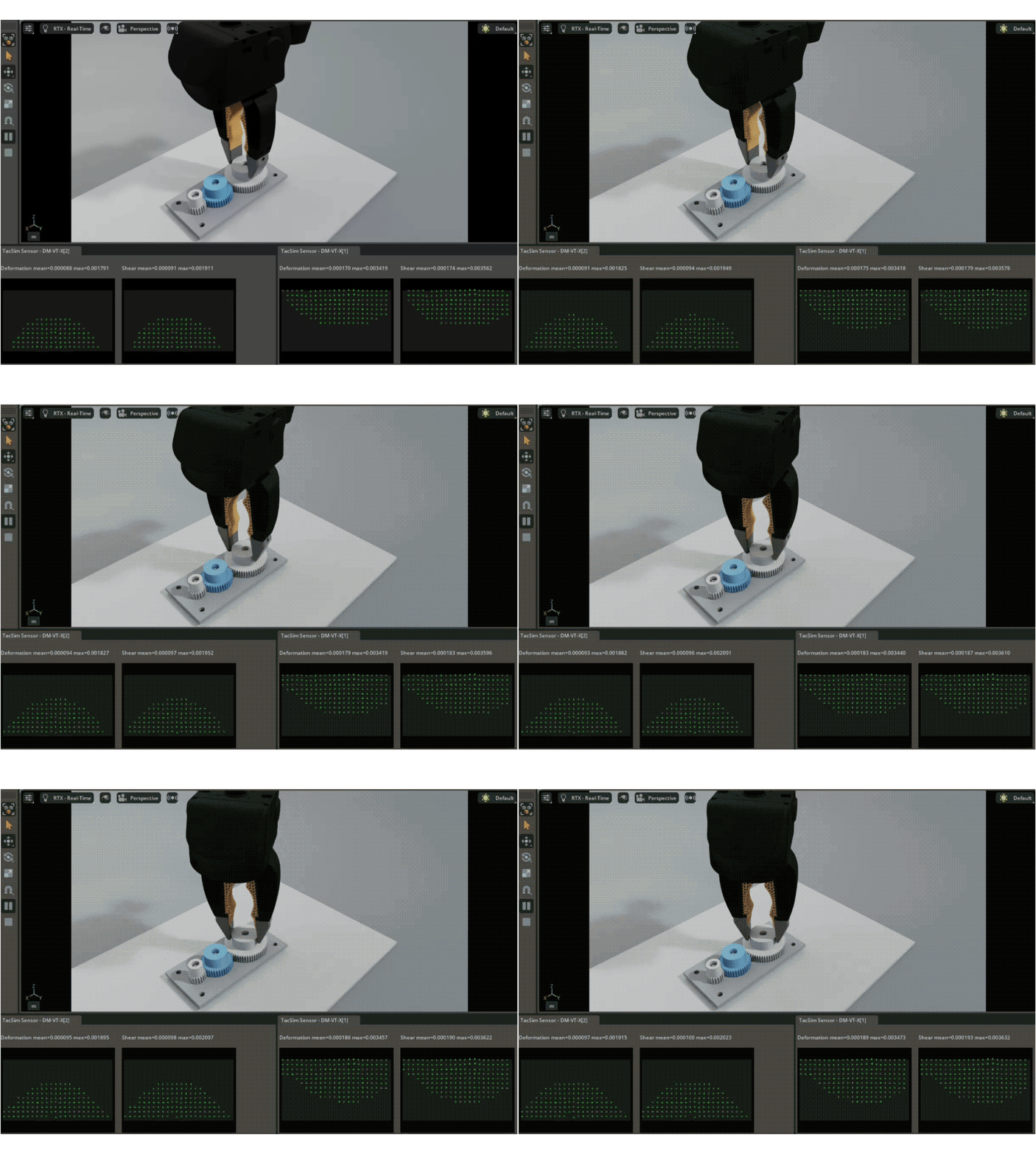
That level of detail is what makes the RobOmni simulation environment genuinely useful. The tactile data being generated reflects a realistic, multidimensional picture of physical interaction, not a simplified stand-in.
A Digital Twin Built for Direct Hardware Transfer
RobOmni includes a 1:1 digital twin of Daimon's DM-TacClaw tactile gripper. A 1:1 scale means geometry, sensor placement, and force distribution in the simulation match the physical hardware exactly. Teams that run evaluations in RobOmni and then move to physical hardware do not have to recalibrate their assumptions about how the gripper behaves in the real world.
The platform also supports multiple mainstream robot embodiments within the same unified framework, including humanoid robots and robotic arms. Cross-embodiment evaluation has been difficult to do consistently, and RobOmni makes it straightforward by bringing different robot types under one evaluation standard.

The Data Flywheel RobOmni Creates
One of the less obvious benefits of a standardized evaluation framework is what it enables over time. Daimon describes it as a data flywheel, and the logic is worth spelling out clearly.
When evaluation is standardized, data collected across different projects become directly comparable. Comparable data can then be used to validate model capabilities with real confidence. Validated results drive more targeted model iteration. And that iteration feeds back into better data collection priorities. The cycle builds on itself in a way that isolated, team-by-team evaluation simply cannot achieve.
Without a shared benchmark, that cycle does not work. Teams end up rebuilding evaluation setups from scratch, producing results that cannot be compared across organizations and doing redundant work across the industry. RobOmni addresses that problem by giving the field a standardized, comparable, reproducible, and extensible evaluation framework.
For businesses specifically, this changes how due diligence works when evaluating physical AI. Instead of relying purely on a vendor's internal test results, buyers gain access to benchmark scores generated using the same framework everyone else uses.
How RobOmni Fits into Daimon's Broader Work
Daimon Robotics has been building toward this kind of infrastructure as part of a broader technology stack. The company's work spans the full pipeline from tactile sensing hardware through to trained models. Earlier this year, in April, Daimon released Daimon-Infinity, the largest omni-modal robotic dataset for physical AI, including high-resolution tactile sensing. Together, these milestones solidified Daimon's role in building the essential infrastructure for tactile sensing and dexterous manipulation.
RobOmni sits at the evaluation layer of that pipeline. It is the tool that lets teams measure whether all the other pieces are working the way they should in contact-rich scenarios.
Daimon's broader approach centers on the physical AI. Leveraging the world's first monochromatic vision-based tactile sensing technology,Daimon treats tactile sensing as a full modality on par with vision in their physical world modeling rather than an add-on to the standard VLA architecture. RobOmni reflects that same priority. It is built around the idea that tactile intelligence deserves the same kind of rigorous, standardized evaluation infrastructure that vision-based systems have had for years.
What This Means for Teams Working in Physical AI
For businesses evaluating embodied AI solutions for logistics, manufacturing, or laboratory automation, RobOmni gives the evaluation process a more concrete foundation. For research teams, it provides a benchmark that results can actually be measured against and compared across different organizations.
The embodied AI community has been asking for exactly this kind of shared standard. RobOmni is currently the industry's most comprehensive standardized evaluation framework focused on tactile perception and physical interaction, and it fills an infrastructure gap that has been slowing the whole field down. As more teams work on contact-rich manipulation, having a common framework to measure against will only become more valuable. Daimon and Galbot call upon the community to join RobOmni, working together to advance the convergence of standards for physical interaction and to foster the development of embodied intelligence.
ⓒ 2026 TECHTIMES.com All rights reserved. Do not reproduce without permission.


