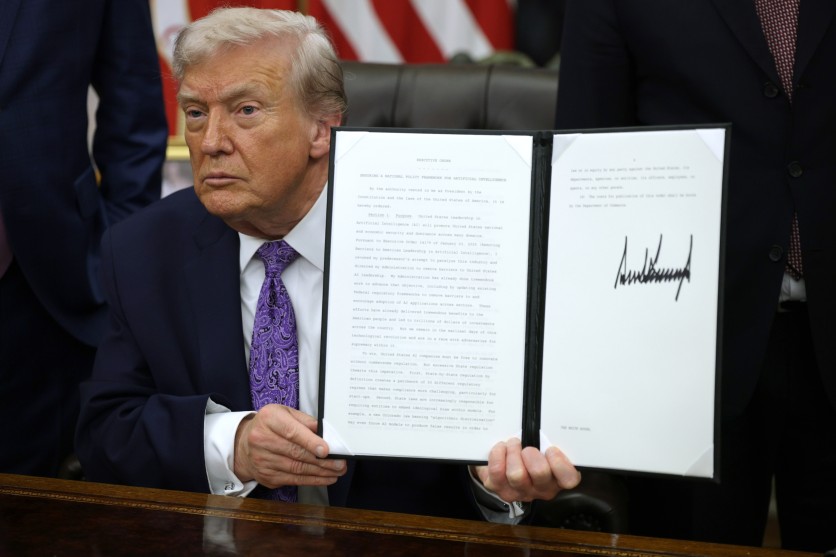
President Donald Trump has signed an executive order directing federal agencies to create a voluntary framework through which AI developers can give the US government early access to certain frontier models for cybersecurity and related national security testing.
The June 2 executive order calls for a classified benchmarking system to identify AI models with sufficiently advanced cyber capabilities. Developers of models that meet the threshold could then provide federal evaluators with access for up to 30 days before sharing those systems with other trusted partners.
The policy could place government cybersecurity testing closer to the release process for future models from OpenAI, Anthropic, Google and other frontier AI developers.
However, the order does not impose a mandatory 30-day waiting period. It does not require companies to obtain government approval before launching a model, and it does not create a federal licensing or preclearance system.
That distinction is central to understanding the order. The government is being offered an early role in testing some of the most powerful AI systems, but it is not being given a veto over the launch of the next GPT, Claude or Gemini model.
What the Order Actually Establishes
The order instructs the Treasury Department, National Security Agency, Cybersecurity and Infrastructure Security Agency, National Institute of Standards and Technology and other federal bodies to establish the new framework within 60 days.
The agencies must create and maintain a classified benchmarking process focused on advanced cyber capabilities. The purpose is to determine whether a model is powerful enough to qualify as a "covered frontier model."
The NSA director would make that designation in consultation with the national cyber director, CISA, the president's science and technology adviser and other relevant officials.
A developer could voluntarily ask the government to determine whether a model under development meets the threshold. If it does, the company could provide federal evaluators with access for a period of up to 30 days.
The order requires the framework to include protections for intellectual property, cybersecurity, confidentiality and insider risk. These safeguards are important because frontier models may contain commercially sensitive information and represent billions of dollars in research and computing investment.
The Associated Press reported that the process would allow the government to examine advanced AI models before wider release. The legal text is more precise: the 30-day access period would occur before a developer makes a covered model available to "other trusted partners."
Trusted-partner testing often takes place shortly before a public launch, so the government process could become part of the broader pre-release schedule. But the order does not require every frontier model to undergo federal review before public availability.
Could It Slow GPT, Claude or Gemini Releases?
The new framework could affect release schedules, but any delay would result from voluntary participation and implementation choices rather than a legal approval requirement.
A participating developer may need to reserve time for government testing, evaluate vulnerabilities identified by federal experts and coordinate with agencies over which trusted partners receive early access.
That work could add another stage to an already complex model-release process.
OpenAI, Anthropic and Google already conduct internal safety evaluations, external red-team testing and limited early-access programs before major launches. Federal cybersecurity testing could be performed alongside some of those existing procedures.
The 30-day period is also a maximum access window, not an automatic delay imposed on every model. The order does not state that companies must wait the full month, and it does not say a model must remain unreleased if federal evaluators have not completed their work.
An analysis by WilmerHale noted that developers retain control over whether to participate and when to release their systems. The order does not give the government a formal right to approve, reject or modify a model.
Nevertheless, voluntary participation could become commercially influential.
Frontier AI companies sell services to federal agencies, defense contractors, banks, healthcare providers and operators of critical infrastructure. Companies that cooperate with federal cybersecurity testing could gain credibility with customers that handle sensitive data or operate essential systems.
Over time, participation could also influence government procurement rules, federal contracts or industry security standards. In that scenario, the framework would remain legally voluntary while becoming increasingly important for companies seeking government or critical-infrastructure business.
That remains a possible development, not an existing requirement.
Why the Government Wants Early Access
The order reflects concern that advanced AI models could strengthen both cyber defense and cyberattack capabilities.
Powerful models may help defenders inspect software, discover vulnerabilities, generate security patches and respond to attacks more quickly. The same capabilities could potentially help malicious actors identify weaknesses, automate intrusion attempts or target critical systems.
The administration wants federal security agencies to evaluate these capabilities before the most powerful systems are distributed more widely.
The order also directs the Treasury Department to establish an AI cybersecurity clearinghouse in cooperation with AI developers, federal agencies and critical-infrastructure operators.
The clearinghouse would coordinate AI-assisted software vulnerability scanning, validation, patch development and remediation. It is intended to help organizations identify and fix vulnerabilities across software and infrastructure, rather than simply inspect unreleased AI models.
CISA is also instructed to expand access to AI-enabled defensive tools for federal agencies, state and local governments and critical-infrastructure operators. The order specifically emphasizes organizations that may lack extensive cybersecurity resources, including rural hospitals, community banks and local utilities.
These provisions show that the policy is not limited to regulating AI developers. It also seeks to use advanced AI as a defensive cybersecurity tool.
Voluntary by Design
The executive order explicitly rejects a mandatory model-licensing regime. Its legal text states that the policy should not be interpreted as authorizing compulsory licensing, preclearance, permitting or government approval for the development or release of AI models.
That language separates the order from proposals that would require AI laboratories to obtain formal authorization before training or releasing highly capable systems.
The voluntary structure reduces the risk that federal review will become an immediate bottleneck. It also limits the government's ability to ensure that every potentially dangerous model is tested. A developer could decline to participate. A company could also disagree with the government over whether a system meets the definition of a covered frontier model.
Another unresolved issue is transparency. Because the benchmarking system will be classified, the public may receive little information about why one model is designated for testing while another is not.
The order also gives significant discretion to the NSA director and other federal officials involved in model designation and the selection of trusted partners. Critics may question whether those decisions are technically consistent or influenced by political and commercial considerations.
AI Companies Welcome the Framework
OpenAI, Anthropic and Google publicly welcomed the order, according to Reuters and AP.
OpenAI CEO Sam Altman said the order struck an appropriate balance. Anthropic said it looked forward to working with the administration on implementation, while Google executive Kent Walker described the initiative as an important step.
Those statements indicate support for a voluntary, technically focused process.
They do not mean that the companies have committed to submitting every future GPT, Claude or Gemini model for government testing. Participation will depend on how the framework is implemented, how covered models are defined and whether developers trust the government to protect confidential information.
The companies' positive response is nevertheless significant. Frontier labs have generally supported government access to model evaluations when the process is narrowly focused, confidential and does not amount to mandatory licensing.
A Review Framework, Not a Launch Veto
Trump's order represents a limited shift toward more active federal involvement in frontier-model cybersecurity.
The administration continues to emphasize rapid US AI development and competition with China. At the same time, the order recognizes that models with advanced cyber capabilities may create risks that cannot be evaluated solely inside private companies.
The resulting policy is a compromise.It gives federal security agencies earlier access to certain powerful systems while leaving developers in control of participation and release decisions.
The framework could eventually become a routine part of the development cycle for major AI models. It may also influence government contracts, critical-infrastructure adoption and industry security expectations.
But under the order as written, the government cannot require OpenAI, Anthropic or Google to wait 30 days, obtain a license or receive approval before launching a model.
Future versions of GPT, Claude and Gemini may face closer federal scrutiny before wider deployment.
Washington has gained an opportunity to enter the testing room earlier. It has not been given control of the launch button.
ⓒ 2026 TECHTIMES.com All rights reserved. Do not reproduce without permission.


