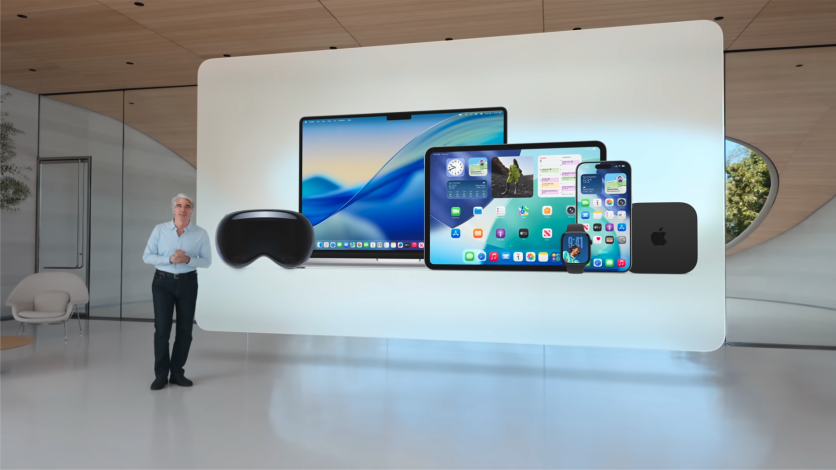
Tomorrow at 1:00 p.m. ET, Apple will open WWDC 2026 with a keynote that makes official what it announced a year ago: macOS 27 will require Apple Silicon, leaving the final four Intel Macs permanently behind. For owners of those specific machines — the MacBook Pro 16-inch (2019), the MacBook Pro 13-inch (2020, four Thunderbolt 3 ports), the iMac 27-inch (2020), and the Mac Pro (2019) — Monday's announcement ends any remaining ambiguity about their upgrade timeline. Developer betas for macOS 27 will be available immediately after the keynote, with a wide release expected around September 2026.
The split is not administrative. The hardware reason for the incompatibility sits inside every M-series Mac: a dedicated Neural Processing Unit that Apple calls the Neural Engine. Intel Macs do not have one. That absence is what separates the two eras.
Four Mac Models Hit the macOS 27 Compatibility Wall
Apple confirmed the Intel exclusion at WWDC 2025's Platforms State of the Union, giving owners a full year of notice. The four models losing eligibility with macOS 27 represent the last Intel Macs that survived into macOS 26 Tahoe support. Every other Intel Mac — every MacBook Air, every Mac mini, every earlier MacBook Pro and iMac — was already dropped from macOS support in prior years.
These were not entry-level machines. A maxed-out Mac Pro (2019) cost north of $10,000 at the time of purchase. The 27-inch iMac and 16-inch MacBook Pro were Apple's professional flagships. The year of advance notice softens the blow somewhat, but owners of machines purchased as recently as six years ago are now looking at a frozen platform. Apple has confirmed the four affected models and their ineligibility for macOS 27.
What "Unsupported" Means in Practice
macOS 26 Tahoe, released September 15, 2025, is the last major OS version these machines will ever receive. Apple has committed to three years of security updates for Intel Macs running Tahoe, which extends coverage through approximately fall 2028. That patch window means the machines do not become unsafe overnight. A MacBook Pro 16-inch (2019) running macOS 26 Tahoe will receive security fixes at roughly the same pace as Apple Silicon Macs until the patch window closes.
The feature gap is a different matter. macOS 27 arrives with a rebuilt Siri powered by a custom model built on Google's Gemini technology, expanded Apple Intelligence tools, and continued refinement of the Liquid Glass interface first introduced in Tahoe. None of those capabilities will be available on Intel hardware — not because Apple chose not to port them, but because the on-device inference pipeline those features depend on requires the Neural Engine that Intel chips never included.
Starting with macOS 26.4 in February 2026, Apple introduced a system-level alert that fires every time a user opens an Intel-only app, warning that the software will stop functioning in a future macOS release. macOS 26.5, the current release as of May 11, 2026, continues showing those alerts. Any app still relying on Intel-only code after five years of M1 availability will almost certainly never receive a native Apple Silicon build.
Why Apple Intelligence Requires Neural Engine Hardware
The Apple Neural Engine is a dedicated hardware co-processor integrated directly onto every M-series system-on-a-chip. Its function is to execute matrix multiply-accumulate operations — the core mathematical primitive of neural networks — in parallel, at low power. The M1, which shipped in November 2020, included a 16-core Neural Engine capable of 11 trillion operations per second. The M4 raised that to 38 trillion operations per second. The recently introduced M5 reaches approximately 133 trillion operations per second by embedding dedicated Neural Accelerators inside each GPU core as well.
Intel chips used in Macs through 2020 have no equivalent hardware. Running the same inference workloads on a CPU is possible in principle but is orders of magnitude slower and far more power-intensive — conditions that make real-time features like live transcription, on-device image generation, and contextual Siri responses impractical. This is not a software limitation Apple can work around. The hardware is simply not present.
The second architectural reason is unified memory. On every M-series Mac, the CPU, GPU, and Neural Engine share a single pool of high-bandwidth on-chip memory. The M1's unified pool runs at 68 gigabytes per second; the M1 Max reaches 400 gigabytes per second. Traditional PC architectures, including the Intel configurations in those four Mac models, keep system RAM and GPU memory separate — moving data between them introduces latency and energy overhead that compounds with every inference pass. Apple Intelligence features are designed around the assumption of zero-copy memory access. Intel Macs cannot provide it.
Rosetta 2 cannot bridge this gap. It translates software instructions; it does not add hardware. No firmware update, no system patch, and no emulation layer can install a Neural Engine onto a logic board that was manufactured without one.
Rosetta 2 Heads for the Exit After macOS 27
Apple Silicon Mac owners who still run Intel-era apps face a parallel deadline. Apple's developer documentation confirms that "Rosetta support for apps will end after macOS 27." Rosetta 2 is the binary translation layer that allows Intel-compiled software to run on Apple's ARM-based M-series chips by converting x86_64 instructions to ARM64 at install time or first launch. It has served as the compatibility bridge since November 2020.
Rosetta 2 has always had limits: it cannot translate kernel extensions, AVX/AVX2/AVX512 vector instructions, or virtual machine apps that handle x86 platforms. After macOS 27, those limits become permanent for everything. Apple has said it will retain a narrow subset of Rosetta functionality specifically for older unmaintained gaming titles, but the general-purpose translation layer that enterprise software, audio plugins, and legacy CAD tools depend on will be gone with macOS 28, expected in fall 2027.
Apple described its own commitment at WWDC 2025: "Rosetta was designed to make the transition to Apple silicon easier, and we plan to make it available for the next two major macOS releases — through macOS 27 — as a general-purpose tool for Intel apps to help developers complete the migration of their apps." That window is now down to one release.
What Intel Mac Owners Should Do Before September
For owners of the four affected Intel Mac models, the practical decision tree is now clear. macOS 26 Tahoe is fully supported today and will receive security patches for roughly two more years. The machines remain usable. The question is whether the platform freeze — no new features, a shrinking compatible app universe, and a firm patch expiration — justifies staying put.
For Apple Silicon Mac owners who depend on Intel-era apps: every application still showing a Rosetta warning in macOS 26.4 and later is a candidate for replacement or migration audit before macOS 28 ships. Enterprise IT administrators face the most concentrated exposure. According to a community-tracked database cited by TechTimes, more than 18,800 Intel-only Mac titles had been catalogued as of late May 2026, spanning legacy business software, audio production plug-ins, older CAD tools, and unmaintained utilities.
Monday's WWDC 2026 keynote, beginning at 1:00 p.m. ET, will make the transition official in the most public way possible. Developer betas for macOS 27 will be available immediately afterward.
Frequently Asked Questions
What Intel Mac models will not run macOS 27?
Four Intel Macs that currently support macOS 26 Tahoe will not be eligible for macOS 27: the MacBook Pro 16-inch (2019), the MacBook Pro 13-inch (2020, four Thunderbolt 3 ports), the iMac 27-inch (2020), and the Mac Pro (2019). All other Intel Macs lost macOS support in previous years and are already unsupported.
Will my Intel Mac still work after macOS 27 releases?
Yes. Intel Macs running macOS 26 Tahoe will continue to function and will receive Apple security updates for approximately three years after Tahoe's September 2025 release, covering the machines through roughly fall 2028. They will not receive macOS 27 features or any future major OS updates.
Why won't macOS 27 run on Intel Macs?
The primary reason is hardware. Every M-series Mac contains a dedicated Neural Processing Unit called the Neural Engine, which executes the parallel matrix operations that Apple Intelligence features require. Intel Macs shipped without any equivalent hardware. Running the same on-device AI inference workloads on a CPU would be too slow and power-intensive for real-time use, and no software update can add hardware that was never built into the machine.
When does Rosetta 2 end on Apple Silicon Macs?
Rosetta 2 will remain fully functional through macOS 27, expected in fall 2026. Apple's developer documentation confirms that general Rosetta support ends after macOS 27, meaning macOS 28 — expected in fall 2027 — will discontinue the translation layer for most Intel apps, with a narrow exception preserved for older unmaintained gaming titles.
ⓒ 2026 TECHTIMES.com All rights reserved. Do not reproduce without permission.


