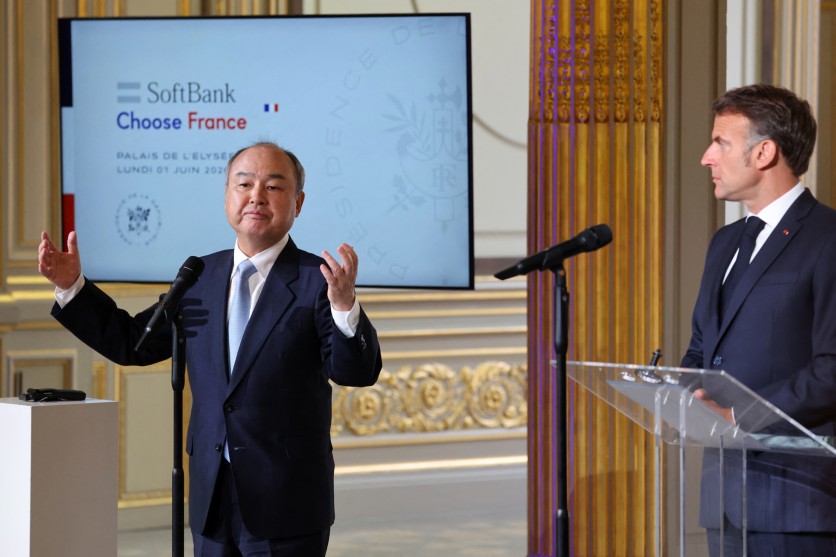
SoftBank Group will build and operate 5 gigawatts of AI data center capacity in France in an investment that could reach €75 billion, founder and chief executive Masayoshi Son announced in person at the Choose France summit. As TechCrunch reported, it is SoftBank's largest AI infrastructure commitment in Europe to date — and it pins the project to the resource that now decides where AI gets built: electricity.
The plan is phased. According to CNBC, the first €45 billion phase — about $52 billion — will deliver 3.1 gigawatts in the northern Hauts-de-France region by 2031, with sites in Dunkirk, Bosquel, and Bouchain. The announcement landed as SoftBank became Japan's most valuable company, a sign of how central the AI buildout has become to its worth.
Why AI's newest bottleneck is power, not chips
The choice of France points to the constraint increasingly governing the industry. Training and running frontier models consumes electricity on an industrial scale, and the limiting factor for new capacity is no longer silicon or capital but access to large, stable, low-carbon power. France supplies exactly that: it generates most of its electricity from nuclear reactors, giving it an abundant, dispatchable, low-emission grid that many rivals — including parts of the United States, where local grids are straining under data center demand — cannot offer.
That advantage is engineered into the project. State-owned nuclear utility EDF is partnering on the buildout and providing the site of a former power plant in Bouchain, placing new compute beside existing grid infrastructure. SoftBank also plans to work with French power and cooling specialist Schneider Electric on a large-scale industrial cluster at the Port of Dunkirk. Tom's Hardware noted that France's nuclear grid is precisely the asset U.S. sites lack.
What 5 gigawatts actually demands to build
Five gigawatts is a staggering figure — roughly the output of several large nuclear reactors and far beyond a conventional data center campus, which is usually measured in tens or low hundreds of megawatts. Delivering it means securing not just server halls but transmission, substations, cooling at scale, and multiyear power contracts that guarantee delivery.
That is why reusing a decommissioned power plant is a technical decision, not a symbolic one. A former generation site already carries high-voltage grid connections — one of the longest-lead-time elements of any large build. Co-locating with nuclear generation also cuts transmission losses and shields the project from the price volatility that fossil-dependent grids pass through to electricity buyers.
Europe's energy bet, and your stake in it
The commitment is the clearest sign yet that Europe means to compete for AI infrastructure rather than cede it to the United States and the Gulf — and that the contest will turn substantially on energy policy. France is wagering that cheap, clean, reliable nuclear power is a durable edge in an industry whose appetite for electricity is outrunning most grids' ability to expand.
The scale also reframes a question ordinary readers have a stake in. AI's power draw is rising fast, and large new loads can strain grid capacity and push up electricity costs for everyone on the same network. France's nuclear surplus blunts that tension at home; in regions without spare low-carbon capacity, the same buildout pressure has already begun showing up in residential power bills and strained local grids. SoftBank's France project is, in effect, a live demonstration of the energy conditions that make hosting AI viable — and an implicit warning to places that lack them.
The numbers remain commitments rather than spent money, and the portion beyond €45 billion is subject to extension rather than guaranteed. But the direction is unambiguous: the next phase of the AI race is being fought over gigawatts, and SoftBank has placed a very large bet on where the power will come from.
Frequently Asked Questions
How much is SoftBank investing in French AI data centers?
SoftBank has committed to develop 5 gigawatts of AI data center capacity in France in an investment that could reach €75 billion. The first phase is about €45 billion, or roughly $52 billion, delivering 3.1 gigawatts in the Hauts-de-France region by 2031.
Why is SoftBank building AI data centers in France specifically?
France generates most of its electricity from nuclear power, giving it an abundant, low-carbon, dependable grid at a time when power availability is the main constraint on new AI data centers. State utility EDF is partnering on the project and providing a former power plant site with existing grid connections.
Does AI data center growth raise electricity costs for households?
It can. Large new AI loads add demand that, in regions without spare low-carbon capacity, can strain local grids and contribute to higher residential power bills. France's nuclear surplus is intended to absorb the new demand without that pressure.
ⓒ 2026 TECHTIMES.com All rights reserved. Do not reproduce without permission.


