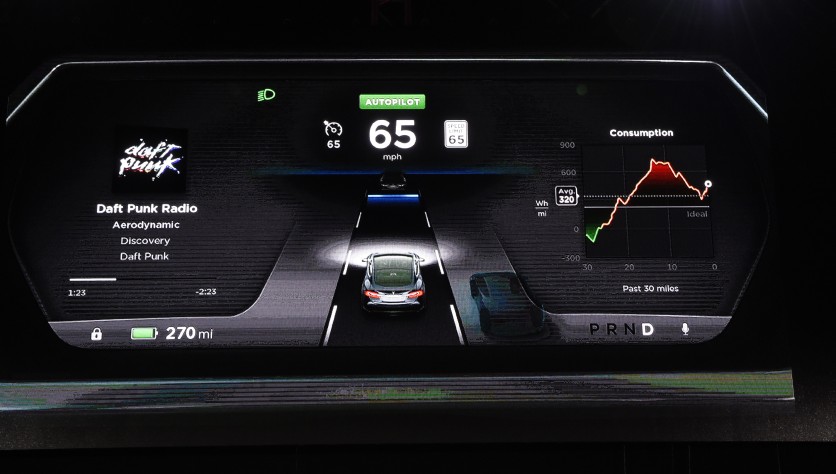
xAI has begun pushing Grok V9-Medium, its largest model yet, into Tesla's connected-car fleet and the X social network — the moment Elon Musk has been building toward, and the clearest demonstration so far of a distribution advantage no other AI company has. Where OpenAI and Google reach users through apps and cloud deals, Musk can route a new model directly into hundreds of millions of X accounts and millions of internet-connected Teslas at once. Grok V9 flowing into both simultaneously is the vertical-integration "flywheel" that has unsettled competitors — and it is now turning.
For a reader deciding how much this matters, the key is to separate two things the framing tends to blur: what Grok V9 actually does in a car, and why its reach — not necessarily its smarts — is the part rivals find hard to counter.
What Is Grok V9-Medium?
Musk announced on June 5, 2026 that Grok V9-Medium had completed training at 1.5 trillion parameters — roughly three times the size of the current production model, v8-small, at about 500 billion parameters. Parameter count is a rough proxy for capacity, not a guarantee of quality, but a threefold jump signals a substantial increase in the model's headroom for reasoning, coding, and multimodal tasks.
Ahead of the rollout, xAI rounded out the assistant with supporting pieces: Grok Voice for spoken interaction and a Grok Imagine 1.5 image-generation preview through its API. The company also named Jack Garabedian, a senior manager from SpaceX's Starlink division, to lead data annotation for Grok — a sign of how tightly Musk's companies share talent and infrastructure.
Read more: Musk's Big AI Week: Grok V9 Finishes Training at 1.5 Trillion Parameters as Driverless Tesla
Does Grok V9 Actually Drive the Car?
No — and the distinction is the most important fact in this story. Grok is an in-car AI assistant: the system behind "Hey, Grok" voice interaction, conversational queries, and natural-language navigation commands. It is not the software that drives the vehicle. Tesla's Full Self-Driving stack remains a separate system, and Grok V9 does not change it. What Grok V9 changes is the experience of riding in and talking to a Tesla, not the mechanics of how it drives.
That distinction matters, but it does not make the integration trivial. A markedly more capable assistant — one that can hold context, reason through multi-step requests, and handle richer voice and visual input — turns the car's screen into a genuine AI surface rather than a novelty. And because Grok reaches Teslas through over-the-air updates, a single push can upgrade the assistant across a fleet that already spans millions of vehicles in an expanding list of countries.
Why Does Musk's "Flywheel" Worry Competitors?
The strategic story is distribution. Most AI labs spend heavily to acquire both users and compute; Musk's empire supplies them internally. X provides a massive, real-time stream of users and data; Tesla provides a global hardware footprint; xAI provides the model, trained on infrastructure tied to the same orbit of companies. Each turn of the wheel feeds the next: more users generate more interaction data, which can sharpen future models, which draw more users.
For rivals, the concern is not that any single Grok release tops their best model on a benchmark. It is that Musk can deploy a competitive model to an enormous installed base instantly, without negotiating distribution, and improve it continuously against a captive stream of real-world usage. That is a structural advantage that a better model alone is hard-pressed to counter — and it is why the simultaneous push into cars and the feed reads, to competitors, as more threatening than the model's raw scores.
Read more: Grok AI New Model Triples Parameter Count, Targets Coding Lead: Release Expected Mid-June
What Are the Caveats?
A model that has "completed training" is not the same as one proven in the wild. The 1.5-trillion-parameter figure describes size, not measured performance; independent benchmarks will determine whether Grok V9 actually narrows the gap with the leading models from OpenAI, Anthropic, and Google. Musk's release timelines also have a long history of slipping, so the rollout's pace and completeness are worth watching rather than assuming. And deploying a more powerful conversational model into cars and a social platform at scale raises the usual questions about reliability, content moderation, and safety that benchmark scores do not capture.
There is also the matter of substance versus reach. Distribution gets a model in front of people; it does not, by itself, make that model better than the alternatives a tap away. Grok's edge is that it is already there — embedded in the car and the feed. Whether users prefer it once it arrives is a separate test that only real-world use will settle.
Why It Matters
Grok V9 reaching Tesla and X at once is less a single product launch than a demonstration of a business model. The AI race has largely been fought on capability — whose model is smartest. Musk is betting that distribution is the harder thing to replicate, and that owning the model, the social platform, and the hardware lets him turn an incremental upgrade into an instant, fleet-wide event. If Grok V9 proves genuinely competitive on quality, pairing a strong model with unmatched built-in reach would be one of the most formidable positions in the industry. If it does not, the flywheel still spins — just with a model users may route around. Either way, the mechanism Musk has assembled is now running in the open.
Frequently Asked Questions
What is Grok V9-Medium?
Grok V9-Medium is xAI's latest large language model, which Musk said completed training on June 5, 2026 at 1.5 trillion parameters — about three times the size of the current v8-small production model. It powers Grok's assistant across X and Tesla vehicles.
Does Grok V9 control Tesla's self-driving?
No. Grok is an in-car AI assistant for voice interaction, questions, and navigation commands. It does not drive the car — Tesla's Full Self-Driving is a separate system that Grok V9 does not change.
How does Grok reach Tesla cars?
Grok is delivered to Tesla vehicles through over-the-air software updates, the same mechanism Tesla uses for other features. That lets xAI upgrade the in-car assistant across millions of connected Teslas at once, across a growing list of supported countries.
Why is Grok's integration with Tesla and X significant?
It gives Musk a built-in distribution channel rivals lack: hundreds of millions of X users and millions of cars that can receive a new model instantly. The advantage is reach and real-world usage data, though distribution alone does not prove Grok is more capable than competing models.
ⓒ 2026 TECHTIMES.com All rights reserved. Do not reproduce without permission.


