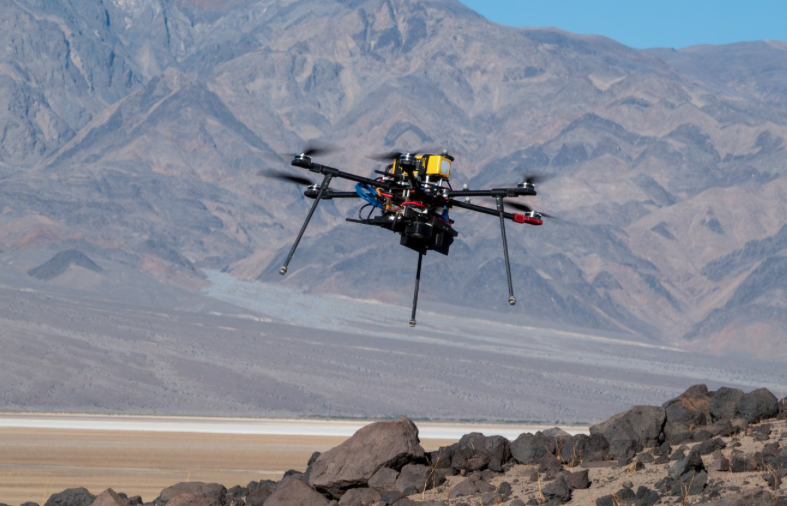
NASA has sent over three drones to the famed Death Valley in California for a team to test the unmanned aerial vehicles (UAVs) in extreme conditions.
The space agency launched this test in hopes of solving the key issues found on the Ingenuity Space Helicopter's run that lasted for years on the Red Planet, where it crashed after three years of service.
NASA Tests 3 Drones in 'Death Valley' for Future Mars Missions
NASA and its Jet Propulsion Laboratory (JPL) have recently launched a test that involves a team flying three drones over the Death Valley National Park to test these UAVs in extreme conditions reminiscent of Mars.
The team also ventured over to the Mojave Desert, also in California, to test the said drones earlier this year, focusing on "barren, featureless desert dunes" for the Martian simulation.
The team focused on areas like the park's Mars Hill and Mesquite Flats Sand, where the temperature could go as high as113 degrees Fahrenheit (45 degrees Celsius). The team was able to acquire useful findings, including the use of different camera filters to make it easier for drones to track the ground, as well as new algorithms to safely land.
Apart from this, the team launched additional tests over at the Mojave Desert to simulate the same situations of a Mars-like environment for drones to fly over, with field testing giving them more insights and a "much more comprehensive perspective," said Nathan Williams of JPL.
Read Also: Mars Exploration and the Future of Human Spaceflight: How NASA's Missions Are Paving the Way
NASA Wants to Solve Ingenuity Issues
NASA's test wants to solve the issues that the Ingenuity Space Helicopter faced in its groundbreaking mission that spanned three years. After a record-breaking flight, Ingenuity met its end as it failed to determine that it was close to the Martian surface and crashed.
With this test, the team looked into various methods that would allow drones to determine if they are close to the surface even if they are "featureless," one that could potentially save a mission and continue its exploration for a future excursion on Mars.
NASA's Ingenuity Space Helicopter

It has been a long journey for NASA since the Perseverance mission on Mars in 2020, with the agency having delivered the rover and its accompanying Ingenuity Space Helicopter on the neighboring planet's surface in April 2021.
Ingenuity was originally meant to be a test for NASA to bring drones to the Red Planet, with the agency only planning five flights for the so-called "space helicopter."
However, Ingenuity exceeded expectations for NASA as it was able to cross its five-flight threshold shortly and easily, with the space agency noting that the team saw a "glitch-free" experience in its early missions.
Instead of retiring Ingenuity early, NASA went on to use the opportunity of having a space helicopter at their disposal to see and study Mars at another angle, something which surface-based rovers cannot do.
Back in January 2024, NASA went on to fly Ingenuity's 72nd flight, which was also subsequently its last mission as the remote-controlled helicopter was unable to perceive the surface and had a bad crash.
ⓒ 2026 TECHTIMES.com All rights reserved. Do not reproduce without permission.


