Figure AI's latest breakthrough has ignited global curiosity after CEO Brett Adcock claimed that the company's F.03 humanoid robot became the first of its kind to enter the White House.
The appearance took place during a tech-focused summit tied to First Lady Melania Trump's "Fostering the Future Together" initiative.
Sci-Fi Moment Comes to Life
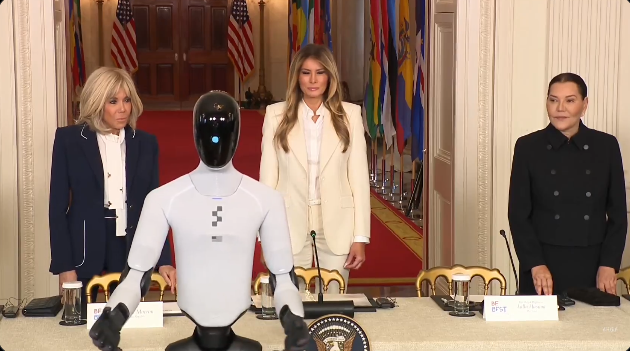
During the event, the F.03 robot delivered a short but striking demonstration. The humanoid machine walked into the room, greeted attendees in multiple languages, and exited without interaction.
Though brief, the presentation created a powerful impression on the audience as they witnessed advanced robotics in a real-world political setting.
So proud to see F.03 make history as the first humanoid robot in the White House 🤖 🇺🇸 pic.twitter.com/tXsxpEErsi
— Brett Adcock (@adcock_brett) March 25, 2026
The moment quickly went viral, sparking discussions about whether this was truly the first time a humanoid robot had stepped inside the White House.
Read more: Elon Musk Reveals When Tesla's Optimus Robot Could Finally Hit Homes—and Why 2027 Isn't Guaranteed
Have Humanoid Robots Been There Before?
While robots have appeared in political environments, few match the definition of a humanoid robot in this context.
According to Gizmodo, former U.S. President Barack Obama once interacted with disability advocate Alice Wong via a telepresence robot. However, that device functioned more like a mobile screen than a human-like machine.
Similarly, ASIMO, developed by Honda, has met world leaders, including Obama, but only during international events in Japan. Another notable example is Albert HUBO, which appeared at a global summit in South Korea. Still, none of these instances occurred within the White House itself.
What Defines a 'Humanoid' Robot?
The debate ultimately hinges on definition. Earlier robotic devices blurred the line. In 1987, President Ronald Reagan reportedly received a Tomy Omnibot 2000. While innovative at the time, its wheeled design lacks the human-like mobility expected of modern humanoid robots.
In contrast, Figure AI's F.03 features bipedal movement and lifelike interaction capabilities, aligning more closely with what experts consider a true humanoid system.
Expect to See More Robots in Public Spaces
Whether or not this moment is officially recognized as a "first," it signals something bigger. The presence of a humanoid robot in a high-level government setting means that they will become the norm in the years to come.
Aside from innovation, demonstrations like this could become more common, not just as showcases, but as functional tools in public service, education, and administration.
We can conclude that humanoid robots are no longer confined to labs or exhibitions. They are stepping into real-world environments, including the most powerful rooms in the world.
ⓒ 2026 TECHTIMES.com All rights reserved. Do not reproduce without permission.


