
The live entertainment pay booth was one of the most quietly expensive fixtures in the industry. A venue posted a host at a table with a cash drawer, a credit card terminal, and a spreadsheet. The host typed names by hand, misspelled them, forgot phone numbers, entered wrong spending amounts, and generated a database that was useless by morning. Operators woke up to no record of who was there, no way to reach them, and no defense against the chargebacks that would arrive in the next billing cycle. This had been the industry standard for decades.
Tamas An, Alex Manavi, and Paul Stacek looked at that pay booth and saw a broader problem. Their answer became Speakeasy, the operations and intelligence infrastructure powering the live experience economy. Today, the platform serves venues, creators, hospitality groups, and festivals alike: OMNIA Las Vegas, LIV Las Vegas, Barstool Nashville, Somewhere Nowhere New York, Marquee New York, Jason Aldean's Las Vegas, Drai's Las Vegas, E11EVEN Miami, and roughly 200 others across 30-plus U.S. cities. In two years of operation, the company has not lost a single client.
A Platform Built Outward from the Hardest Problem
Before founding Speakeasy, the core team watched operators cobble together mismatched tools. Each system captured a fragment of the guest relationship. None of them talked to each other. A high-value patron, who attended a venue 28 times in a year, existed in four separate databases under four different spellings of their name.
Tamas, who studied computer science and physics at the University of Chicago, led the technical build with a specific mandate: collapse the stack. The industry warranted it; U.S. consumer spending on live events reached $51.4 billion in 2024, up roughly 30 percent from 2019 (Bureau of Labor Statistics, Consumer Expenditure Survey, 2024), yet the software infrastructure underneath it remained a decade behind. Rather than building horizontally into the easier parts of the market, he started at the front door, the most exposed, highest-friction point in the venue operation, and built outward from there.
The result is a platform covering the critical functions that previously required separate vendors: at-door ticketing and payments, CRM and floorplan management, pre-sold event ticketing, with distribution to over 300 million listeners, SEO and LLM optimization, off-site point of sale solutions, anti-chargeback protection, and much more. The pricing model for at-door entry and online ticketing is flat at one dollar per ticket, a structure designed to eliminate the percentage-based fee friction that made legacy ticketing platforms adversarial to operators.
What the Product Actually Does
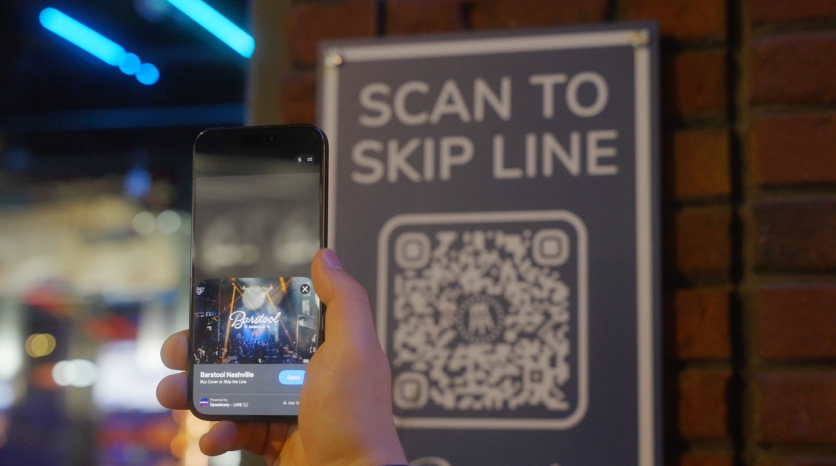
At the door, a guest scans a QR code, pays, and receives a digital ticket, with the venue capturing verified contact information and marketing consent in the process. More than 90 percent of Speakeasy entries convert into opted-in guests. For comparison, the industry baseline for usable marketing data out of a manual entry process is effectively zero.
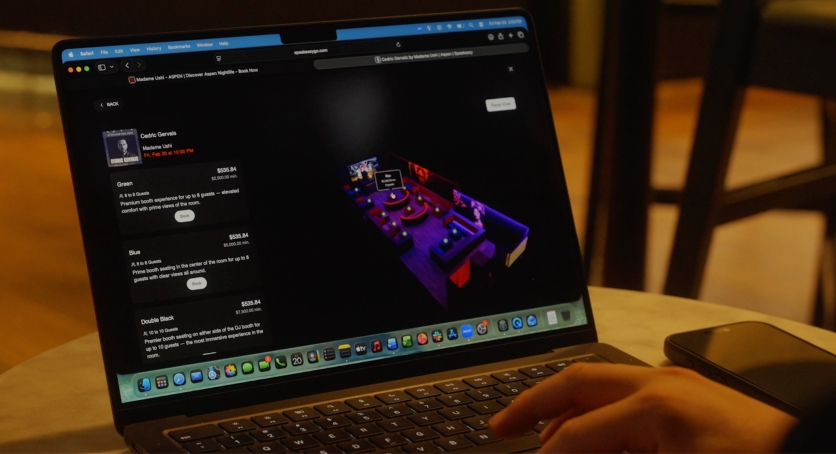
The intelligence layer, which Speakeasy calls IQ, is what differentiates the platform beyond transaction processing. Because every guest interaction flows through a single system, IQ builds a longitudinal profile of each guest that grows more valuable with every visit. Proprietary models translate that data into actionable outputs: who is at risk of not returning, who should be retained, and when to reach them. A guest who attended 28 times and spent $1,080 over two years but hasn't returned in 56 days will appear on a venue marketing manager's radar, flagged, contextualized, and ready to act on.
The off-site point-of-sale system runs hardware-free, capturing the evidence needed to contest disputes before operators think to ask for it. This matters in an industry where high-spend reservations routinely trigger chargebacks, and a single reversed charge on a tab can represent several thousand dollars.
"Speakeasy has been a godsend for our operation. We've increased revenue thanks to an intuitive, easy-to-use system that integrates seamlessly with our POS. Consolidating ticketing and table reservations into one platform allowed us to move away from multiple tools. It's streamlined our entire workflow—and our accounting team loves it too." — Gino LoPinto, Managing Partner, E11EVEN Miami
The Case Studies
In Las Vegas, a major venue generated more than $163,000 in new revenue through premium skip-line entry in its first 128 days on Speakeasy, all at 100 percent gross margin, since the product required no additional labor or inventory. The annualized value-add at that venue exceeds $469,000.
At a leading Chicago venue, Speakeasy produced a 16 percent year-over-year increase in at-door revenue while meaningfully reducing operating costs. Marketing opt-in through the Speakeasy entry flow reached 92.4 percent.
Good Night John Boy, a 350-capacity venue in Chicago's West Loop operated by Forward Hospitality, generated $203,000 in annualized incremental revenue through skip-line premium entry alone, purely gross margin, no cost of goods. A leading open-air concert venue in Cleveland, operating four months per year, saved $23,006 in ticket fees in its first 39 days of using Speakeasy's ticketing solution after switching from a legacy platform. The venue is now planning to eliminate a $17,000 monthly marketing agency spend, replacing those services with Speakeasy's CRM and outreach tools.
The aggregate client base represents a meaningful footprint. Eighty-three percent of Speakeasy's 200-plus clients came through referral. Not one has left.
"Our nightclubs and day-clubs have been using the Speakeasy mobile payment solution for on-site admission. The platform has significantly accelerated the payment and entry process... We constantly challenge the Speakeasy team with feature enhancements, and they truly deliver." — Stephane Tousignant, Director of Ticketing & Support Services, TAO Group Hospitality
ⓒ 2026 TECHTIMES.com All rights reserved. Do not reproduce without permission.


