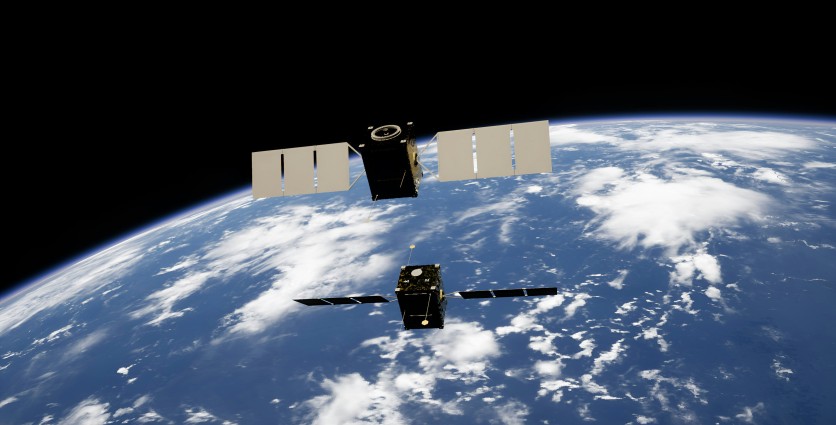
Solar storms satellites must withstand are among the most powerful natural space events, driven by space weather activity that releases massive energy bursts into the solar system. These events include coronal mass ejection flux that can overwhelm satellite electronics, disrupt communication systems, and increase radiation exposure in orbit. As solar activity intensifies, satellites in both low Earth and geostationary orbits face growing operational risks.
Space weather also influences Earth's magnetic environment, creating geomagnetic induced currents that interfere with onboard systems and ground-based infrastructure. Radiation belt enhancement during strong solar events further increases particle density around satellites, raising the risk of data corruption and hardware degradation. Together, these effects make solar monitoring essential for modern satellite operations and global communication stability.
Solar Storms That Satellites Face: Radiation and Power Surges
Solar storms satellites encounter can release intense bursts of charged particles that penetrate shielding and disrupt onboard systems. High-energy protons generated during coronal mass ejections can cause single event upsets, leading to temporary or permanent errors in satellite memory and electronics. These disruptions can affect communication, navigation, and imaging systems in orbit.
Space weather conditions also create power surges through geomagnetic induced currents that stress satellite electrical systems. As radiation levels rise, solar panels can lose efficiency, and onboard components may experience unexpected resets or failures. To reduce damage, satellites often rely on radiation-hardened designs and automated protective modes during peak solar activity.
Space Weather Forecasting for Satellite Protection
Solar storms can be partially mitigated through advanced space weather forecasting systems that monitor solar activity in real time. Satellites positioned at L1 points, along with ground-based observatories, provide early warnings of incoming coronal mass ejections, giving operators time to prepare. These forecasts help reduce the risk of sudden system failures during high-radiation events.
Space weather monitoring also supports decision-making for orbital adjustments and system shutdown protocols. When solar activity increases, satellite operators may switch systems into safe mode to protect sensitive electronics from radiation belt enhancement effects. This proactive approach helps maintain mission continuity and reduces long-term hardware damage in orbit.
Solar Storms Damage Mechanisms on Satellites Explained
The Solar storms that satellites experience can cause damage through both immediate impacts and long-term exposure to radiation. High-energy particles can gradually degrade solar panels, reducing their efficiency and limiting power generation over time. This slow wear affects satellite lifespan and overall performance in orbit.
Space weather also causes charging effects on satellite surfaces, leading to electrical discharges that can damage internal components. Deep dielectric charging can build up within materials, increasing the risk of sudden failures during strong geomagnetic events. These combined effects make radiation shielding and system redundancy essential for satellite durability.
Advanced Satellite Protection Against Space Weather Risks
Solar storms don't just affect satellites in space—they also influence how engineers design, monitor, and protect orbital systems. As space weather becomes more intense during solar cycles, satellite operators rely on smarter tools and real-time data to reduce risk. These evolving strategies help maintain stable communication, navigation, and Earth observation systems.
- Real-Time Space Weather Monitoring Systems: Solar storms satellites are better protected today through continuous monitoring from space-based and ground-based observatories. These systems detect coronal mass ejections early, allowing operators to prepare satellites for incoming space weather disturbances.
- Automated Satellite Safety Protocols: Modern satellites can automatically switch into safe mode when space weather becomes severe. This reduces exposure to geomagnetic induced currents and helps prevent system overloads or failures.
- Radiation-Hardened Satellite Engineering: Spacecraft are now built with stronger shielding and components designed to withstand high radiation levels. This improves resilience against radiation belt enhancement and extends satellite operational lifespan.
- Predictive Solar Cycle Modeling: Scientists use long-term solar activity models to forecast periods of high solar storm intensity. These predictions help mission planners design safer orbits and improve satellite deployment strategies.
Space Weather Risks and Satellite Resilience Strategies
Solar storms satellites must endure continue to challenge global communication and navigation systems as solar activity cycles intensify. Space weather events can disrupt signals, damage hardware, and reduce operational efficiency across multiple orbital layers. Understanding these risks is essential for designing more resilient space systems.
Advancements in forecasting, shielding, and automated response systems are helping reduce the impact of coronal mass ejection flux and radiation belt enhancement. While risks cannot be fully eliminated, improved monitoring and engineering strategies ensure satellites remain functional even during extreme solar events.
Frequently Asked Questions
1. What are solar storms and why do they affect satellites?
Solar storms are bursts of energy from the Sun that release charged particles into space. These particles can interfere with satellite electronics and communication systems. When they reach Earth's orbit, they interact with space weather conditions and magnetic fields. This makes satellites more vulnerable to disruptions and damage.
2. How does space weather damage satellites?
Space weather can cause radiation exposure, electrical charging, and system errors in satellites. High-energy particles may penetrate shielding and trigger malfunctions in onboard systems. Over time, this can reduce performance and shorten satellite lifespan. Severe events may even cause partial or total system failure.
3. Can satellites be protected from solar storms?
Yes, satellites use shielding, radiation-hardened components, and safe-mode operations during strong solar activity. Operators also rely on space weather forecasts to prepare for incoming storms. These measures reduce the risk of permanent damage. However, they cannot eliminate all risks completely.
4. What is radiation belt enhancement in space weather?
Radiation belt enhancement refers to an increase in high-energy particles trapped around Earth. These particles can build up during strong solar storms. They increase the risk of satellite damage and communication issues. This is why monitoring space weather is important for satellite safety.
ⓒ 2026 TECHTIMES.com All rights reserved. Do not reproduce without permission.


