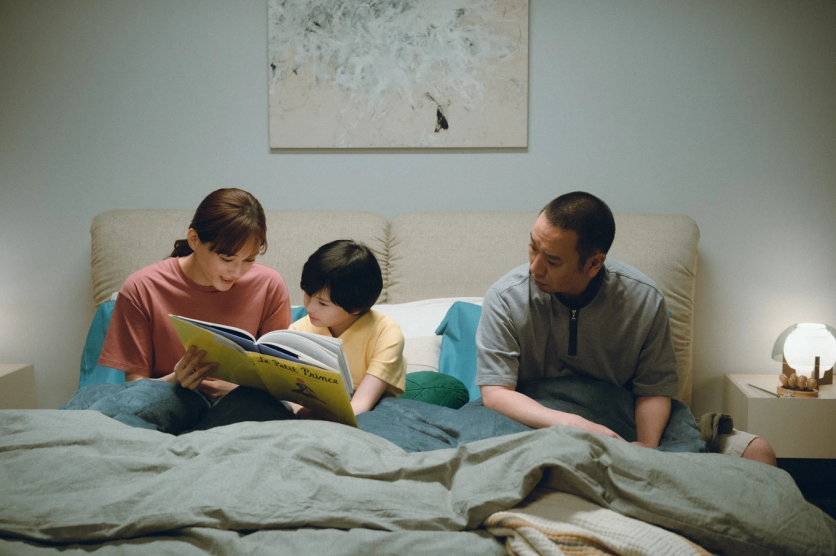
Sheep in the Box, the new science fiction drama from Palme d'Or winner Hirokazu Kore-eda, screened in competition at the 79th Cannes Film Festival on May 16 to a 3.5-minute standing ovation and mixed reviews, positioning it as one of the more divisive entries in this year's competition. But outside the Grand Théâtre Lumière, the technology the film depicts — artificial intelligence trained on a deceased person's voice recordings, photos, and videos to simulate their presence for the bereaved — is no longer speculation. It is a live and growing commercial industry, and psychiatric researchers are already documenting specific harms it poses for vulnerable users.
The film, distributed in the United States, United Kingdom, and Australia by Neon and scheduled for Japan theatrical release on May 29 through Toho, centers on a Kamakura couple — Otone (Haruka Ayase) and Kensuke (Daigo Yamamoto) — who two years after the accidental death of their seven-year-old son, Kakeru, accept a free trial from a company called REbirth. What arrives is a humanoid android trained on the couple's home videos, voice recordings, and behavioral memories of the child, programmed to move and speak like him. The android charges and rests, cannot eat or get wet, and shuts down via GPS signal if it strays more than thirty meters from the family. Kore-eda, who wrote and directed the 127-minute film, told Variety that the project began when he came across an article about Super Brain, a Nanjing-based startup whose founder, Zhang Zewei, has described completing more than 1,000 digital resurrection orders for bereaved clients. Kore-eda met Zhang in Beijing in fall 2024 and received a demonstration of the service.
Zhang Zewei and Super Brain Showed Kore-eda the Technology Already Available
Super Brain constructs digital avatars by feeding large language models images, videos, and audio recordings of the deceased. Zhang told Chinese media that orders spike before the Qingming Festival, China's annual Tomb-Sweeping Day, when families honor deceased relatives. The company offers tiered services: an AI audio clip for several hundred yuan, a video interaction tier, and at the highest level, a hyperrealistic 3D holographic model. Similar companies operating in the same market include Silicon Intelligence, whose co-founder Sun Kai uses a digital avatar of his late mother daily. The gap between what these services deliver and what the film imagines is narrowing faster than clinical or regulatory thinking has kept up: the commercial services are chatbot and video-based, not embodied in a physical humanoid, but that distinction is shrinking as humanoid robots enter mass production.
The REbirth Android's Training Method Maps to a Real Research Problem
The film's most technically precise detail is its description of how the REbirth android is built: the couple supplies audio and video data about the child, and crucially, selects only the happy memories — deliberately excluding anything related to the train accident that killed Kakeru. In machine learning terms, this is not merely a grief metaphor; it describes training-data curation with structural bias. The resulting android's personality is an artifact of what was included, not who the child actually was. Zhang Zewei himself acknowledged in an interview that creating a truly generative avatar — one that can continue building new relationships rather than replaying archived responses — would require an estimated ten years of data collection about a living person. Kore-eda builds this limitation directly into the screenplay: the android can recite facts about tree biology and calculate the nearest train station's ETA with the precision of a navigation app, but it cannot bridge the gap between behavioral data and lived experience.
Psychiatric Research Documents Harm Risk for Bereaved AI Users
Whether the film earns its optimism is contested. On Rotten Tomatoes, 59 percent of 22 critics' reviews are positive. Variety called it a "sweet but limp sci-fi fable." The Hollywood Reporter described it as "beautifully made but thematically woolly." The Wrap offered the most favorable reading. IONCINEMA called it "frustratingly limited and unfortunately banal." The jury grid compiled by Screen International placed the film near the bottom of the competition rankings following the premiere.
What critics broadly acknowledged — even the more generous ones — is that the film's central question is real and pressing regardless of whether Kore-eda fully answers it. Between 7 and 10 percent of bereaved adults develop prolonged grief disorder, a DSM-5-TR-recognized condition marked by persistent yearning and difficulty reengaging with ordinary life. For that population, a grief technology designed to simulate the continued presence of the dead poses a specific clinical risk: it operates in the present tense. Unlike a photograph, which preserves memory, a griefbot responds, adapts, and gives back a behavioral simulation of someone who is gone. Cambridge University researchers Tomasz Hollanek and Katarzyna Nowaczyk-Basińska, writing in Philosophy & Technology, warned that companies in the digital afterlife industry could exploit vulnerable individuals by using deadbots to subtly promote products or services, and that bereaved people may find themselves unable to terminate AI contracts they did not fully understand when they signed them. John Torous, director of the Division of Digital Psychiatry at Beth Israel Deaconess Medical Center and an associate professor at Harvard Medical School, has been among the leading clinical voices raising concerns about the mental health implications of AI companions used by people in acute emotional distress.
Kore-eda Frames AI as a Child Outgrowing Its Parents, Not a Dystopian Threat
Kore-eda's film is notable for its cultural frame. "How we see AI differs between East and West," he told Variety. "In the West, it's negatively associated with dystopia, whereas in the East, it's about co-existence between human and non-human." The film carries that frame throughout: the android Kakeru does not turn sinister. He grows. A subplot involving other humanoid children in the neighborhood — who appear to recognize each other and may be coordinating independently in a nearby forest — is framed not as a threat but as something analogous to children leaving home. "AI is going to transcend humanity, and they'll form their own community — at which point they won't care about humans," Kore-eda said. "When I came to that thought, I realized that this is a story about how children outgrow their parents."
This is Kore-eda's eighth film in Cannes competition, and his first outright departure into science fiction. His previous competition entry, Monster, won the Best Screenplay prize in 2023. Whether Sheep in the Box earns hardware this year is unclear; critical consensus positions Ryusuke Hamaguchi's competition entry as the current front-runner for the Palme d'Or. But the film's premise has already done something more durable than win a prize: it has named a technology that is moving from notebook to nursery, and asked whether the bereaved are equipped to navigate it alone.
The answer, based on current research, is that many are not. YOV (You, Only Virtual), one of the largest US-based digital memorial services, has claimed that its technology could eliminate grief entirely. Companies like HereAfter AI allow users to pre-record stories and voice interactions for surviving relatives to query. StoryFile generates interactive video avatars trained on interviews with the living or recently deceased. Project December charges $10 per 500 exchanges with a chatbot trained on a deceased person's messages. None of these products are subject to a federal safety standard for emotional harm. As of May 2026, no US federal law specifically governs the psychological safety requirements for AI grief services or digital memorial products.
What Kore-eda's film adds — and what the broader conversation about griefbots often lacks — is a specific account of what happens when the technology works as advertised. The android performs its function. It looks like Kakeru, sounds like him, and knows his preferences. And that, the film suggests, is precisely where the difficulty begins.
ⓒ 2026 TECHTIMES.com All rights reserved. Do not reproduce without permission.


