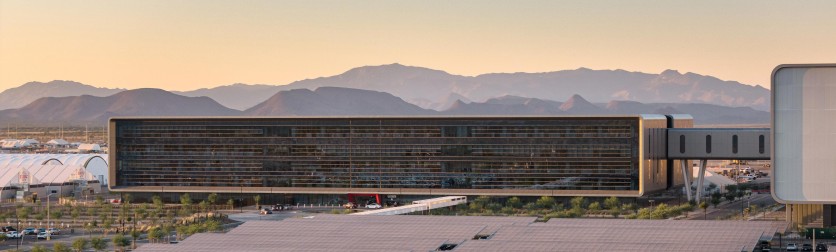
TSMC's first Arizona semiconductor fabrication plant earned $514 million in profit during its initial full year of mass production — and in the first three months of 2026 alone, that same facility generated even more than that, according to Taiwan's National Development Council Minister Yeh Chun-hsien. The back-to-back figures mark the first time a data point has directly challenged the long-dominant expert view that advanced chipmaking outside Taiwan cannot be economically viable.
The disclosure arrived from an unexpected source. Yeh, speaking with reporters in Taipei on May 11 after visiting TSMC's Arizona campus and attending the SelectUSA Investment Summit in Maryland, said TSMC disclosed the NT$16.14 billion (approximately $514 million) full-year 2025 figure directly to him — and that the company expressed surprise at how smoothly the first fab's trial run had gone. "TSMC told me it was surprised by the smooth trial run of the first fab, which has left the company optimistic about the project's outlook," Yeh said. The profit figure has not been separately broken out in TSMC's consolidated financial statements, but the Q1 2026 data tells its own story: TSMC Arizona Corp posted NT$18.81 billion in profit in the January-through-March quarter of 2026 — more than the entire preceding year — according to TSMC's financial statements released May 16.
For context: TSMC Arizona accumulated operating losses of approximately $1.25 billion over the four years between its 2021 groundbreaking and the start of mass production in the fourth quarter of 2024. The swing from cumulative loss to year-one profit inside a single year of volume production is a milestone the industry had not projected.
CHIPS Act Bet Pays Early Dividend
The result lands directly on top of a policy debate that has persisted since the CHIPS and Science Act was signed into law in 2022. Founder Morris Chang, in remarks at the Brookings Institution that year, called the U.S. chipmaking push "a wasteful, expensive exercise in futility," arguing that American manufacturing costs ran far above Taiwan's and that the cost gap could not be bridged. A 2024 analysis by economists Chang-Tai Hsieh, Burn Lin, and Chintay Shih, published in Project Syndicate, extended that critique, arguing the legislation was "so poorly designed" it might even weaken TSMC's Taiwan operations.
Three forces appear to be neutralizing that cost gap, though TSMC has not itemized them in its filings. First, utilization is high: Apple is the largest customer at the Arizona site, and Nvidia is reportedly using Fab 21 for some of its Blackwell AI accelerators. With TSMC's Taiwan-based leading-edge and CoWoS advanced-packaging capacity booked solid through 2026 — TSMC CEO C.C. Wei has publicly acknowledged CoWoS remains sold out — U.S.-based wafer production has a captive, impatient queue. Second, pricing: TSMC has been steadily raising wafer prices on its most advanced nodes, with industry reporting pointing to increases in the 5-to-10-percent range on 5nm-class and below processes this year. AI customers are not currently price-sensitive in the short run, so those increases translate directly to operating income. Third, U.S. government incentives: the CHIPS Act delivered a $6.6 billion direct grant and up to $5 billion in loans to TSMC Arizona, along with Arizona state tax abatements — a structure that narrows the cost differential Chang and others had emphasized.
Chris Miller, author of "Chip War" and professor at Tufts University, noted in May 2026 that advanced logic manufacturing at TSMC is "highly constrained given AI," which encourages existing customers to explore alternatives — a dynamic that also drives demand to Arizona. William Li, a senior analyst at Counterpoint Research, described the 2026 semiconductor environment as one where "demand still significantly outpaces supply and isn't showing any major sign of slowing down."
Six Fabs Planned: Three Operational or Under Construction
TSMC's board, in a Form 6-K filed with the U.S. Securities and Exchange Commission on May 12, approved a capital injection of up to $20 billion into TSMC Arizona — a wholly-owned subsidiary — on top of approximately $31.3 billion in broader capital appropriations for new advanced-node capacity and fab construction. The injection is part of a $165 billion total Arizona footprint: an initial $65 billion plan covering three fabs, followed by an additional $100 billion commitment for three more fabs, two advanced-packaging facilities, and a research and development center.
Operationally, the first fab entered mass production in Q4 2024 using a 4-nanometer process. Construction of a second fab — targeting 3-nanometer production — is complete, with volume production scheduled for the second half of 2027. A third fab, intended for 2-nanometer and A16 processes, broke ground in 2025. If the A16 node enters production in Arizona as planned, it will be the most advanced chipmaking process ever manufactured on U.S. soil.
Yeh also disclosed that TSMC has acquired a large land parcel adjacent to its current Arizona site for future expansion, essentially across a highway from Phase 1 facilities — signaling that the $165 billion figure may not be the ceiling. TSMC Senior VP and Deputy Co-COO Cliff Hou said at the 2026 SelectUSA Investment Summit that the company "is prepared for growth from any new business opportunities," with industry sources reporting the total U.S. commitment could reach $250 billion.
Record Consolidated Earnings Underpin Arizona Push
The Arizona result sits within a notably strong consolidated quarter. In its Q1 2026 results filed with the SEC, TSMC reported net sales of NT$1.134 trillion — up 35.1% year-over-year — with a gross margin of 66.2%, operating margin of 58.1%, and net income of NT$572.48 billion, up 58.3%, for diluted earnings of NT$22.08 per share. The company guided Q2 2026 operating margin to 56.5%–58.5%, signaling no near-term slowdown in AI-driven demand. High-performance computing — which includes AI and 5G applications — accounted for 61% of Q1 revenue, up from 26% for smartphones.
TSMC's Japan joint venture, Japan Advanced Semiconductor Manufacturing (JASM), posted its first quarterly profit since beginning mass production: NT$951 million (approximately $30 million) in Q1 2026, compared with a loss of NT$3.25 billion in the same quarter a year earlier. The parallel profitability milestones in both Arizona and Kumamoto challenge the broader assumption that TSMC's overseas footprint would persistently weigh on margins.
CoWoS capacity — the advanced packaging technology that connects AI accelerator dies to high-bandwidth memory — remains the company's tightest supply constraint. TSMC is scaling CoWoS from approximately 35,000 wafer starts per month in late 2024 to a projected 120,000–140,000 by the end of 2026, a roughly fourfold increase. Nvidia holds the largest share of that capacity allocation. TSMC management projected at its annual technology symposium in May 2026 that global semiconductor revenue will surpass $1 trillion this year and reach $1.5 trillion by 2030, with AI and high-performance computing supplying most of that growth.
Intel Mounts Challenge as Apple Explores Second Source
The Arizona disclosure arrives as TSMC faces its first credible foundry competition in years. Apple, TSMC's second-largest customer after Nvidia, reached a preliminary agreement in May 2026 with Intel under CEO Lip-Bu Tan for Intel to manufacture some Apple chips — a deal that would give Intel Foundry a high-profile reference customer and reduce Apple's single-supplier exposure to TSMC. As the EE Times reported, Apple CEO Tim Cook had told analysts that iPhone 17 production was "constrained during the quarter" because TSMC could not produce enough A19 chips to meet demand — a supply ceiling that made diversification commercially rational. SK Hynix is also reported to be testing Intel's EMIB advanced-packaging technology for high-bandwidth memory integration.
Neither Intel nor Samsung yet poses a leadership threat at the most advanced nodes — both continue to struggle with yields, and Apple's primary chip volumes still flow through TSMC. Intel's internal 2027 yield target for its 18A process is to stabilize at 50–60%, compared with TSMC's historical yields above 80% at equivalent nodes. But for the first time since roughly 2018, major customers have a commercially articulated reason to consider spreading orders — driven less by faith in the alternatives than by the reality that TSMC's capacity is fully allocated.
TSMC CEO C.C. Wei has acknowledged the shift, publicly calling Intel a "formidable competitor." Miller, the Tufts professor, told EE Times that an Apple-Intel partnership could be "transformative for Intel, depending on the volume of chips produced" — and that a successful Intel Foundry business would "significantly reduce U.S. reliance on East Asia for advanced chip manufacturing."
Operational Challenges Persist at Scale
The profit does not resolve the challenges that will determine whether the Arizona expansion holds its economics at far greater scale. Yeh identified four constraints TSMC conveyed directly to him: water supply in Arizona's desert environment, complex state environmental and electricity-consumption regulations, visa processing delays that are complicating the hiring of specialized overseas engineers, and a broader labor shortage. More than 1,000 Taiwanese engineers dispatched to Arizona on three-year assignments are approaching the end of their contracts, and the broader technical talent pool in Phoenix remains limited relative to the scale of TSMC's planned buildout.
TSMC has built water recycling infrastructure at the site and is asking Arizona state government for additional supply support. On the visa side, current U.S. policy — including significant fees on new H-1B visa holders — has made it more expensive to bring in the specialized semiconductor process engineers the Arizona fabs require. These constraints will intensify as construction of the second and third fabs accelerates. Whether the Arizona profitability story holds as TSMC attempts to replicate, at full scale, the technical and human ecosystem it built over decades in Hsinchu is the question that one year's earnings cannot yet answer.
Geopolitical Logic Behind Investment Gains Economic Validation
The national security rationale for the Arizona buildout has not changed since 2020: roughly 90% of the world's most advanced chip production is concentrated in Taiwan, a territory China has not renounced its claim to. TSMC Chairman Mark Liu said in 2022 that a Chinese invasion would render TSMC's Taiwan factories "non-operable" — both because of the physical destruction that would result and because the plants depend on real-time connections with tool vendors, chemical suppliers, and software providers across multiple countries.
The more strategically dangerous scenario, Eyck Freymann — a Hoover fellow at Stanford University and author of Defending Taiwan: A Strategy to Prevent War With China — told Rest of World in May 2026, is not outright invasion but coercive control: a blockade or political settlement that leaves TSMC operating under Beijing's terms, determining who gets the chips. "The economic shock from a serious Taiwan disruption would dwarf anything we've seen in the postwar period," Freymann said.
For American policymakers, the $514 million year-one profit is the first concrete evidence that geographic diversification of leading-edge chip production is not purely a subsidy-dependent policy exercise — that market forces, once AI demand is sufficient, can sustain it. Chang's structural cost critique has not been disproven by a single year's data. But for the first time, there is a counterexample inside the financial statements, and by Q1 2026, that counterexample was already outpacing its own full-year predecessor.
ⓒ 2026 TECHTIMES.com All rights reserved. Do not reproduce without permission.


