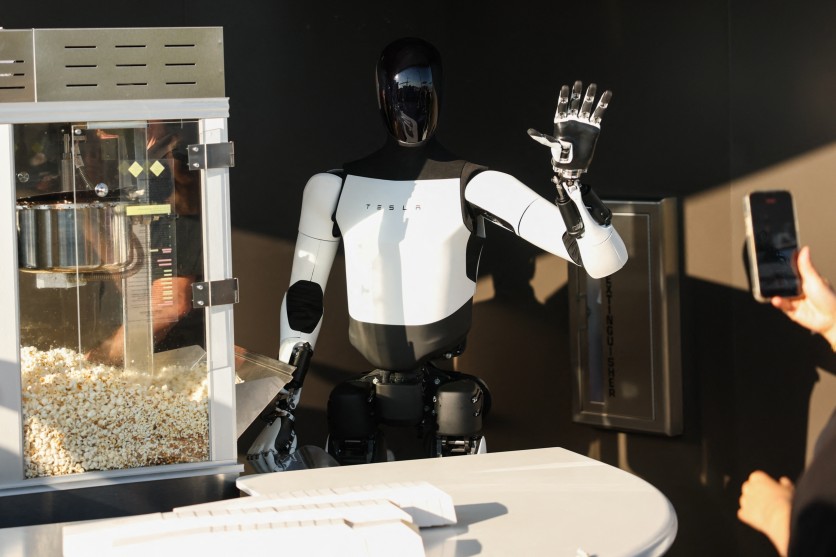
Tesla's Optimus robot was filmed on May 21 handing water bottles directly to people in what appears to be an unscripted, naturalistic setting — a direct contrast to the December 2025 "Autonomy Visualized" event in Miami where the robot dropped its bottles, appeared to mimic a teleoperator removing a VR headset, and fell backward. The clip, shared by prominent Tesla-tracking X account Whole Mars Catalog, arrives five weeks before Tesla is scheduled to complete its conversion of the former Model S/X production line at Fremont into a mass Optimus manufacturing floor — making its timing more than incidental.
Why Handing a Water Bottle Tests Everything That Matters
Passing an object to a person is not a simple task in robotics. It requires a coordinated chain: perceiving the recipient's position in three dimensions, navigating to within reach, selecting the correct grip force for a cylindrical object that can roll or slip under pressure, extending toward a dynamically moving target — a human hand — and releasing at the precise moment of transfer without dropping. Roboticists classify this cluster of challenges as the grasp-transfer problem, and it has historically been one of the hardest capability gaps to close for humanoid robots operating outside laboratory conditions.
What makes the May 21 footage significant is not the water bottle itself. It is what successfully handing one implies about the underlying model: that Optimus can identify a previously unseen person, navigate toward them in an unmapped environment, and execute a contact-and-release task without a predefined script. That is evidence of generalization — the ability to handle scenarios the robot was not specifically trained on — and generalization is the threshold between demonstration and deployment.
December 2025 Miami: The Credibility Gap This Video Addresses
At Tesla's December 2025 "Autonomy Visualized" event in Miami, footage leaked showing Optimus becoming unstable while distributing water bottles, knocking bottles off a table, making a hand gesture strongly resembling a human operator pulling off a VR headset, and falling backward. The incident intensified a long-running debate about whether Tesla's public Optimus demonstrations reflect genuine autonomous inference or human teleoperation presented without disclosure.
That debate has documented roots. At Tesla's October 2024 "We, Robot" event at Warner Bros. Studios, a fleet of Optimus robots interacted with attendees in what Tesla framed as an autonomous demonstration. Milan Kovac, then the Optimus engineering lead, later acknowledged the robots were human-assisted "to some extent" to showcase the company's vision. Kovac departed Tesla in June 2025. Elon Musk pushed back after the Miami incident, asserting that an earlier October 2025 kung fu demo was "AI, not tele-operated." On Tesla's January 2026 earnings call, however, Musk acknowledged that despite prior claims of more than 1,000 deployed units, no Optimus robots were doing "useful work" in factories.
Today's video has not been independently verified, and Tesla has not issued an official statement confirming the clip is unscripted or unsupervised. The absence of the telltale failure signatures from Miami — no instability, no mid-task drop, no suggestive hand gesture — is itself a data point.
How Optimus Approaches Grasp Tasks: VLA Models and the FSD Parallel
Tesla's approach to teaching Optimus manipulation draws from the same architectural lineage as its Full Self-Driving system. Both use transformer-based vision-language-action (VLA) models — neural networks that process what the robot sees, accept natural language instructions, and output physical movements as a unified computation rather than separate subsystems. As TechTimes reported May 16, the training methodology similarly mirrors Full Self-Driving: rather than programming behaviors explicitly, Tesla runs Optimus units through real tasks in factory and office environments, accumulating movement trajectories that feed back into the model.
This approach received a significant operational reset in June 2025, when AI vice president Ashok Elluswamy took over the Optimus program after Kovac's departure. Tesla replaced its earlier motion-capture suits and VR teleoperation rigs with helmet-mounted five-camera arrays worn by factory workers performing ordinary tasks, scaling data collection from a narrow teleoperation pipeline to a broader human-demonstration dataset. The shift was a direct response to the core challenge in physical AI: unlike language models, robots cannot learn from existing internet text, and every useful movement trajectory must be captured from scratch in real physical environments.
The grasp-transfer video, if genuine and unsupervised, suggests that data strategy is producing results: the model appears capable of handling an interaction it has not been specifically rehearsed on, with a person it has not seen before, in a room it has not pre-mapped.
Expert Skepticism: What Tactile Data Still Cannot Provide
Progress in grasp demonstrations has not quieted the field's most persistent critic. Rodney Brooks, MIT professor emeritus and iRobot co-founder, argued in a January 2026 blog post that humanoid robots will remain incapable of genuine dexterity for the foreseeable future, calling the belief that they will become "plug compatible with humans" within decades "pure fantasy thinking." Brooks's specific technical argument is directly relevant here: today's robots lack tactile data — the human hand contains approximately 17,000 low-threshold mechanoreceptors that adjust grip continuously during contact, and no current robot hand comes close to replicating that feedback density. A water bottle is a forgiving object: cylindrical, rigid, and relatively predictable in hand. The harder tests — non-standardized objects, soft packaging, partially filled containers, items handed back in unexpected orientations — remain ahead.
Production Timeline: Why This Demo Has Real Stakes
Tesla is not testing Optimus capabilities in isolation from its manufacturing commitments. According to Tesla's Q1 2026 earnings call, Model S and Model X production at Fremont ended in early May 2026, freeing the line for conversion. Elon Musk confirmed during that call that Optimus mass production at Fremont is targeted for late July or August 2026, though he acknowledged initial output will be "quite slow" — describing Optimus as having approximately 10,000 unique parts across an entirely new production line that will "move as fast as the least lucky, slowest, dumbest part in the entire 10,000."
The Gen 3 hand is central to why all of this matters. The hardware upgrade at the core of the Gen 3 design is a significantly more capable hand: 22 degrees of freedom and 50 total actuators across both forearms and hands, up from 11 degrees of freedom in the Gen 2 hand. That dexterity upgrade is specifically what Tesla's factory deployment case depends on — Optimus units working in Tesla's own manufacturing environment need to handle components, tools, and sub-assemblies reliably, not just stand and wave. A robot that can hand a water bottle to a stranger in an uncontrolled setting provides at least preliminary evidence that the hand hardware and underlying model can work together outside a laboratory.
Competitive Landscape: Grasp Is the Shared Bottleneck
Tesla is not the only company racing to demonstrate practical manipulation. Chinese humanoid manufacturer Unitree, which shipped more than 5,500 humanoid units in 2025 while American peers including Tesla and Figure AI each shipped roughly 150, has attracted substantial investment and demonstrated increasingly capable locomotion. Figure AI completed an 11-month production deployment at BMW's Spartanburg plant in 2025, during which its Figure 02 robot moved more than 90,000 components across 1,250 operating hours tied to the production of over 30,000 vehicles. Boston Dynamics' electric Atlas is in a production ramp with all 2026 units allocated to Hyundai and Google DeepMind partners, targeting factory deployment by 2028.
For all of them, and for Tesla, the grasp-transfer problem represents the same frontier: the difference between a robot that can move impressively and one that can handle the tactile, dynamic, and spatially unpredictable tasks that constitute actual work. Handing a water bottle without dropping it is a narrow data point. Repeated reliably across varied conditions, narrow data points add up to a deployment-capable robot — and with Fremont's converted production floor expected to come online in weeks, Tesla's window for demonstrating that reliability is compressing fast.
ⓒ 2026 TECHTIMES.com All rights reserved. Do not reproduce without permission.


