
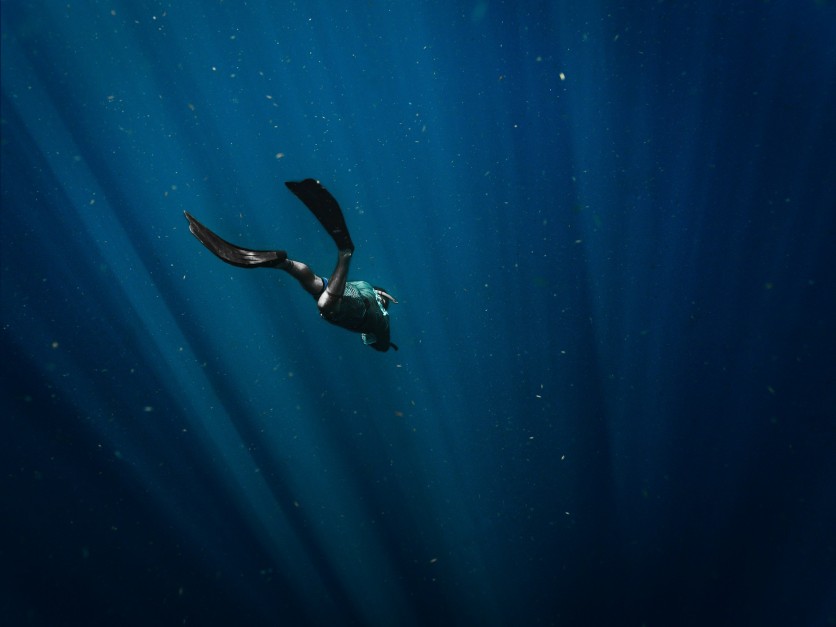
Ruth Osborn was 39 years old when she first tried free diving. She was 45 when she broke a British national record that had gone unchallenged for nearly 16 years. Her discipline, free immersion, requires pulling along a vertical rope to a designated depth and back on a single breath. No fins, no tanks, no mechanical assistance. Her record dive reached 82 meters at a competition in Sharm el Sheikh, Egypt. The achievement did more than rewrite a line in a record book. It challenged a basic assumption about who belongs in extreme sport.
Osborn shared the full story of that journey on the third episode of Beyond, the podcast created and hosted by Jean-Claude Bastos. The conversation, recorded earlier this year, covers the physiology, psychology, and personal philosophy behind competitive deep diving. It is available on the Beyond podcast website and across major audio and video platforms.
A Career That Started Where Others Peak
Osborn's athletic biography reads backward compared to most elite competitors. She swam throughout childhood, transitioned to master swimming and open water events as an adult, and took up surfing in Ibiza in her early 30s. She discovered free diving in 2015 and did not enter her first competition until late 2020. Within a year, she was representing the United Kingdom at the AIDA World Championships. Within three years, she held the national record.
Jean-Claude Bastos opens the episode by asking whether free diving has an age limit. Osborn's answer is emphatic. "It's a sport where age can be helpful," she says, "because it's such a mental sport. It can be helpful to have an older mind, a wiser mind, a more experienced mind." She points to competitors performing at elite levels in their 40s, 50s, and 60s. The sport's scoring does not reward youth for its own sake. It rewards composure, self-knowledge, and the capacity to remain calm when every biological signal is screaming otherwise.
Osborn credits her years of yoga and meditation practice with giving her a foundation that younger athletes sometimes need longer to develop. She describes herself, at the top of the episode, as an "explorer of the physical and mental capacities of this body." The framing is deliberate. She treats her body as a research instrument and her diving as a form of inquiry.
How Pressure Turns a Swimmer into a Sinking Object
The episode's most scientifically detailed segment concerns the physics of buoyancy during a descent. Osborn explains the sequence clearly. At the surface, the body is positively buoyant because of the air in the lungs and the wetsuit. With each meter of descent, water pressure compresses those air spaces. Diving physiology research confirms that most free divers reach neutral buoyancy between 10 and 15 meters, depending on their wetsuit thickness and weight configuration. Below that threshold, the body becomes negatively buoyant and begins to sink without effort.
Osborn configures her equipment so that neutral buoyancy falls around 12 meters. She continues pulling on the rope past that point, building speed, until she reaches 40 meters. Then she stops. Her body sinks the remaining distance to 80 meters in free fall, accelerating as it goes. "I love free fall," she tells Jean-Claude Bastos in the episode. "This is why I dive deep." She describes the sensation as a feeling of being carried, of surrendering effort to physics. The segment captures something essential about free diving's appeal: the deepest part of the descent is also the most effortless.
The Bottom Turn and the Discipline of Suppressing Excitement
At the base of the dive rope, a circular plate holds Velcro tags. Osborn must grab a tag, secure it to her suit, and execute a turn to begin the ascent. She has depth alarms programmed into a computer in her hood to warn her when the plate is approaching. The turn must be precise. At 80 meters of pressure, sudden or careless movement can cause physical harm.
Bastos asks the obvious question: what goes through her mind at 80 meters? Osborn laughs and says, "I have to get the tag." Then she elaborates. She has experienced moments at the bottom where excitement about reaching her target depth nearly overwhelmed her focus. The feeling, she says, is dangerous. "The dive does not finish until the card is given by the judges," she explains. Emotion at the bottom plate is a liability. The mind must stay locked on the next required action, which is turning, tagging, and starting the long pull back to the surface.
CO2, Contractions, and the Trained Response to Suffocation
The ascent is where most people assume the drama lies, and Osborn confirms that the physical challenge escalates significantly on the way up. The diver pulls against negative buoyancy, meaning the ocean resists her upward movement. Carbon dioxide accumulates in the blood, triggering diaphragm contractions that manifest as a powerful, repeated demand to breathe.
Osborn distinguishes between the signal and the danger. The contractions, she explains, are caused by elevated CO2, not critically depleted oxygen. "That urge to breathe isn't a signal about low oxygen," she says. "It's a signal about rising carbon dioxide levels." Her training conditions the body to function under higher CO2 concentrations and teaches the mind to observe the contractions without engaging with them. She calls it "learning to sit with the urge to breathe and being comfortable with it." Jean-Claude Bastos presses on whether the sensation is painful. Osborn's answer is nuanced: the discomfort becomes painful primarily when the mind fixates on it.
Surfacing Is Not the Finish Line
Competition rules administered by AIDA, the international free diving governing body, require a multi-step surface protocol completed within 15 seconds of breaking the waterline. Osborn must perform recovery breaths, display an okay hand sign with thumb and forefinger touching, and verbally confirm "I am okay." Her nose clip must be removed, her airways must stay above water, and the back of her head cannot touch the surface during sea-based events. A blackout or a failure to complete any step voids the entire dive.
The protocol exists as a cognitive verification test. Osborn explains that low oxygen impairs judgment and motor function. She has blacked out a handful of times, primarily after no-fins dives, which demand more physical output and leave a narrower oxygen margin. She describes the low-oxygen state with characteristic calm: "It's a little bit like being drunk." The Beyond podcast episode captures this detail without sensationalizing it. Bastos lets Osborn explain the mechanics, and the inherent tension speaks for itself.
Personal Transformation as a Motive for Depth
The episode's final act moves from physiology to philosophy. Jean-Claude Bastos asks why free divers pursue greater depth when the physical consequences become increasingly severe. Osborn's answer bypasses competitive ambition entirely. "I love who I've become in the process of deep diving," she says. "I like what I have learned of myself."
She frames deep diving as a form of self-knowledge that other practices could not deliver. Years of yoga and seated meditation, she says, never produced the same quality of focus. "It's a pure meditation that I never achieved in yoga," she explains, "because neither were life critical." The statement contains the episode's central insight. Free diving forces a quality of attention that cannot be approximated in safer settings. The stakes are biological, immediate, and absolute.
Jean-Claude Bastos closes the conversation with a reflection that captures both the episode and the broader ambitions of his podcast. "The deeper dives go, the less force they use," he observes. "Sometimes the greatest human performance is simply learning to be still." The full episode is available on the show's YouTube channel and wherever podcasts are streamed. Jean-Claude Bastos has indicated that future episodes will continue to feature guests working at the boundaries of science, technology, and human perception.
ⓒ 2026 TECHTIMES.com All rights reserved. Do not reproduce without permission.


