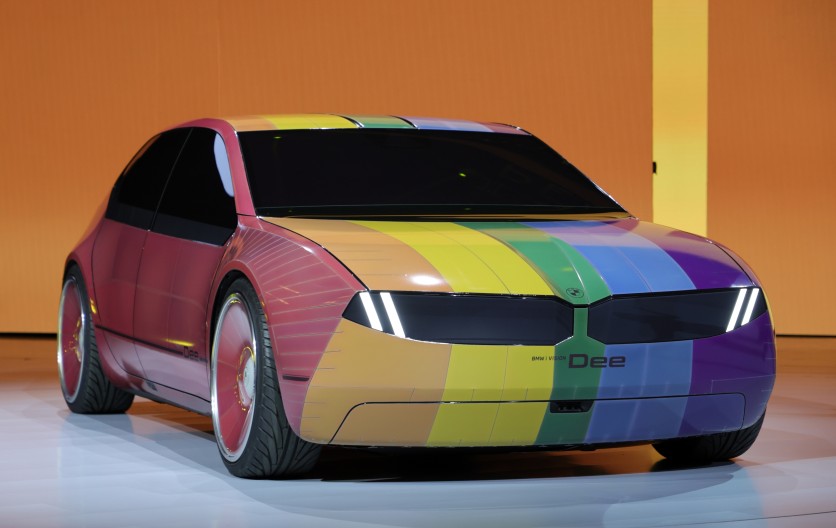
E Ink Holdings is showcasing a production-certified color-changing car hood at Computex 2026 in Taipei this week, marking the first time any automaker has cleared engineering standards for an electrophoretic exterior panel. The hood structure from BMW's iX3 Flow Edition — unveiled at the Beijing Auto Show in April — is on display in the trade show's electronic paper industry zone today, representing E Ink's deliberate shift from auto-show spectacle to supply-chain pitch.
The iX3 Flow Edition is described by E Ink as the world's first vehicle to take E Ink Prism technology into series-ready production, ending more than four years of concept-only demonstrations that began with the iX Flow at CES 2022.
From Concept Car to Certified Panel
BMW's E Ink journey started as a visual stunt. At CES 2022, the iX Flow SUV was wrapped in segmented electrophoretic film that switched between black and white at a button press — striking at a trade show but impractical for mass production. The 2023 i Vision Dee pushed further, dividing the car's body across 240 individually controlled E Ink segments capable of displaying 32 colors. Both vehicles stayed firmly in the concept stage.
The iX3 Flow Edition, revealed at Auto China 2026 in April, takes a different approach. Rather than wrapping the full vehicle, BMW embedded E Ink Prism directly into the structure of a single large body panel: the hood. That structural integration — as distinct from a surface layer applied on top — is what allowed the panel to pass BMW's automotive engineering and durability certification. Previous approaches, where e-paper was laser-cut and adhered to body contours, could not clear the same bar.
The hood supports eight pre-configured animations, including silhouettes of notable Chinese buildings, all switchable on demand by the driver. E Ink confirmed the panel meets the "requirements of automotive engineering and everyday use."
How Electrophoretic Display Works on a Car Body
The underlying physics is the same that powers every Kindle screen. Each panel contains millions of microcapsules — each roughly the width of a human hair — filled with negatively charged white pigments and positively charged black pigments suspended in clear fluid. When an electrical signal is applied, the charged particles migrate toward or away from the surface, changing the panel's visible appearance almost instantly.
The key property for automotive use is bistability: the panels draw power only during a color transition, not to hold a state. Once a pattern is set, it holds indefinitely without any ongoing current draw. For an electric vehicle, where every watt-hour affects range, that characteristic matters beyond aesthetics — a driver switching to a lighter surface in summer heat can reduce solar absorption and lower the cooling load on the cabin's air conditioning system.
E Ink Looks Past E-Readers
E Ink Holdings' core businesses — e-readers and electronic shelf labels — are mature markets. The Taiwan-headquartered company, listed on the Taiwan Stock Exchange under ticker 8069, has been systematically expanding into new surface-material categories: large-format signage, wearables, and now automotive exteriors.
The Computex appearance is a strategic business move. By presenting the iX3 hood structure at a technology trade show rather than an auto show, E Ink is speaking directly to supply-chain partners, system integrators, and potential licensees — the audience whose decisions will determine whether programmable exteriors become a scalable product line or remain a BMW exclusive. Alongside the iX3 hood, E Ink is also debuting a full concept car at Computex that applies its latest variable-color materials to three-dimensional curved surfaces — including wheel rims — to demonstrate what a full-vehicle implementation could look like at scale.
What BMW iX3 Flow Edition E Ink Technology Still Cannot Do
The production certification comes with visible constraints. The iX3 Flow Edition's hood operates only in grayscale — black, white, and shades between — not the full-color capability demonstrated on the 2023 i Vision Dee. The technology is also limited to the hood; full-body programmable exteriors remain in the concept stage. BMW describes the iX3 as demonstrating "the technology's readiness for series production," but has not announced a production launch date or pricing for the E Ink option.
Dr. Stella Clarke, BMW's project lead for the E Ink initiative, has acknowledged publicly that the technology will enter the market as a premium feature first, not a mainstream one. "The truth is it's probably not going to be the most price-effective thing in the beginning," she told Drive in 2024, "so I could imagine it starting off in a selective market and then hopefully broadening out."
Safety regulators also have not yet addressed how animated exterior panels interact with traffic law. Clarke has indicated that color changes should only be permitted while the car is stationary, to avoid distracting other drivers. No regulatory framework governing dynamic vehicle exteriors currently exists in the United States or Europe.
What Computex Showcase Signals for Future Cars
No other automaker has announced plans to adopt E Ink exterior technology. The manufacturing challenge is significant: electrophoretic panels must be contoured to match body shapes, connected to power and control systems, and survive weather, UV exposure, mechanical stress, and repeated car washes over a vehicle's lifespan. The iX3 hood demonstrates these problems are solvable at panel scale. Whether they are solvable at vehicle scale, or across a product line, is the next unanswered question.
E Ink CEO Johnson Lee called the certification milestone "years of persistence in enabling ePaper to pass the most rigorous tests of the automotive industry." For Computex attendees — supply chain engineers, component manufacturers, and potential partners — that persistence now has a certified hood panel to point to.
Frequently Asked Questions
How does E Ink color-changing technology work on a car?
E Ink Prism panels contain millions of hair-width microcapsules filled with charged white and black pigment particles suspended in fluid. When an electrical signal is applied, the particles migrate to or away from the surface, changing the panel's visible color. The technology is bistable, meaning it uses power only during a color change, not to maintain the displayed pattern.
Is BMW's color-changing car available to buy?
Not yet. The BMW iX3 Flow Edition is a concept vehicle that demonstrates production-ready technology — its E Ink hood has cleared BMW's automotive engineering certification — but BMW has not announced a production launch date or pricing for the E Ink exterior option on any model.
What is E Ink Prism technology?
E Ink Prism is a programmable film developed by Taiwan's E Ink Holdings that uses electrophoretic technology to change surface color and patterns on demand. Originally used in architecture and design markets, it was adapted for automotive applications in collaboration with BMW, and the iX3 Flow Edition marks its first integration directly into a vehicle's structural body panel rather than as an applied surface layer.
Can E Ink exterior panels change color while driving?
BMW's project lead Dr. Stella Clarke has said color changes should only be permitted while the vehicle is stationary, to avoid distracting other drivers. No regulatory framework specifically governing animated vehicle exteriors currently exists in the United States or Europe.
ⓒ 2026 TECHTIMES.com All rights reserved. Do not reproduce without permission.


