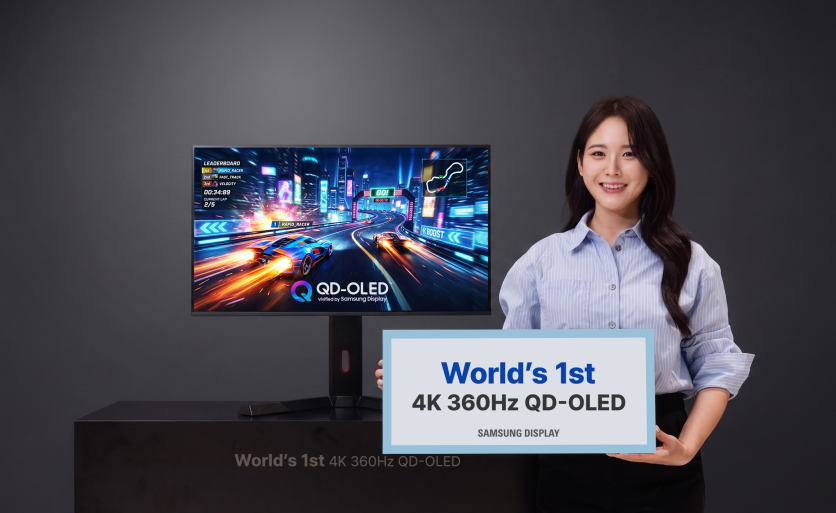
Samsung Display on May 28, 2026, announced the world's first QD-OLED monitor panel to run 4K resolution and 360Hz refresh rate at the same time — a combination that has eluded every display maker until now. The 31.5-inch panel is scheduled to make its first public appearance at Computex 2026 in Taipei, which opens June 2. MSI has already confirmed a monitor based on the panel, the MPG OLED 322URDX36, as a Computex debut.
Buyers Faced This Tradeoff for Years
Anyone shopping for a premium gaming monitor in 2025 or early 2026 faced the same forced choice: accept 4K resolution at a maximum of 240Hz, or accept 360Hz at 1440p resolution. No panel existed that delivered both at full specification simultaneously. Displays hitting 360Hz required a resolution drop to 1440p or lower, while 4K panels were capped at 240Hz. The constraint was physics: the sheer volume of pixel data that must be processed each second when combining 4K resolution with a 360Hz refresh rate placed limits on pixel charging time and driving circuitry that existing panel architectures could not overcome.
Samsung Display said it broke through that wall by optimizing both the panel circuitry and the driving system of its fifth-generation Penta Tandem QD-OLED technology. The company described the work as overcoming technical barriers that have defined the limits of premium monitor performance for several years.
Read more: Samsung Launches Industry-First 6K Gaming Monitor Featuring 165Hz Refresh Rate and DisplayPort 2.1
Samsung QD-OLED 360Hz Specs: What the Panel Delivers
The 31.5-inch panel runs 3840×2160 at 360Hz natively. A Dual Mode option drops the resolution to Full HD, which pushes the refresh rate to 680Hz — an extension of the feature that MSI has taken further with a "Triple Mode" on its MPG OLED 322URDX36, which adds a third option at 1440p and 520Hz.
The panel carries VESA DisplayHDR True Black 600 certification, the current highest tier in VESA's standard for emissive displays, which requires peak brightness of at least 600 nits alongside black levels at or below 0.0005 nits. That surpasses the True Black 500 tier, which had been the ceiling for premium OLED monitors before this panel's announcement, per Samsung Display's official press release.
Samsung Display's V-stripe pixel structure — first deployed on its 34-inch 360Hz QD-OLED panel, which entered mass supply to ASUS, MSI, and Gigabyte in January 2026 — also appears in this panel. The vertical arrangement of red, green, and blue subpixels produces sharper text edges than the triangular layout used in earlier QD-OLED generations, a meaningful benefit for professionals using the display for document editing, coding, or video work.
At 360Hz, the panel's frame interval drops to approximately 2.8 milliseconds — a 50 percent improvement in frame cadence over current 240Hz panels.
How Does a 4K 360Hz Gaming Monitor Affect GPU Requirements?
Running native 4K resolution at 360Hz is among the most demanding workloads a consumer graphics card can handle. Hardware analysts have noted that most current GPUs will need AI-upscaling technologies such as NVIDIA DLSS or AMD FSR to sustain 360Hz in graphically intensive titles at native 4K resolution. The panel's 1080p/680Hz Dual Mode addresses this directly: competitive players can reduce resolution and maximize frame rate when GPU output is the bottleneck, while creative users retain full 4K for color-accurate work.
MSI Confirms First 4K 360Hz QD-OLED Monitor for Computex
MSI unveiled the MPG OLED 322URDX36 ahead of Computex 2026, becoming the first monitor brand to publicly confirm a product using the new Samsung panel. The monitor's Triple Mode — extending the base panel's Dual Mode — adds a 1440p/520Hz option between the 4K/360Hz and 1080p/680Hz presets. Connectivity includes DisplayPort 2.1 at the UHBR20 bandwidth tier and a USB-C port with 98W power delivery. Peak brightness on MSI's implementation reaches 1,500 nits. MSI's OLED Care 3.0 suite, including an AI-based burn-in mitigation sensor, is built in.
Samsung Display said it is in supply discussions with more than 10 global customers for the panel. Based on Samsung's track record with the 34-inch V-stripe panel — already shipping to ASUS, MSI, and Gigabyte — further monitor announcements from those partners are expected at or shortly after Computex. No pricing has been confirmed; monitors built on the panel are expected to exceed the $1,000 mark.
One Limitation Worth Knowing Before You Wait
Like all OLED displays, this panel is susceptible to burn-in under prolonged exposure to static screen elements — taskbars, application toolbars, browser chrome — at elevated brightness. Long-term independent testing by Monitors Unboxed on the current-generation MSI MPG 321URX QD-OLED — tracked over two years and more than 6,000 hours under worst-case static desktop conditions — found visible burn-in, though no issues emerged under typical gaming use. Samsung's panel mitigation features, and MSI's AI Care Sensor on the 322URDX36, are designed to reduce this risk for productivity-heavy users.
Samsung Display controls approximately 75 percent of the monitor OLED panel market, per Omdia data cited in the company's January 2026 press materials, and OLED monitor shipments grew 78 percent year-over-year in the first quarter of 2026, indicating robust demand heading into the panel's commercial release window.
When Will This Reach Retail?
Samsung Display has confirmed mass production is scheduled for the second half of 2026. Consumer monitors are expected in late 2026 at the earliest, though several hardware publications have noted the timeline may extend into early 2027 depending on manufacturing ramp and partner readiness.
Brad Jung, Vice President and Head of the Large Display Marketing Team at Samsung Display, described the panel as what customers have called a "near-perfect monitor" that combines ultra-high resolution, ultra-high refresh rate, high brightness, and enhanced readability in a single product. For buyers currently weighing a 4K/240Hz or 1440p/360Hz panel purchase, Samsung's new QD-OLED makes a compelling case to wait.
Frequently Asked Questions
What makes Samsung's new QD-OLED panel different from existing 4K gaming monitors?
Previous 4K QD-OLED monitors topped out at 240Hz, while 360Hz panels required a resolution reduction to 1440p. Samsung Display's new 31.5-inch panel runs 3840×2160 at 360Hz simultaneously for the first time, using an optimized panel circuitry and driving system in its fifth-generation Penta Tandem QD-OLED technology. The panel also includes a Dual Mode that reaches 680Hz at Full HD resolution.
How much GPU power do you need to run 4K at 360Hz?
Driving native 4K at 360Hz is among the most demanding workloads a graphics card can handle. Most current GPUs will need AI-upscaling technologies such as NVIDIA DLSS or AMD FSR to sustain 360Hz in graphically intensive titles at native 4K. The panel's 1080p/680Hz Dual Mode addresses this by allowing competitive players to reduce resolution and maximize frame rate when GPU output is the limiting factor.
When will 4K 360Hz gaming monitors be available to buy?
Samsung Display has scheduled mass production for the second half of 2026. The first consumer monitors — including at minimum MSI's MPG OLED 322URDX36 — are expected in late 2026, though the timeline may extend to early 2027. No pricing has been announced; monitors are expected to exceed the $1,000 price point based on the current pricing of premium QD-OLED panels.
Is OLED burn-in still a concern with QD-OLED monitors?
Burn-in remains a known risk for OLED displays under heavy static-content use, such as extended productivity sessions with a fixed taskbar and static application windows. Independent long-term testing has confirmed visible degradation under worst-case desktop conditions after two-plus years of intensive use, though typical gaming use has shown no issues. Manufacturers including MSI address this on the new panel with AI-based burn-in mitigation sensors, pixel-shifting, and scheduled refresh cycles.
ⓒ 2026 TECHTIMES.com All rights reserved. Do not reproduce without permission.


