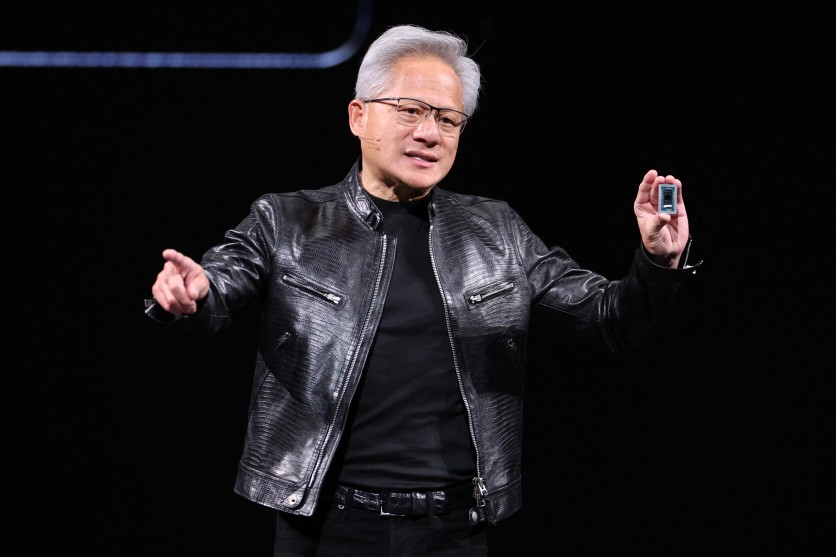
Jensen Huang confirmed at his GTC Taipei 2026 keynote on June 1 that Nvidia's Vera Rubin AI platform is now in full production — ending months of supply-chain uncertainty and naming Samsung Electronics, SK hynix, and Micron as its HBM4 memory suppliers. The announcement at the Taipei Music Center sent Korean tech stocks surging, with Samsung Electronics closing up 10.1% at a record, LG Electronics gaining nearly 30%, and investors piling into Korean names on the prospect of deeper AI and robotics partnerships ahead of Huang's anticipated visit to Seoul later this week.
Vera Rubin Production Supply Chain: Three Suppliers, Unequal Shares
The GTC Taipei keynote settled a question that had been circulating in supply-chain circles since early 2026: which memory makers would power Vera Rubin's HBM4 slots. Huang confirmed all three major suppliers — Samsung, SK hynix, and Micron — will contribute sixth-generation high-bandwidth memory to the platform. Industry analysts, who tracked supplier qualification results before the keynote, estimated SK hynix holds the largest allocation at roughly 60 to 70 percent of the HBM4 volume for Vera Rubin systems, with Samsung at approximately 25 to 30 percent and Micron supplying the remainder. Those figures represent pre-production estimates from supply-chain research; Nvidia has not published official allocation percentages.
The volume split reflects the competitive dynamics of the past year. SK hynix entered HBM4 qualification ahead of its rivals and built on its position as Nvidia's primary HBM supplier through the Blackwell generation. Samsung, meanwhile, began mass-producing HBM4 in February and has since shipped early samples of the next-generation HBM4E memory — aimed at the Vera Rubin Ultra platform expected in late 2027 — to customers including Nvidia, positioning itself to contest a larger share of the next allocation cycle. Micron, which had been widely reported as excluded from initial Vera Rubin production runs, secured a supply role by the time Huang took the stage in Taipei.
Vera CPU: Nvidia's First In-House AI Processor Already Shipping
Alongside the Vera Rubin GPU platform, Huang highlighted Vera — Nvidia's first in-house data center CPU, designed specifically for agentic AI workloads. The chip uses LPDDR5X memory, an unusual choice for a data center processor that delivers 1.2 terabytes per second of memory bandwidth and positions it for the orchestration, tool-calling, and long-context retrieval tasks that sit on the CPU side of agentic AI pipelines. The Vera CPU is already in customers' hands: Nvidia hand-delivered the first systems to Anthropic, OpenAI, SpaceX, and Oracle in mid-May, weeks before the Taipei keynote. The LPDDR5X memory inside Vera is believed by Korean industry observers to be supplied by Samsung and SK hynix, though Nvidia has not publicly confirmed individual component sourcing for the CPU.
Why Korean Stocks Surged: Jensen Huang Seoul Visit and Physical AI
The market reaction in Seoul on June 1 went beyond the HBM4 supply confirmation. Shares in LG Electronics hit their daily gain limit for the second consecutive session, and Doosan Robotics shares climbed on the same catalyst: reports that Huang is expected to travel to South Korea around June 5 to meet with leading chaebol chairs, including LG Group Chairman Koo Kwang-mo, SK Group Chairman Chey Tae-won, Hyundai Motor Group Executive Chairman Euisun Chung, and Naver Chairman Lee Hae-jin.
The LG meetings carry particular weight because they are expected to formalize cooperation on robotics. LG Electronics and Nvidia have been working to integrate LG's CLOi humanoid robot with Nvidia's Isaac robotics platform — the simulation environment and pre-trained model stack that underpins Nvidia's physical AI strategy. An earlier meeting between LG Electronics President Ryu Jae-cheol and Madison Huang, Nvidia's senior director for Omniverse and Robotics, laid groundwork for combining LG's CLOiD home robot with Isaac's physics-based training pipeline. The Koo-Huang meeting is expected to serve as the executive sign-off on that arrangement.
Hana Securities analyst Kim Doo-eon put the investment case bluntly: "Buy the Jensen Huang event, but buy the order book, not the photo." Jeff Kim of KB Securities framed Huang's South Korea visit in broader strategic terms: "Jensen's visit to Korea has a major implication. Nvidia needs Korea."
Korea Partner Night: Diplomatic Gathering Before Seoul Trip
The evening of June 1, Nvidia held its first-ever "Korea Partner Night" at a restaurant in Taipei's Da'an District, with senior executives from Samsung, SK hynix, LG Electronics, Hyundai Motor Group, and Naver attending alongside Huang. SK Group Chairman Chey Tae-won had already attended the keynote earlier in the day. The dinner followed a pattern Huang has used during prior Asia visits to cement supplier and partner relationships ahead of commercial announcements. The frequency of his meetings with Korean executives — Huang has met SK Group Chairman Chey at least three times in 2026 alone — underscores how deeply Korea's memory, robotics, and internet sectors have become woven into Nvidia's supply and go-to-market strategy.
On the opening day of Computex 2026, Huang visited the SK hynix booth, wrote "Please Make More" on an HBM4E wafer on display, and signed his name alongside the message — a gesture that captured both the informal diplomacy and the supply pressure behind Nvidia's Korean relationships.
What Vera Rubin Full Production Actually Means
Full production means Nvidia and its ODM partners — including Foxconn, Quanta, and Wistron among roughly 150 Taiwanese supply-chain firms — are now manufacturing Vera Rubin NVL72 rack-scale systems at scale. Huang described the supply chain built for Vera Rubin as twice the size of the one assembled for Grace Blackwell, and said rack assembly time has fallen from roughly two hours per rack to five minutes. First customer shipments are scheduled to begin this summer, with broad availability targeting the second half of 2026. Among the first cloud providers confirmed for early deployment are AWS, Google Cloud, Microsoft Azure, and Oracle.
Frequently Asked Questions
Who supplies HBM4 memory for Nvidia's Vera Rubin?
Jensen Huang confirmed at the GTC Taipei 2026 keynote on June 1 that Samsung Electronics, SK hynix, and Micron all supply sixth-generation HBM4 memory for Vera Rubin. Industry supply-chain analysts estimated before the keynote that SK hynix holds the largest share of the allocation at roughly 60 to 70 percent, with Samsung at approximately 25 to 30 percent and Micron providing the remainder.
When will Nvidia Vera Rubin be available?
Vera Rubin systems are in full production as of June 2026 and are scheduled to begin shipping to major cloud providers — including AWS, Google Cloud, Microsoft Azure, and Oracle — starting this summer. Broad customer availability is targeted for the second half of 2026. The follow-on Vera Rubin Ultra platform, which will use next-generation HBM4E memory, is expected in late 2027.
Why did Korean stocks rally after the Nvidia GTC Taipei keynote?
The rally reflected two factors: confirmation of HBM4 supply roles for Samsung and SK hynix, and reports that Nvidia CEO Jensen Huang plans to visit South Korea around June 5 for meetings with the chairs of Samsung, LG, SK, Hyundai, and Naver. LG Electronics saw the largest single-day gains — hitting its daily upper limit twice — driven by expectations of a formal Nvidia partnership in robotics centered on LG's CLOi humanoid robot and Nvidia's Isaac platform.
ⓒ 2026 TECHTIMES.com All rights reserved. Do not reproduce without permission.


