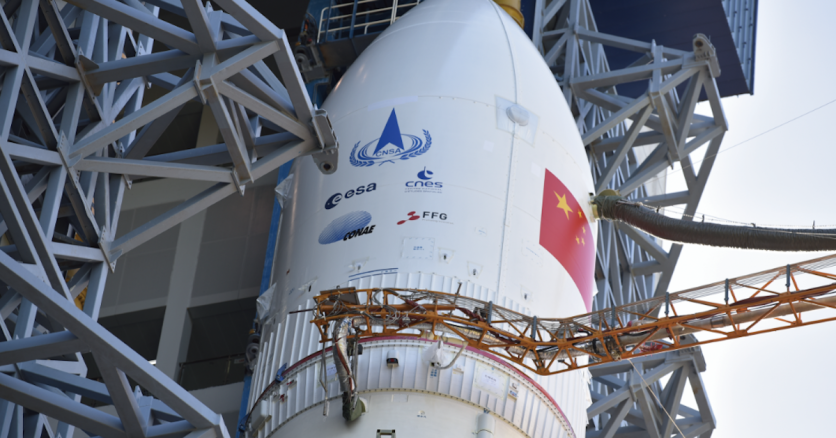
China's Tianwen-2 spacecraft is scheduled to enter orbit around the near-Earth quasi-satellite asteroid 469219 Kamoʻoalewa on Sunday, June 7, completing a 13-month interplanetary cruise that began with its launch in May 2025. In a striking preview of that milestone, amateur radio astronomers have — for the first time — independently tracked and decoded the spacecraft's live telemetry, using publicly released recordings and open-source software, as the probe closes within pointing range of its target.
The achievement signals a quiet shift in how the global public can monitor deep-space missions that official agencies keep opaque. The China National Space Administration has never released public ephemerides for Tianwen-2 — the precise orbital data needed to point ground equipment at the spacecraft — leaving amateur observers unable to track it for the 13 months since launch. That constraint dissolved last week when the spacecraft drew close enough to Kamoʻoalewa that any observer can simply point a dish at the asteroid's coordinates.
What Makes Kamoʻoalewa Worth a Decade-Long Mission
Kamoʻoalewa, formally designated 2016 HO3, was discovered in April 2016 by the Pan-STARRS 1 telescope operated at Haleakala Observatory in Hawaii. It is between 40 and 100 meters in diameter — roughly the size of a large building — and is the smallest asteroid ever to be visited by a spacecraft. The object occupies an unusual quasi-satellite orbit, looping around the Sun in a path that keeps it perpetually near Earth without being gravitationally captured by our planet. That stability will last only about three centuries before gravitational perturbations shift it elsewhere.
What makes Kamoʻoalewa a priority science target is its reflectance spectrum. Unlike most near-Earth asteroids, which tend toward carbonaceous or stony compositions, its spectrum closely resembles the lunar silicate material studied in NASA's Apollo samples. Benjamin Sharkey, a planetary scientist at the University of Arizona, described his team's reaction when they first observed it: "I looked through every near-Earth asteroid spectrum we had access to, and nothing matched." This finding, published in Communications Earth & Environment in 2021, opened the question of whether the asteroid might be a fragment of the Moon itself.
A 2024 study in Nature Astronomy used numerical simulations to suggest the asteroid's physical and orbital properties are consistent with a fragment expelled from a crater larger than 10 to 20 kilometers formed on the Moon within the last few million years, identifying the young crater Giordano Bruno on the lunar far side as the most likely source. A separate 2025 study pointed instead to Tycho crater based on a spectral match with Chang'e-5 lunar soil samples, demonstrating that the specific source crater remains actively debated. What both studies agree on is the broader hypothesis: if confirmed by Tianwen-2's returned samples, Kamoʻoalewa would represent a new category of extraterrestrial material — a window into the Moon's deep interior unavailable from any surface sample in the existing Apollo or Chang'e collections.
Read more: China Launches Tianwen-2 to Aim for Double Sample Return, Deeper Solar System Exploration
How Amateur Radio Operators Cracked Tianwen-2's Signal
On May 25 and 26, the CAMRAS group used their 25-meter Dwingeloo radio telescope in the Netherlands to receive and record Tianwen-2's X-band telemetry broadcast at 8,428.19 MHz, reporting that the spacecraft was 1.1 degrees away from Kamoʻoalewa's position in the sky. They published the raw SigMF recordings in their public data archive.
Daniel Estévez, an amateur radio engineer who signs as EA4GPZ/M0HXM, then decoded the recordings using a custom GNU Radio flowgraph he developed and published openly on GitHub, along with a Jupyter notebook containing his full telemetry analysis. The decoded frames showed a spacecraft operating in quiet cruise mode: housekeeping channels with oscillating values, what appears to be a thermal controller cycling a heater, and a set of floating-point readings whose meaning is not yet known. "Perhaps some of the spacecraft's systems are still on sleep mode," Estévez wrote on his blog. "It will be interesting to see if more telemetry shows up when the orbit injection begins."
The AMSAT-DL group subsequently confirmed the reception using their 20-meter dish at Bochum observatory in Germany, decoding a full 10-hour track of telemetry on May 27 in real time using the open-source SatDump satellite processing software. That extended dataset allowed Estévez to determine the spacecraft's internal timestamp format — a 6-byte counter using Beijing time as its epoch, a detail that had eluded him from the shorter Dwingeloo recordings alone. All findings and analysis code were published publicly in a follow-up post on May 28.
What Can Scientists Learn from the Asteroid's Possible Lunar Origin?
The scientific stakes are significant precisely because no sample like this exists anywhere on Earth. All three previous asteroid sample-return missions — Japan's Hayabusa and Hayabusa2, which visited Itokawa and Ryugu, and NASA's OSIRIS-REx, which returned material from Bennu — targeted carbon-rich or silicate asteroids of asteroidal origin. Kamoʻoalewa, if the lunar hypothesis holds, would be compositionally distinct from all of them, carrying material ejected from the Moon's surface and interior during an ancient high-energy impact.
European Space Agency researcher Marco Fenucci has noted that the returned sample should clarify whether the asteroid originated as lunar ejecta — a question that ground-based spectroscopy alone cannot definitively answer. The technology for analyzing returned extraterrestrial material has advanced considerably since the Apollo era: modern instruments can detect organic compounds, isotopic ratios, and mineral textures at nanometer scales, meaning the scientific return from even 100 grams of Kamoʻoalewa material could be disproportionate to its mass.
Read more: China Launches Tianwen-2 to Aim for Double Sample Return, Deeper Solar System Exploration
How Tianwen-2 Plans to Sample a Near-Weightless Rock
Collecting material from Kamoʻoalewa presents challenges that none of the previous asteroid missions faced at equivalent scale. At 40 to 100 meters across, the asteroid is the smallest ever visited, and its gravity is essentially negligible. It also spins once every 28 to 29 minutes — faster than any previously visited asteroid — meaning the spacecraft must autonomously match the object's rotation during approach and contact. Commands sent from Earth face a communication delay that rules out real-time guidance, so the spacecraft's onboard systems must handle the entire sampling sequence without human intervention.
"The most formidable challenge we face lies in the multitude of unknowns regarding our exploration targets," said Chen Chunliang of the China Aerospace Science and Technology Corporation, as quoted by the Chinese Academy of Sciences. "The asteroid's shape, rotational behavior and surface characteristics all remain unclear, which significantly complicated the design of both the spacecraft and its sampling methods."
Tianwen-2 carries two distinct sampling strategies to account for these uncertainties. The first is a touch-and-go approach comparable to those used by OSIRIS-REx and Hayabusa2, in which the spacecraft briefly contacts the surface and collects material before ascending. The second is a novel anchor-and-attach method that uses four robotic arms equipped with drill tips to latch onto the asteroid's surface — a technique never before attempted in deep space — allowing for longer-duration contact and more controlled sample acquisition. The mission aims to return a minimum of 100 grams of surface material to Earth.
Mission Continues After Sample Return
Orbit insertion on June 7 opens approximately a year of close-proximity study at progressively lower altitudes, from 20 kilometers down to 600 meters, using Tianwen-2's suite of 11 science instruments. These include a visible-infrared imaging spectrometer, a thermal radiation spectrometer, a multispectral camera, and a detection radar capable of probing the asteroid's subsurface structure. Sample collection is scheduled to begin July 4, 2026, with the spacecraft departing Kamoʻoalewa on April 24, 2027.
The sample return capsule will separate from the main spacecraft on November 29, 2027, for a parachute-assisted landing in China's Gobi Desert. After that, Tianwen-2's mission does not end. The spacecraft will use Earth's gravity for a slingshot maneuver and set a course for the main asteroid belt, where it is scheduled to enter orbit around the active asteroid 311P/PanSTARRS on January 24, 2035. That 480-meter object, which periodically develops comet-like dust tails despite orbiting between Mars and Jupiter where surface ice should not persist, puzzles astronomers about the origins of cometary activity in the inner solar system.
Amateur observers who want to track Tianwen-2 in the days ahead can do so by pointing suitable dish hardware toward Kamoʻoalewa's current sky coordinates. All decoded telemetry data, the GNU Radio flowgraph, and the Jupyter analysis notebook from the Dwingeloo and Bochum observations are publicly available through Daniel Estévez's GitHub repository, linked from his blog at destevez.net.
Frequently Asked Questions
What is Tianwen-2 and what is it trying to do?
Tianwen-2 is China's first asteroid sample-return mission, launched in May 2025 by the China National Space Administration aboard a Long March 3B rocket. Its primary objective is to enter orbit around the near-Earth quasi-satellite asteroid 469219 Kamoʻoalewa, collect at least 100 grams of surface material, and return those samples to Earth by late 2027. After the sample capsule lands in China's Gobi Desert, the spacecraft continues on a second mission phase, traveling to study the main-belt active asteroid 311P/PanSTARRS, with arrival scheduled around 2035.
Is Kamoʻoalewa a piece of the Moon?
Current evidence strongly suggests it could be, but confirmation awaits Tianwen-2's returned samples. The asteroid's reflectance spectrum closely matches space-weathered lunar silicates, and two separate peer-reviewed studies — one in Nature Astronomy in 2024 and one published in 2025 — concluded that its orbital and physical properties are consistent with material ejected from the Moon by an ancient high-energy impact. The studies disagree on which specific lunar crater is the source, with the Giordano Bruno and Tycho craters both proposed. Returned samples will allow direct laboratory comparison with Apollo and Chang'e-5 lunar material using modern analytical instruments.
How can amateur radio operators track Tianwen-2?
Because China has not published orbital ephemerides for Tianwen-2, the spacecraft was untrackable by outside observers for most of its 13-month cruise. Now that it is close to Kamoʻoalewa, observers can point dish hardware toward the asteroid's sky coordinates and receive the probe's X-band signal at 8,428.19 MHz. The SigMF recordings captured by CAMRAS at the Dwingeloo telescope, along with the GNU Radio decoder flowgraph and Jupyter telemetry analysis notebook developed by Daniel Estévez (EA4GPZ), are freely available on GitHub for anyone to use or build upon.
When will Tianwen-2 return asteroid samples to Earth?
The sample return capsule is scheduled to separate from the spacecraft on November 29, 2027, and land in China's Gobi Desert. Tianwen-2 is set to begin close-up sampling operations as early as July 4, 2026, following the June 7 orbit insertion and an initial remote-sensing campaign to map the asteroid's surface and identify
ⓒ 2026 TECHTIMES.com All rights reserved. Do not reproduce without permission.


