In a market defined by the collision of traditional finance and distributed ledger technology, one principle has emerged as an unambiguous differentiator for early-stage fintech infrastructure platforms: institutional credibility is not optional. Protocols may be technically sound, tokenomics elegantly designed, and governance frameworks thoughtfully constructed, but without the validation that comes from seasoned capital markets professionals, the gap between promising innovation and trusted infrastructure remains stubbornly wide.
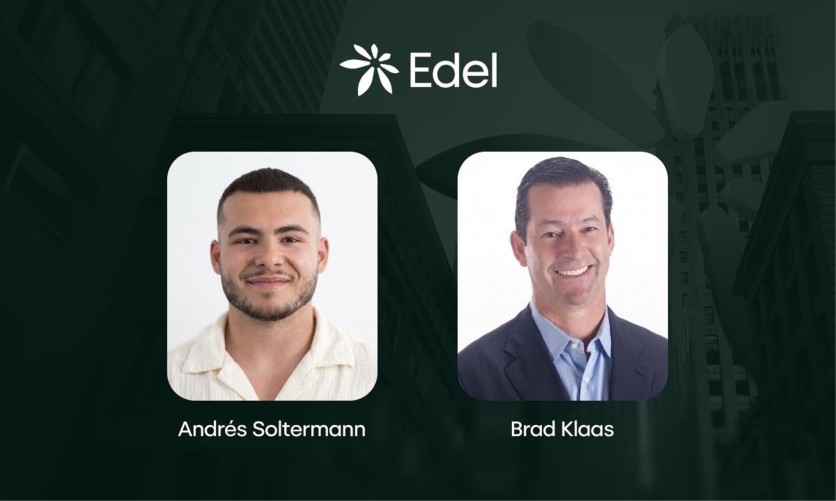
Edel Finance, the Singapore-based DeFi protocol positioning itself as the on-chain credit layer for tokenized equities, has made a calculated move to close that gap. The platform has brought Brad Klaas onto its advisory board, a former Global Head of Securities Lending at BlackRock who later served as Advisor to the CIO for Digital Assets, Tokenization, and Industry Transformation at Franklin Templeton. The appointment arrives at a pivotal moment: Edel's mainnet went live in March 2026, the broader real-world asset tokenization sector has surpassed $19 billion in market capitalization, and tokenized equities, a segment that barely registered in mid-2025, crossed the $1 billion threshold in Q1 2026.
This is not a cosmetic board expansion. It is a structural play for the kind of institutional trust that converts a compelling DeFi concept into a functioning global lending market.
WHO IS BRAD KLAAS
Brad Klaas occupies a rare position in the architecture of financial services: a practitioner whose career spans the foundational plumbing of capital markets on one hand, and the emerging infrastructure of digital asset finance on the other. His trajectory places him at precisely the intersection Edel Finance needs to credibly occupy.
A Massachusetts Institute of Technology alumnus, Klaas spent the formative chapters of his career inside the machinery of institutional capital markets. At BlackRock, one of the world's largest asset managers overseeing trillions in assets, he served as Global Head of Securities Lending, where he was responsible for one of the largest securities lending programs in existence, managing tens of billions in lendable assets and working directly with prime brokers, custodians, and institutional counterparties. The role placed him at the centre of the same market infrastructure that Edel Finance is now attempting to migrate on-chain.
His subsequent transition to Franklin Templeton, where he held the title of Advisor to the CIO for Digital Assets and Business Acceleration, reflected a broader shift in his professional orientation: from executing within legacy systems to helping one of the world's most established asset managers navigate the tokenization era. At an institution with over $1.5 trillion in assets under management, Franklin Templeton has been notably aggressive in its blockchain ambitions, launching one of the first tokenized money market funds on a public blockchain. Klaas's advisory role there positioned him inside the conversations where traditional finance was first seriously reckoning with the on-chain future.
Beyond these institutional anchors, Klaas has been a visible voice at the intersection of digital assets and capital markets, speaking at industry events such as Digital Assets Week and appearing in discussions on the role of blockchain technology in driving transparency, efficiency, and more direct interactions between investors and companies. His professional descriptor on public platforms identifies him squarely in the fintech executive category: digital assets, capital markets, asset management, blockchain, and payments. He also played a role in the early days of primebroker.com, an initiative that points to a career-long interest in how market infrastructure can be made more transparent and accessible.
" For decades, banks and prime brokers have been the ones unlocking liquidity from stock portfolios. By moving this infrastructure on-chain, we are giving investors direct access to the same financial mechanics in a transparent and global system. "
— Andrés Soltermann, Co-founder and CEO, Edel Finance
EDEL FINANCE: REBUILDING THE CREDIT LAYER OF EQUITY MARKETS
Edel Finance is not trying to tokenize stocks. That problem is being addressed by others, among them Ondo Finance, xStocks, and increasingly major exchanges, including Coinbase and Robinhood. What Edel has identified is the layer above tokenization: the lending, borrowing, and collateralisation infrastructure that turns a stock into a productive financial asset rather than a static on-chain representation.
The platform describes itself as the autonomous revenue engine for tokenized equities, built on Ethereum-compatible smart contracts with isolated liquidity pools for assets including USDC and tokenized equities. Users can deposit tokenized stocks, earn yield by lending them to borrowers, and use tokenized equities as overcollateralized assets to access stablecoins or construct leveraged long or short positions. The protocol eliminates the need for perpetual exchanges and places settlement on-chain at T+0, against the traditional finance standard of T+2.
The market Edel is targeting is significant by any measure. Traditional securities lending is a multi-trillion-dollar industry in which the mechanics of borrowing against portfolios, generating yield by lending shares, and margin financing have historically been the exclusive domain of institutional participants operating through opaque bilateral relationships with prime brokers. Retail investors have been effectively locked out of a yield-generating infrastructure that runs beneath their own portfolios.
Edel's architecture was designed specifically for equities rather than cryptocurrencies, addressing the real-world complexities that DeFi lending protocols built for digital assets were never designed to handle: dividend payments, corporate restructuring events, stock splits, and trading schedules that differ from the 24/7 nature of crypto markets. The protocol's risk systems incorporate overcollateralization at 150% loan-to-value ratios, automated liquidations via Chainlink oracles, and institutional-grade compliance partnerships for regulatory jurisdictions, including the EU.
The platform's testnet attracted over 90,000 participants before mainnet launch, with more than 10,000 active users on the Robinhood Chain testnet alone. When its initial 1,500-user testnet limit was reached almost immediately, the team raised it to 5,000, a signal of demand that preceded the broader industry milestone of tokenized equities crossing $1 billion in Q1 2026.
WHY THIS ADVISORY BOARD MOVE MATTERS
Advisory board appointments in early-stage fintech are a well-worn playbook, frequently deployed as marketing tools carrying little operational weight. What distinguishes Klaas's appointment is the specificity of the fit. His expertise is not adjacent to what Edel is building; it is precisely its institutional antecedent.
A former head of securities lending at BlackRock advising a platform that is rebuilding securities lending on blockchain rails is not a strategic stretch. It is an acknowledgment, from someone who ran one of the largest such programs in the world, that the underlying mechanics Edel is creating correspond to a real institutional need. That correspondence carries significant weight in conversations with institutional counterparties, custodians, and prime brokers who are evaluating whether to integrate with or lend credibility to emerging on-chain infrastructure.
His Franklin Templeton background adds a further layer of relevance. Having worked inside an asset manager that was itself pioneering tokenized financial products, Klaas brings an understanding of how large institutions navigate regulatory frameworks, governance requirements, and internal approval processes when engaging with blockchain-based infrastructure. That knowledge is not trivially available, and it is precisely what an early-stage protocol requires when seeking to graduate from retail and crypto-native adoption toward institutional integration.
There is also a market positioning dimension. The tokenized equity space is becoming competitive rapidly. Ondo Finance, backed by significant capital and established integrations with platforms like MetaMask and Solana, has emerged as a leading tokenized stock issuer. Coinbase and Gemini are expanding into crypto stocks. Polymath has been operating in the security token space since 2021. For Edel, which is focused on the lending and collateralisation layer rather than issuance, differentiation must come from the quality of the infrastructure and the trust of the counterparties it attracts. An advisory board that includes a former BlackRock securities lending head directly reinforces both.
INDUSTRY CONTEXT: TOKENIZATION, GOVERNANCE, AND THE RACE FOR INSTITUTIONAL TRUST
The advisory board expansion at Edel Finance should be read against a backdrop of accelerating institutional commitment to asset tokenization that has moved from tentative experimentation to embedded financial infrastructure within a remarkably compressed timeframe.
Tokenized real-world assets have more than tripled since early 2025, reaching $19.3 billion in market capitalization by the end of Q1 2026, according to CoinGecko. Tokenized equities specifically, a segment that barely registered in mid-2025 with a few million dollars in market value, scaled to nearly $500 million by Q1 2026, and has since crossed the $1 billion threshold. Trading volumes for tokenized stocks hit $15.1 billion in Q1 2026 spot trading volume alone. More telling still, blockchain wallet data from Chainalysis shows that RWAs are increasingly the reason institutional participants come on-chain in the first place, not a secondary consideration after crypto exposure.
BlackRock CEO Larry Fink's declaration that the next generation of markets will be the tokenization of securities has moved from a provocative prediction to an operating hypothesis across the industry. JPMorgan's Kinexys platform is processing over $2 billion in daily transactions. Goldman Sachs and BNY Mellon are tokenizing money market funds. Franklin Templeton, where Klaas worked on the digital assets advisory side, runs one of the largest tokenized Treasury products in the market. Regulatory clarity, particularly following the GENIUS Act in July 2025, which established a federal framework for payment stablecoins, has removed a significant obstacle to institutional deployment.
Within this context, governance and credibility have become primary competitive variables. Protocols that can demonstrate institutional-grade governance frameworks, meaningful advisory structures, and a track record of responsible capital market thinking are better positioned to attract the custodians, prime brokers, and institutional investors whose participation is required to build deep, functional on-chain lending markets.
The pattern of recruiting traditional finance executives into DeFi advisory roles is not incidental. It reflects a structural reality in how institutional capital moves: verification precedes allocation. Risk committees at traditional institutions require evidence of governance quality, and advisory boards composed of credible practitioners are part of that evidence base. Klaas's appointment is therefore both a strategic signal and a practical tool in Edel's institutional development process.
SEC Chairman Paul Atkins has noted that the migration to on-chain securities has the potential to remodel aspects of the securities market, a framing that positions tokenization not as a disruption of existing finance but as a modernisation of its infrastructure. That framing is central to how platforms like Edel pitch to institutional counterparties, and it is the kind of framing that carries considerably more weight when an advisor has lived it from the inside of one of the world's largest asset managers.
LOOKING AHEAD: BUILDING THE INFRASTRUCTURE FOR INSTITUTIONAL ON-CHAIN FINANCE
The race to build the credit layer of tokenized equities is underway, and it will be decided by who can most credibly bridge the standards of traditional capital markets with the mechanics of on-chain infrastructure. Edel Finance, with its mainnet live and a testnet that demonstrated genuine market demand, is positioning itself to be a primary candidate for that role.
Brad Klaas's advisory board appointment reflects a deliberate institutional maturation strategy. It is a signal that Edel understands its target market is not just the crypto-native investor seeking yield on tokenized Tesla shares, but the institutional participant who needs to know that the lending infrastructure they are engaging with has been validated by someone who managed the same mechanics at scale inside the world's largest asset manager.
The broader trajectory of the tokenization market points toward a convergence of TradFi governance standards and DeFi execution speed. Platforms that achieve that convergence first, with the infrastructure depth, the regulatory navigation, and the institutional credibility to operate at the junction, will become foundational financial infrastructure for the next decade. Edel Finance, with its mainnet launch and this advisory board expansion, has positioned itself to compete for that role.
For a platform built on the premise that decades of securities lending infrastructure can be made transparent, global, and accessible without the intermediaries that have historically captured the majority of the yield, having Brad Klaas at the advisory table is not merely symbolic. It is a strategic investment in the institutional trust that will determine whether that premise becomes reality.
About Edel Finance: Edel Finance is building the on-chain credit layer for tokenized equities, creating an institutional-grade money market where investors can lend, borrow, and earn yield on tokenized stocks. The platform is accessible at edel.finance.
Additional Reporting: Market data sourced from CoinGecko RWA Report 2026, RWA.xyz, Chainalysis, and Investing.com/Chainwire. Brad Klaas professional history verified via Digital Assets Week speaker records and Franklin Templeton public disclosures.
ⓒ 2026 TECHTIMES.com All rights reserved. Do not reproduce without permission.


