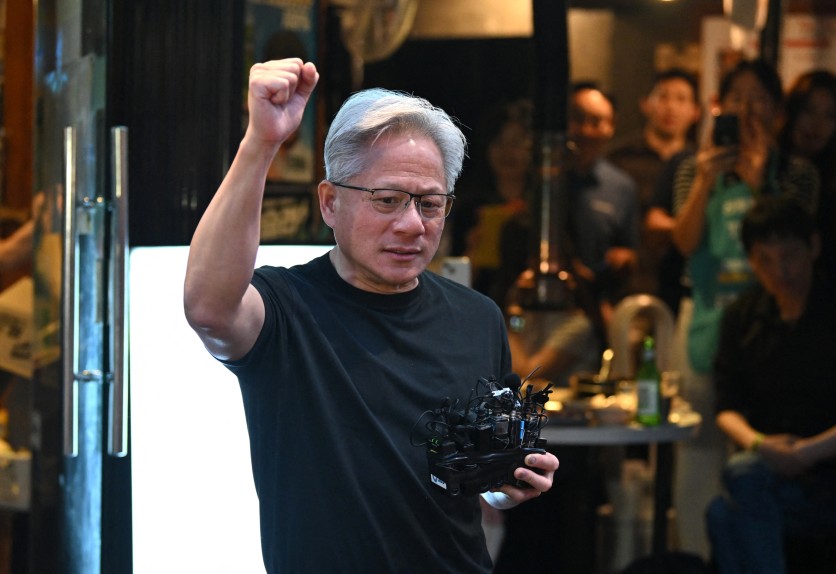
NVIDIA CEO Jensen Huang touched down in Seoul on Friday and headed straight for a gaming cafe — not a boardroom — making six-time League of Legends World Champion Lee "Faker" Sang-hyeok his first stop in South Korea and gifting the 29-year-old T1 captain a personally signed GeForce RTX 5090 graphics card. "Only one in the world," Huang told the approximately 500 fans packed into T1 Base Camp in Seoul's Mapo district. "This might be worth a million dollars."
Fresh off the Computex 2026 stage in Taipei — where he unveiled the RTX Spark, NVIDIA's first-ever laptop superchip — Huang used Friday's esports showcase to introduce the platform to Korean gamers directly, distributing signed vouchers redeemable for an RTX Spark device when it launches this fall.
"Korea Birthplace of Esports": Huang Credits Gaming Culture That Shaped NVIDIA
Taking the stage to sustained cheers, Huang credited Korean gaming culture with forging NVIDIA's identity. "Korean gamers chose the best graphics processing units to win, and that was NVIDIA," he said. "I thank you all for supporting NVIDIA for so long." He recalled his first visit to Korea, when StarCraft dominated television and players competed before live studio audiences — the moment, he said, that showed him gaming could be a spectator sport. Korea was, in his words, "not only the inventor of esports" but also "the protagonist that established gaming as a spectator sport."
Upon learning that the PCs at the venue ran an RTX 4070, Huang called the GPU an "antique" — then produced the signed flagship RTX 5090. Faker, whose personal machine runs on an RTX 5070 per Huang's own remark to the crowd, responded by presenting the NVIDIA chief with a T1 jersey bearing his own signature, and the two posed for a photograph with the full T1 roster: Choi "Doran" Hyeon-joon, Moon "Oner" Hyeon-joon, Kim "Peyz" Su-hwa, and Ryu "Keria" Min-seok.
"Today, I got to spend some time with CEO Jensen Huang, and it was a very meaningful experience," Faker said afterward. "Graphics cards are extremely important to us as gamers, and I believe there are many people whose contributions have helped make it possible for us to succeed as professional gamers."
T1 COO Ahn Woong-ki confirmed that the relationship between the two companies extends beyond a one-off photo opportunity. "We have been in discussions on various fronts, including business, for some time," he said. "I believe that is why a meeting like today's was possible." He declined to specify the areas under discussion.
RTX Spark at Gaming Cafe: NVIDIA Introduces Laptop Superchip to Esports Fans
The T1 event served as an informal first public preview of the RTX Spark beyond the Computex show floor. Huang raffled a second RTX 5090 — this one co-signed by both himself and Faker — to one fan in the crowd, and distributed two signed black cards as vouchers for RTX Spark devices to two additional winners. "It's not released yet," he told the crowd. "It will be released this fall. If you bring the card, you will get the RTX Spark."
The RTX Spark is NVIDIA's first superchip designed for Windows laptops and compact desktops. Built in partnership with MediaTek and fabricated on TSMC's 3nm process, it fuses a 20-core Grace ARM central processing unit with a Blackwell GPU carrying 6,144 CUDA cores and fifth-generation Tensor Cores capable of 1 petaFLOP of FP4 AI computation. The two dies connect over NVLink-C2C at 600 GB/s — roughly five times the bandwidth of PCIe Gen 5, at lower power — giving the CPU and GPU shared access to up to 128 GB of LPDDR5X memory at 300 GB/s. That unified memory pool eliminates the data-transfer bottleneck that occurs when a discrete GPU communicates with a CPU over a separate PCIe bus, the same architectural approach Apple uses in its Silicon chips.
For gamers, the headline figure is GPU performance comparable to an RTX 5070 Laptop GPU, depending on the OEM's thermal design. NVIDIA confirmed the chip will run across a power envelope from single-digit watts up to roughly 80W in the largest laptop configurations — meaning a thin 14mm chassis and a larger workstation-class portable will deliver noticeably different sustained performance from identical silicon. Over 30 laptops and more than 10 desktops from ASUS, Dell, HP, Lenovo, Microsoft, and MSI are confirmed for fall launch.
Huang told fans at T1 Base Camp that he and Microsoft CEO Satya Nadella had agreed three years prior to reinvent the PC. "We ended up creating a new generation of PCs that encompass both laptops and desktops," he said. "This is the most efficient platform ever built."
How RTX Spark Differs From Traditional Gaming Laptop Architecture
Traditional Windows gaming laptops pair a discrete NVIDIA GPU with a separate Intel or AMD CPU, connected over a PCIe bus. Each chip has its own memory pool, and any time the GPU needs data held by the CPU — or vice versa — that data must travel across the PCIe interconnect, consuming latency and bandwidth. RTX Spark replaces this architecture with a single SoC where the Blackwell GPU and Grace CPU share the same physical memory pool over NVLink-C2C, an interconnect that delivers approximately five times the bandwidth of PCIe Gen 5. The result is that AI workloads — which require moving large model weights and activation tensors between compute units — can execute far more efficiently, and memory-capacity constraints that would otherwise force large language model inference into the cloud can instead be handled locally on up to 128 GB of unified RAM.
The chip's 1 petaFLOP of FP4 AI throughput is sufficient to run 120-billion-parameter large language models locally with up to one million tokens of context, according to ASUS's published specifications. That capability sits at the center of NVIDIA's broader pitch: RTX Spark is not just a gaming chip but the foundation of a new category it calls "AI PCs," in which software agents that can run tasks autonomously in the background no longer require a cloud connection.
Read more: Nvidia at Computex 2026: Jensen Huang Flies to TSMC as Vera Rubin Ramp Strains Taiwan Supply Chain
Jensen Huang Korea Visit Continues With Semiconductor and Robotics Meetings
Friday's T1 stop was the opening scene of a five-day schedule Huang described as packed with surprises. That same evening, he met SK Group Chairman Chey Tae-won, LG Group Chairman Koo Kwang-mo, and Naver Chairman Lee Hae-jin over Korean barbecue near Hongdae to discuss AI semiconductors and data center infrastructure. Individual meetings with Samsung, SK Hynix, and Hyundai Motor are planned for Saturday, with further public appearances including a ceremonial first pitch at a Doosan Bears baseball game on Sunday and a second business leaders gathering on Monday.
The visit is Huang's second to Korea in seven months. During his October 2025 stop for the APEC summit, he pledged more than 250,000 advanced NVIDIA GPUs for South Korean AI infrastructure alongside Samsung, SK Hynix, and Hyundai Motor. South Korea's importance to NVIDIA is structural: Samsung and SK Hynix together supply the high-bandwidth memory that powers every NVIDIA AI accelerator, and both are confirmed suppliers of the HBM4 memory in the company's next-generation Vera Rubin platform.
Faker's record as the most decorated League of Legends player in history — six World Championship titles, ten LCK domestic crowns, and the first esports athlete to receive South Korea's highest state athletic honor — gave Friday's encounter a weight no sponsored post could manufacture. Huang, whose NVIDIA became the first company to reach a $5 trillion market capitalization in October 2025, has spoken openly about Korean gaming culture as formative for his company. For an audience that grew up watching both men define their respective fields, the pairing carried cultural significance that extends well beyond a product launch.
That signed RTX 5090 — wherever Faker ultimately keeps it — may become one of the most storied artifacts in gaming history.
Frequently Asked Questions
What GPU does Faker use?
At the time of Jensen Huang's June 2026 visit to T1 Base Camp in Seoul, Huang noted that Faker's personal machine uses an RTX 5070. The T1 Base Camp venue's PCs were running RTX 4070 units, which Huang called "antiques" before gifting Faker the signed RTX 5090.
What is the NVIDIA RTX Spark?
The RTX Spark is NVIDIA's first superchip designed for Windows laptops and compact desktops, unveiled at Computex 2026 in Taipei. It combines a 20-core Grace ARM CPU and a Blackwell GPU on a single TSMC 3nm package, with up to 128 GB of shared LPDDR5X memory and 1 petaFLOP of FP4 AI performance. Devices from ASUS, Dell, HP, Lenovo, Microsoft, and MSI are scheduled to launch in fall 2026.
When is the NVIDIA RTX Spark release date?
NVIDIA has confirmed a fall 2026 launch for RTX Spark laptops and desktops. Jensen Huang told fans at T1 Base Camp in Seoul on June 5, 2026 that the product "will be released this fall," and voucher recipients were told to bring their signed cards to exchange for a device upon launch.
How much is a signed Jensen Huang RTX 5090 worth?
Huang himself joked at T1 Base Camp that the co-signed RTX 5090 — bearing both his signature and Faker's — "might be worth a million dollars." For context, a dual-signed Huang RTX 5090 without Faker's signature has previously sold at auction for $12,501. The combined co-signing by both Huang and Faker, described as the only one of its kind worldwide, is likely to command a significant premium in any future private sale or auction.
ⓒ 2026 TECHTIMES.com All rights reserved. Do not reproduce without permission.


