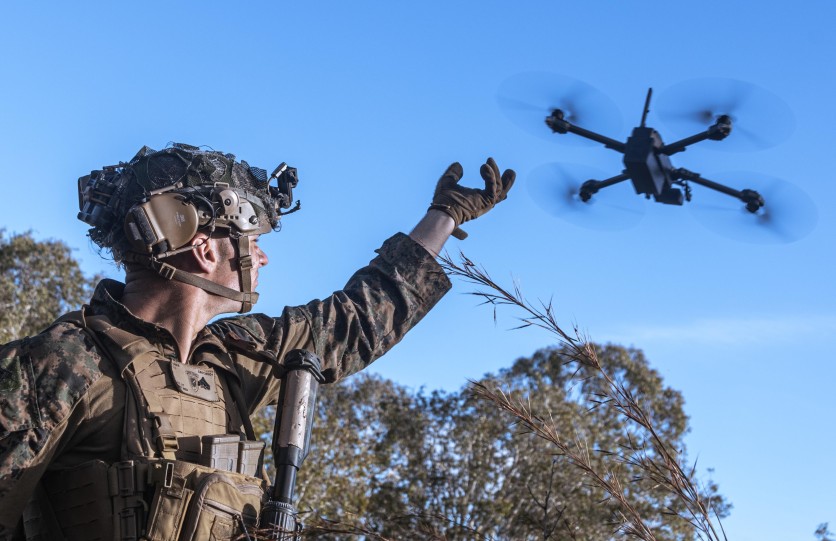
The Pentagon has begun accepting its first first-person-view (FPV) one-way attack drones under the Drone Dominance program — the Department of War's $1.1 billion push to put cheap, lethal quadcopters in the hands of every squad before fiscal year 2026 ends in September. But with deliveries now formally underway, the program's public Leaderboard reveals a gap between ambition and execution: the Pentagon has ordered 20,000 drones from 10 of the 11 Gauntlet I winners, falling 10,000 units short of the 30,000 originally forecast — and only one company has completed its order.
The timing matters beyond the shortfall. Gauntlet II, the program's second open competition, opens Monday at Camp Grayling, Michigan, with approximately 49 companies fielding 79 distinct drone designs competing for at least $300 million in new orders. It is the most consequential open drone competition in U.S. military history, and it will go a long way toward determining which American manufacturers grow into genuine defense primes — and which do not.
Neros Leads Delivery. Skycutter Led the Competition.
To understand the Leaderboard, a distinction matters: competition score and delivery performance are not the same thing.
In the Gauntlet I scoring, Skycutter — a London-based company fielding the Ukrainian-designed Shrike 10 Fiber — placed first with 99.3 out of 100 points, more than 11 points ahead of the field. Neros, whose Archer quadcopter is manufactured in California, placed second with 87.5 points. Napatree Technology ranked third with 80.3 points.
In delivery execution, Neros is the only company that has completed its Phase I order. The company shipped all 2,400 of its contracted Archers, with 1,040 formally accepted by the Pentagon. The nine other vendors have collectively shipped approximately 560 drones — all still awaiting acceptance — while their remaining units are in various stages of production. Napatree, the third-place finisher, has not yet received a contract award, which accounts for the 10,000-unit gap between the 30,000-drone target and the 20,000 units actually ordered.
Travis Metz, the Defense Innovation Unit's program manager for Drone Dominance, put the scoring philosophy plainly to the Senate Armed Services Committee in March: "The Gauntlet I leaderboard is not a statement about the best drones in the industry, or even the best drones in America. It is a snapshot of how the invited vendors performed against the mission vignettes designed by the warfighters. We are not buying drones based on paper requirements."
How Fiber Optics Beat Electronic Warfare: Why Skycutter Scored 99.3
The 11.8-point gap between Skycutter and every other competitor was not statistical noise — it reflected a technical architecture that conventional counter-drone defenses cannot address.
Standard FPV drones transmit on radio-frequency bands — typically 433 MHz, 900 MHz, or 2.4 GHz — using wireless links that military-grade electronic warfare suites are designed to detect, jam, and spoof. Cut that link, and the drone loses control. Skycutter's winning drone, the Shrike 10 Fiber developed in partnership with Ukrainian manufacturer SkyFall, bypasses this vulnerability entirely. Instead of a radio link, it trails a high-tensile, micro-spooled fiber-optic cable — up to 20 kilometers (12.4 miles) long — that carries both the control signal and a 4K video feed as light pulses through glass rather than radio waves through air.
This architecture creates two simultaneous tactical advantages. First, it produces no radio emissions, making the drone invisible to signals-intelligence sensors. Second, jamming systems have no electromagnetic signal to target. Military operators who had just two hours of training per system were able to put the Shrike through combat scenarios in deeply contested electromagnetic environments where RF-based competitors lost control — which explains the near-perfect score.
The tradeoff is physical: the fiber-optic cable is the system's single point of failure. If the cable is severed by debris, wind, or enemy action, the connection is instantly lost. The fiber-optic Shrike variant also costs approximately $1,500 per unit — roughly twice the price of a standard RF-guided FPV — though even that figure approaches Ukraine-war pricing levels that would have been unthinkable in traditional defense procurement.
The Neros Archer, by contrast, uses RF guidance and was procured by the Marine Corps at approximately $2,125 per unit — a price Neros described as approaching Ukrainian pricing levels.
Gauntlet II: Bigger, Harder, Higher Stakes
The second competitive phase of the Drone Dominance program has expanded sharply. Where Gauntlet I invited 25 vendors, Gauntlet II has approved approximately 49 companies fielding around 79 distinct drone designs — a field that includes returning Gauntlet I winners as well as newly invited companies competing for a share of at least $300 million in orders.
The Phase II qualifier runs from June 8 through June 20 at Camp Grayling, Michigan. The evaluation is structured in four stages: a qualifier event, a production-and-delivery test requiring vendors to manufacture 120 drones on a fixed-price order, a final Gauntlet field evaluation by trained warfighters in late August, and then prototype delivery orders to approximately five vendors per mission area.
Phase II also introduces two mission-specific categories with fixed price caps: long-range strike systems at $4,500 per drone, and close-quarters urban assault platforms at $3,500 per drone, with munitions priced at $3,250 per unit.
The stakes for the domestic manufacturing sector are higher than in Phase I. By August 2026, all Drone Dominance vendors must have removed Chinese-sourced motors and batteries from their supply chains or face disqualification — a deadline the defense community has been calling the "Chinese Cliff." China controls an estimated 90 percent of the rare-earth magnets and 99 percent of the drone batteries the global industry depends on, which means every vendor in the competition is currently racing to qualify alternative sources.
Red Cat CEO Jeff Thompson told Axios the program has already clarified what matters most: "They're very blunt about it at Drone Dominance: If you can't produce them and deliver them on time — if you're two weeks late — you're out. It's all about production. The factory is the weapon."
Lethality Prize Winners and the Iran Connection
The Pentagon this week awarded Griffon Aerospace a $68 million contract for Outlaw Gen 3 fixed-wing drones — capable of carrying payloads between 20 and 40 pounds — in support of ongoing U.S. operations against Iran. Griffon was among the Gauntlet I finalists and is returning for Gauntlet II.
In a parallel track, the Defense Innovation Unit named five companies as winners of a Lethality Challenge to develop warhead payloads for Group 1 drones weighing 20 pounds or less: Bravo Ordnance, Kela Defense, Kraken Kinetics, Mountain Horse, and Northrop Grumman. Northrop's winning design is a standardized effects module — combining fuze, warhead, and interface — designed to arm large numbers of drones rapidly using a single interchangeable package.
What the Drone Dominance Program Is
Drone Dominance is a four-phase, $1.1 billion procurement initiative launched by Defense Secretary Pete Hegseth following a July 2025 directive that called Ukraine's FPV drone wars a generational battlefield lesson the United States had been too slow to absorb. "Drones are the biggest battlefield innovation in a generation, accounting for most of this year's casualties in Ukraine," Hegseth wrote. "Our adversaries collectively produce millions of cheap drones each year."
The program is designed to invert the traditional defense procurement model. Rather than awarding multi-year development contracts and evaluating systems on paper specifications, the Gauntlet forces companies to fly actual hardware through combat-relevant mission scenarios evaluated by real military operators. Scores are published publicly. Contracts follow performance. Companies that deliver on time at the promised volume stay in the competition; those that do not are effectively exited.
By contrast with the earlier Replicator initiative — which faced criticism for limited relevance to the Pacific theater — Drone Dominance is explicitly focused on the squad level, not longer-range systems. Secretary Hegseth's directive set a specific end-of-fiscal-2026 deadline to equip every squad, and the September 30 deadline is now less than four months away.
The program has already moved further than critics expected. At the Senate Armed Services Committee hearing in March, lawmakers from both parties expressed strong support, with only Senators Jeanne Shaheen and Richard Blumenthal pressing the Pentagon to engage more directly with Ukrainian manufacturers — an argument the subsequent Gauntlet results appeared to address, given that Skycutter (Ukrainian-designed technology) and Ukrainian Defense Drones Tech Corp. both received orders.
How the US Drone Industrial Base Is Rebuilding
For the American drone industry, the program represents a rare structural opportunity. Chinese manufacturers — principally DJI, which held an estimated 70 to 90 percent share of the U.S. drone market before the December 2025 Federal Communications Commission ban — built dominance through a fully integrated supply chain that domestic producers are now attempting to replicate from scratch.
Neros's trajectory illustrates what rapid domestic scaling looks like. The company delivered its first Archers to Ukraine in 2023 as a combat test platform, closed a $75 million Series B led by Sequoia Capital in late 2025, and is now running a new "Project Millennium" facility in Torrance, California, targeting production of 100,000 Archers by year's end — scaling from 2,500 per month at its El Segundo headquarters. It also announced an NDAA-compliant fiber-optic variant, the Archer Fiber, co-developed with Kela Technologies, in December 2025.
Skycutter co-founder Vincent Gardner told the BBC after the Gauntlet I result that the company may need to relocate manufacturing operations to the United States to sustain the Drone Dominance relationship.
Connor Toler, a product manager at Gauntlet participant Dzyne Technologies, told Axios the program is "creating a demand signal for industry" and motivating companies to plan "their manufacturing processes at scale" rather than one-offs.
The FY2027 Pentagon budget request includes $54.6 billion for the newly established Defense Autonomous Warfare Group — a 24,000 percent increase over the prior year and what former CIA Director David Petraeus described as "the largest single commitment to autonomous warfare in history." Petraeus and other experts also warned, however, that the military and its technology partners are still unprepared for the risks and responsibilities involved in deploying autonomous systems at that scale.
Frequently Asked Questions
What is the Drone Dominance program?
Drone Dominance is a four-phase, $1.1 billion Department of War initiative to procure low-cost, one-way attack drones for every U.S. military squad by the end of fiscal year 2026. Rather than using traditional procurement, it uses a live competitive evaluation called the Gauntlet, where military operators fly and score vendor systems in combat-relevant scenarios — and results are published publicly.
Who won the Pentagon drone competition?
Skycutter, a UK company fielding a Ukrainian-designed drone called the Shrike 10 Fiber, topped the Gauntlet I leaderboard with 99.3 out of 100 points. The Shrike is guided by a fiber-optic cable rather than radio frequency, making it immune to electronic warfare jamming. In delivery performance, Neros has completed its full Phase I order of 2,400 Archer drones — the only vendor to do so.
How do fiber optic drones work?
A fiber-optic FPV drone replaces the radio-frequency control link of a conventional drone with a thin glass-fiber cable that unspools as the drone flies. Control signals and 4K video travel as light pulses through the fiber, producing no radio emissions and making the drone invisible to jamming systems that work by targeting electromagnetic signals. The primary limitation is that if the cable is severed, the drone loses all guidance.
Is the US military behind China and Russia in drones?
By production volume, significantly so. China and Russia each produce millions of drones per year; the U.S. has ordered 20,000 through Phase I of Drone Dominance and is targeting over 200,000 by 2027. However, Drone Dominance is explicitly designed to close that gap by creating a sustained domestic manufacturing base, and the competitive Gauntlet structure is forcing price compression and production scaling simultaneously.
ⓒ 2026 TECHTIMES.com All rights reserved. Do not reproduce without permission.


