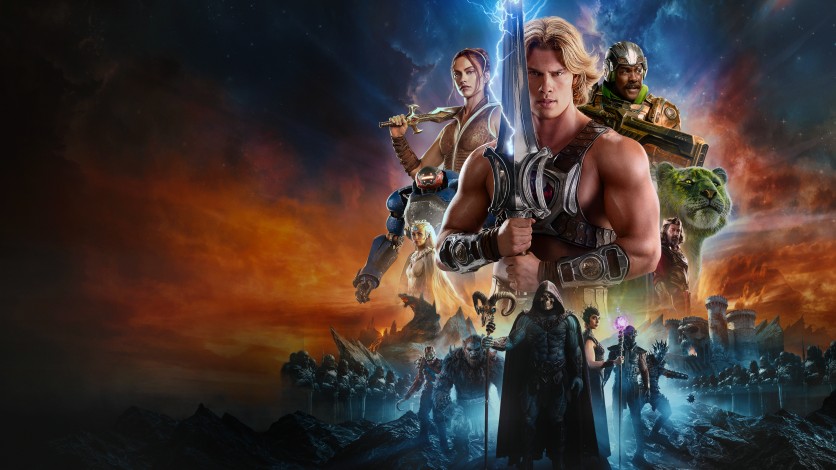
Masters of the Universe opened in theaters June 5, 2026, with Amazon MGM Studios' $170 million adaptation of the Mattel franchise earning approximately $31 million in its opening domestic weekend — a franchise-best 88% audience score on Rotten Tomatoes that landed against mixed critical notices. The film's director, Travis Knight, delivers more than nostalgia: beneath Eternia's laser-rifle-and-broadsword aesthetic are four worldbuilding mechanisms that each have a real scientific parallel, one of which — the sword-as-conduit twist — directly maps onto a genuine discovery in neuroscience published in Science.
Tracking data from opening weekend reporting placed the film second behind Paramount's Scary Movie reboot, which earned an estimated $52–56 million. A CinemaScore of B and a 96% "definite recommend" rating from children under twelve in PostTrak polling suggest the film's word-of-mouth trajectory will be shaped by the youngest third of its three-generational audience rather than by the critics who found its 2:21 runtime and tonal debt to Thor: Ragnarok difficult to overlook.
He-Man Science: The Sword Has No Power of Its Own
The film's central lore revelation — that Prince Adam's Sword of Power is a conduit, not a source — arrives in the climax when the sword shatters and Adam transforms anyway. The Sorceress, played by Morena Baccarin, has spent the entire film signaling this: she chose Adam not because of the weapon but because of his moral character, the sword functioning as scaffolding until he could access what was already resident within him.
That narrative structure has a precise scientific analog in neuroscience research. Nathan Rose and colleagues, publishing in Science in 2016, demonstrated that the brain holds information in what they termed "activity-silent" synaptic states — memory representations stored in synaptic weight changes rather than in sustained neural firing. The stored representation drops to baseline activity, appearing as though it no longer exists, until a single pulse of transcranial magnetic stimulation (TMS) reactivates it — bringing a "forgotten" item back into focal attention without introducing any new information from outside.
The sword-as-TMS-pulse parallel is structural, not superficial. TMS does not supply the memory from an external source; it triggers access to a pre-existing synaptic state that the brain's ordinary inhibitory filtering had suppressed. Adam's sword operates identically within Eternia's cosmology: it does not supply the power of Grayskull; it disrupts the inhibitory filtering — call it Prince Adam's ordinary self-conception — that kept him from accessing a biological capacity already resident in his nervous system. When the sword shatters and Adam transforms anyway, the film is depicting, in genre terms, exactly what the Rose et al. experiment produced in a laboratory setting.
Sword-and-Planet Genre: Post-Catastrophe Technology Heterogeneity
Eternia is the clearest example in contemporary blockbuster cinema of the sword-and-planet genre, a pulp fiction tradition that runs from Edgar Rice Burroughs's Barsoom novels (beginning 1912) through Flash Gordon and into Masters of the Universe's own 1983 animated series. The genre's defining feature is anachronistic technology coexistence: flying ships with laser weapons share a battlefield with medieval knights; sorcerers fight alongside mechanized warriors.
The film's in-universe explanation invokes Eternia's "Great Wars" between science and magic — a cataclysmic ancient conflict that destroyed much of the planet's knowledge infrastructure, leaving civilization in a state of non-linear technological reconstruction. This is not a fantasy conceit without historical precedent. Earth's own record documents extended periods of exactly this kind of mixed-technology conflict: plate armor and longbows sharing the Hundred Years' War battlefield, tanks and cavalry sharing the Western Front in 1914. What the Great Wars would have produced specifically is the uneven destruction of knowledge repositories — if the faction destroying laboratories succeeded while the faction destroying metallurgical techniques failed, the survivors would rebuild integrated prosthetics before they rebuilt electrification infrastructure, producing exactly the profile Eternia displays: sophisticated cybernetic systems alongside characters who use swords as a primary weapon because the industrial base to manufacture firearms at scale no longer exists.
Trap Jaw Cyborg: DARPA's Modular Prosthetics Architecture
Sam C. Wilson's Trap Jaw (Kronis) is the film's most technically interesting character from a systems-engineering standpoint. His mechanical jaw and interchangeable weapon-arm are framed by director Knight not as a power fantasy — the reading the 1980s toy line invited — but as body horror, suggesting modifications imposed under Skeletor's authoritarian regime rather than chosen.
The real-world parallel is the DEKA Luke Arm, developed by Dean Kamen's DEKA Research and Development Corporation under DARPA's Revolutionizing Prosthetics program and cleared by the Food and Drug Administration in May 2014. The Luke Arm is a modular prosthetic configurable for three amputation levels — radial, humeral, and shoulder — with up to ten powered degrees of freedom and six preprogrammed grip patterns. The terminal device is the interchangeable end component: grip, tool adapter, hook. Trap Jaw's interchangeable weapon arm is the Luke Arm's modular architecture scaled to lethality.
DARPA's subsequent HAPTIX (Hand Proprioception and Touch Interfaces) program extended this architecture toward bi-directional peripheral nerve interfaces — systems where sensory feedback from the prosthetic arm returns to the wearer's brain via implanted neural interfaces. The stated goal is restorative: amputee veterans regaining near-natural motor function and tactile sensation. Trap Jaw's horror logic is the ethical inverse of this work — the same neural-interface architecture applied coercively, with a retained biological nervous system instrumentalized rather than rehabilitated. The person becomes a weapons delivery platform; their retained humanity is the targeting system, not the thing being preserved.
Castle Grayskull and Eternia Worldbuilding: Planetary Physics Without Precedent
The franchise has described Castle Grayskull across more than 40 years of iterations as the repository of a universal energy seated at Eternia's center — a planetary location as cosmic nexus, a concept with deep roots in world mythology from the Greek omphalos at Delphi to the Hindu Mount Meru. The 2026 film treats Grayskull as containing the power of all living things, guarded by a conscious steward whose own moral character determines access.
The astrophysical conjecture maps this onto a planetary body with an anomalous core — not the ordinary iron-nickel composition of a rocky planet, but a deposit of stable exotic matter generating fields not present in standard-model physics. A Grayskull-field hypothesis would posit a fifth fundamental interaction coupling to neural coherence and moral character in the same way electromagnetism couples to electric charge, with Skeletor's very desire for domination producing the neural incoherence that scrambles his access. This is admittedly the least scientifically grounded of the four mechanisms — there is no current evidence for a consciousness-coupled fundamental force — but it is the most intellectually honest description of what Eternia's cosmology requires: not a magical exception but a structural addition to physics.
The concurrent franchise comics made this hierarchy explicit before the film's release. He-Man and the Masters of the Universe: The Sword of Flaws (Tim Seeley, January 2026) stated that Eternia's ancient protector Gray understood magic to be more powerful than science, and deliberately positioned Grayskull as a repository rather than a weapon to prevent catastrophic harm from concentrated power. That framing inverts the usual hierarchy in genre fiction: magic is not a primitive approximation of science waiting to be explained away, but the superior force that science can approximate through technology and never fully replicate through engineering alone.
Nostalgia Gap: Why 88% Audience Score Outpaced Critics
The gap between the film's 88% audience score and its mixed critics Tomatometer is not an anomaly but a well-documented reception phenomenon in franchise entertainment. Adult viewers who encountered He-Man as children in the 1983–1990 era bring a pre-formed emotional schema to the screening — a set of icons whose faithful reproduction activates a reward response independent of the film's narrative coherence or structural originality. Jared Leto's theatrical, tantrum-prone Skeletor, Sam C. Wilson's body-horror Trap Jaw, and Nicholas Galitzine's final transformation all function as iconographic callbacks that critics evaluate analytically and nostalgic audiences evaluate affectively, measuring genuinely different things.
Amazon MGM's domestic distribution chief Kevin Wilson pointed to the 96% "definite recommend" from children under twelve as the more meaningful early signal — a three-generational audience (primary nostalgists from 1983, secondary nostalgists from 1990s–2000s reruns, and new-discovery viewers) responding to the same film in ways that aggregate review scores do not cleanly separate. For a sequel to move forward on the foundation this opening built, word-of-mouth conversion across all three cohorts over the coming weeks will matter more than the opening weekend number alone.
Frequently Asked Questions
Is Masters of the Universe 2026 worth watching?
For audiences who grew up with the original franchise, the film delivers its core promise: faithful iconographic reproduction with a committed cast, particularly Jared Leto's theatrical Skeletor, and a climactic lore revelation — that the Sword of Power is a conduit and the strength lives inside Prince Adam — that fans of the animated series will find satisfying. Critics found the tone uneven and the runtime long at 2:21, but the 88% audience score and CinemaScore B suggest the film connects with the audience it was designed for.
What genre does Masters of the Universe belong to, and what is sword-and-planet?
Sword-and-planet is a pulp science-fiction tradition originating with Edgar Rice Burroughs's Barsoom novels in 1912, in which an exotic alien world hosts anachronistic technology strata coexisting without apparent contradiction — energy weapons alongside medieval blades, spacecraft alongside sorcerers. Masters of the Universe is the genre's most recognizable contemporary blockbuster example, with Eternia's mixed technology explained in franchise lore as the product of ancient civilization-destroying wars that left knowledge reconstruction non-linear.
How does He-Man's transformation connect to real neuroscience?
The film's central reveal — that the Sword of Power is a conduit rather than a source of strength — maps onto a 2016 Science study by Nathan Rose and colleagues demonstrating that the brain holds memories in activity-silent synaptic states: information stored in synaptic weight changes, not sustained neural firing, that appears absent until a pulse of transcranial magnetic stimulation reactivates it. The sword functions structurally as that TMS pulse — not introducing power from outside but triggering access to a capacity already resident in Prince Adam's neurobiology.
What real prosthetics technology does Trap Jaw's design mirror?
Trap Jaw's interchangeable weapon-arm parallels the architecture of DARPA's DEKA Luke Arm, FDA-cleared in May 2014, which is modular with up to ten powered degrees of freedom and configurable for different amputation levels. DARPA's HAPTIX program subsequently developed bi-directional peripheral nerve implants that return sensory feedback from the prosthetic to the wearer's brain — the same neural-interface architecture that, in Trap Jaw's case, retains the human nervous system as a weapons guidance system rather than restoring it as a functional limb.
ⓒ 2026 TECHTIMES.com All rights reserved. Do not reproduce without permission.


