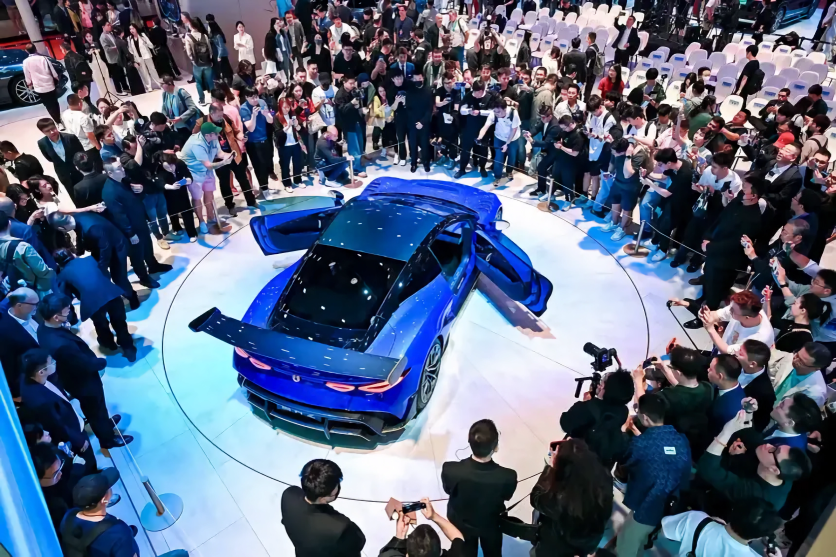
New production-specification photos of the BYD Denza Z electric sports car surfaced on social media today, giving enthusiasts and rivals their clearest look yet at the 1,000-plus-horsepower coupe just weeks before its scheduled dynamic debut at the Goodwood Festival of Speed. Automotive account Thinkercar posted the images on X, showing multiple undisguised examples — including a red performance variant and a blue track-focused trim with a prominent carbon-fiber rear wing — that confirm the production model has arrived largely unchanged from the concept shown at the 2025 Shanghai Auto Show.
The timing carries decision-window urgency for performance-car buyers in Europe. BYD's premium Denza brand officially entered the European market with the Denza Z9 GT in April 2026, and the Z two-door coupe is now weeks from its first public driving demonstration. Goodwood runs July 9–12, making today's photos the last substantive look at the car before it runs the famous Hill.
Two Trims, Three Body Styles
The leaked images show two clearly differentiated configurations. The red car, fitted with a black roof and contrasting stripe graphics, represents what appears to be the standard performance variant. The blue example with white livery and an elevated carbon-fiber rear wing points to a higher-specification track edition. A convertible version with a retractable fabric soft-top had already made its official public debut at the 2026 Beijing Auto Show, where it was shown as a four-seat grand tourer built around BYD's "Pure Emotion" design language — elongated doors, frameless windows, hidden door handles, and a front air scoop intended to improve downforce without exaggerating the car's proportions.
Denza has confirmed three variants in total: a standard hardtop coupe, the convertible, and a track-edition model. The brand has been running a public naming competition to finalize the trim monikers. Wolfgang Egger — former head of design at Audi, Lamborghini, and Alfa Romeo, now BYD's Global Design Director — led the project, and the result lands in roughly the same footprint as a Porsche 911.
What the e3 Platform Actually Does
The Denza Z sits on BYD's e3 architecture, a premium, control-centric platform developed specifically for the Denza brand and positioned above BYD's standard e-Platform 3.0. While the standard e3.0 underpins mainstream BYD passenger cars with a focus on efficiency and scalability, the e3 platform is engineered around a tri-motor independent drive system in which the rear axle carries two separate motors — one per wheel — enabling continuous side-to-side torque distribution. This architecture allows the car to vector torque between the rear wheels in real time, tightening cornering responses without mechanical differential intervention.
Combined output is targeted at over 1,000 hp (750 kW), with BYD claiming a 0–100 km/h sprint in under two seconds. That would place it among the fastest-accelerating production EVs ever built — Rimac Nevera territory — though BYD has not yet published a validated third-party benchmark confirming that figure. The e3 platform also incorporates independent rear-wheel steering and a Road Pre-Scan feature that feeds surface data to the suspension system in under 10 milliseconds.
DiSus-M: Magnetorheological Damping Designed for Electric Vehicles
The suspension system fitted to the Denza Z is the DiSus-M, which Denza describes as the first intelligent magnetorheological body control system designed specifically for new energy vehicles. Understanding what that means requires a brief explanation of what separates it from conventional dampers.
In a standard shock absorber, hydraulic oil flows through fixed or electronically adjustable valves, limiting how quickly damping force can change. A magnetorheological damper replaces that oil with a fluid containing magnetically responsive iron particles suspended in a carrier liquid. When an electrical current is applied to a coil surrounding the damper, the iron particles align and the fluid's resistance increases — stiffening the damper — almost instantaneously. Remove the current, and the fluid reverts to low viscosity in milliseconds.
The DiSus-M system pairs this hardware with predictive road-sensing cameras that scan the surface ahead of the car and calculate damping adjustments in advance of each wheel encountering an obstacle. BYD states the system makes real-time corrections up to thousands of times per second, with a total response time of under 10 milliseconds — fast enough to react to a pothole before the wheel has fully entered it.
It is worth noting what DiSus-M is not. The Yangwang U7 carries BYD's DiSus-Z system, which uses fully electromagnetic linear-motor actuators paired with LiDAR scanning. DiSus-Z can generate active body-motion forces — it can push the suspension outward, not merely restrict its movement. DiSus-M adjusts resistance within the suspension travel; it does not add force to it. Both are sophisticated systems, but they represent different engineering approaches to the same goal of real-time chassis control.
Flash Charging and the Infrastructure Question Worth Asking
The Denza Z is confirmed compatible with BYD's Flash Charging 2.0 technology, which delivers up to 1,500 kW through a single connector — the highest charging rate of any mass-market EV charger currently in production. That peak rate is made possible by a system-wide 1,000V high-voltage architecture pushing 1,000 amps at a 10C charging rate. At that rate, BYD claims the car can recharge from 10 to 70 percent in five minutes, recovering roughly 400 km of range, and from 10 to 97 percent in nine minutes.
The chemistry enabling this sits in the Blade Battery 2.0, announced by BYD in March 2026. The second-generation battery uses a FlashPass ion transport architecture built around three cell-level innovations: a Flash-Release cathode with directionally engineered particle structure that allows lithium ions to exit rapidly during charging; an AI-optimized electrolyte formulation for high ionic conductivity; and a nano-structured anode with multi-dimensional intercalation channels that guide ions into the graphite matrix and prevent lithium plating — historically the primary cause of capacity degradation at high charge rates. The underlying chemistry has also shifted from BYD's original lithium iron phosphate formulation to lithium manganese iron phosphate, enabling a 5 percent increase in energy density while retaining structural stability.
The critical gap for buyers outside China: as of early 2026, BYD has approximately 4,239 Flash Charging stations operational, all in China, with a target of 20,000 by end-2026. In Europe, BYD has announced plans for 3,000 Flash Charging stations but construction is ongoing. A Denza Z owner in Europe in 2026 cannot count on nine-minute charging without a BYD station nearby — and what those stations deliver is, for now, largely a Chinese infrastructure story.
How Does God's Eye 5.0 Compare to Western ADAS?
The Denza Z will also arrive equipped with God's Eye 5.0, BYD's flagship advanced driver-assistance suite updated at a major Chinese launch event in late May 2026. The system uses sensor fusion across cameras, millimeter-wave radar, and ultrasonic sensors, with optional LiDAR on higher hardware tiers. A three-chip configuration of BYD's newly unveiled Xuanji A3 — a 4nm automotive-grade chip developed entirely in-house — can deliver over 2,100 TOPS of computing power per vehicle and natively supports Level 3 and Level 4 autonomous driving capabilities.
By comparison, Tesla's Full Self-Driving relies on a camera-centric vision approach without radar. Mercedes-Benz's Drive Pilot carries certified Level 3 status in select markets but operates within a narrow envelope of highway speeds and defined conditions. BYD's advantage is scale: vehicles equipped with God's Eye collectively accumulate more than 100 million kilometers of real-world driving data per day, which feeds continuous refinements to the system's perception, planning, and control logic. BYD expressly classifies the system as assisted driving rather than full autonomy, and availability of specific features varies by hardware configuration and market.
Where God's Eye 5.0 will work in Europe, at what level of capability, and on what regulatory timeline has not yet been confirmed for the Denza Z specifically.
Global Launch Strategy Skips China
In a notable reversal of BYD's typical market sequencing, the Denza Z will launch globally before entering Chinese showrooms. That decision is a deliberate signal to European buyers and investors: BYD wants the Z to be received first as a premium European product.
Actor Daniel Craig, who became Denza's global brand ambassador in March 2026 and fronted the launch campaign for the Denza Z9 GT, is part of that positioning effort. BYD Executive Vice President Stella Li stated that Craig "represents a powerful combination of strength, sophistication and authenticity" aligning with Denza's global ambitions. Craig appeared on behalf of the Denza brand at the Z9 GT European launch at the Palais Garnier opera house in Paris on April 8, 2026.
The Denza Z has been lapping the Nürburgring's full 20.8-km Nordschleife circuit on semi-slick tires since late 2025, with testing confirmed by Denza General Manager Li Hui in November 2025. No official lap time has been published, and BYD has not announced a formal timed Nordschleife attempt for the Z. The Yangwang U9 Xtreme, BYD's four-motor hypercar, set a production EV Nordschleife record of 6:59.157 in August 2025.
Pricing for the Denza Z has not been confirmed. Industry observers expect the car to carry a premium above the Denza Z9 GT, which launched in Europe in April 2026 starting from €115,000 for the battery-electric version.
Data, China, and What Buyers in Europe Should Know
BYD is headquartered in Shenzhen, China, and the Denza Z's connected-vehicle systems collect location, driving, and sensor data by design. China's National Intelligence Law, Article 7 (2017), requires all Chinese organizations and citizens to support and cooperate with national intelligence work — a legal obligation that applies regardless of where a company's servers are located or what its privacy policy states.
BYD's European head Michael Shu has stated publicly that European customer data remains within Europe and is processed through Google Cloud, which does not operate services in China. In December 2025, BYD vehicles passed China's own voluntary automotive data security assessment. BYD Europe has also published a formal notice under EU Data Regulation 2023/2854, making vehicle-generated data available to users on request.
However, no independent Western security audit of BYD's complete data architecture has published findings confirming whether European user data reaches Chinese servers. Security researchers at Plaxidityx disclosed in 2025 a vulnerability in BYD's DiLink 3.0 operating system — CVE-2025-7020 — that allowed straightforward access to driver data stored in log files, including contact lists and location data, which were found being transmitted to Chinese servers via a pre-installed GSM modem. BYD confirmed the disclosure and patched the vulnerability. UK defence firms, according to reporting in April 2025, were taking a "cautious" approach to Chinese EVs on their premises because of potential state surveillance exposure.
These findings do not establish that the Denza Z will transmit European user data to Chinese intelligence services. They do establish that BYD's data architecture has had a confirmed vulnerability touching precisely this concern, that Chinese law creates a structural mandate for cooperation with intelligence requests, and that no independent audit has publicly verified BYD's stated containment of European data.
Buyers evaluating the Denza Z alongside a Porsche 911 or Mercedes-AMG GT should weigh four things alongside the headline performance figures: whether independent benchmarks will confirm BYD's 0–100 km/h claim before purchase; whether Flash Charging infrastructure will exist in their region at their expected delivery date; whether ecosystem costs — dealer network maturity, parts availability, right-hand-drive confirmation, and resale value in a brand with less than one year of European history — match a likely six-figure investment; and whether the data-sharing obligations under Chinese law represent an acceptable condition of ownership.
Frequently Asked Questions
When does the BYD Denza Z go on sale?
BYD has not announced a final on-sale date for the Denza Z. The car is scheduled to make its dynamic world debut at the Goodwood Festival of Speed in the UK from July 9–12, 2026. Denza's European expansion plans target more than 30 countries and 150 retail stores by end-2026, but specific market launch dates and pricing have not been confirmed as of June 2026.
How fast does the Denza Z charge with Flash Charging?
BYD's Flash Charging 2.0 system delivers up to 1,500 kW through a single connector, enabling a recharge from 10 to 70 percent in approximately five minutes and a full 10 to 97 percent recharge in nine minutes on a compatible station. That rate depends on the availability of BYD's own megawatt-class stations, which number around 4,239 in China as of early 2026; the European network is under construction, with 3,000 stations announced but not yet operational.
What is the DiSus-M suspension on the Denza Z?
DiSus-M is a magnetorheological body control system in which iron particles suspended in damper fluid align under an applied magnetic field, changing the fluid's resistance and stiffening or softening each damper in under 10 milliseconds. The Denza Z pairs this hardware with predictive road-scanning cameras that read the surface ahead and pre-calculate damping adjustments before each wheel encounters a change in road condition.
How much will the Denza Z cost in Europe?
BYD has not confirmed pricing for the Denza Z in Europe. The Denza Z9 GT — a separate, larger grand tourer and currently the brand's European flagship — launched in April 2026 from €115,000 for the battery-electric version. Industry observers expect the Denza Z to carry a comparable or higher price given its performance positioning.
ⓒ 2026 TECHTIMES.com All rights reserved. Do not reproduce without permission.


