
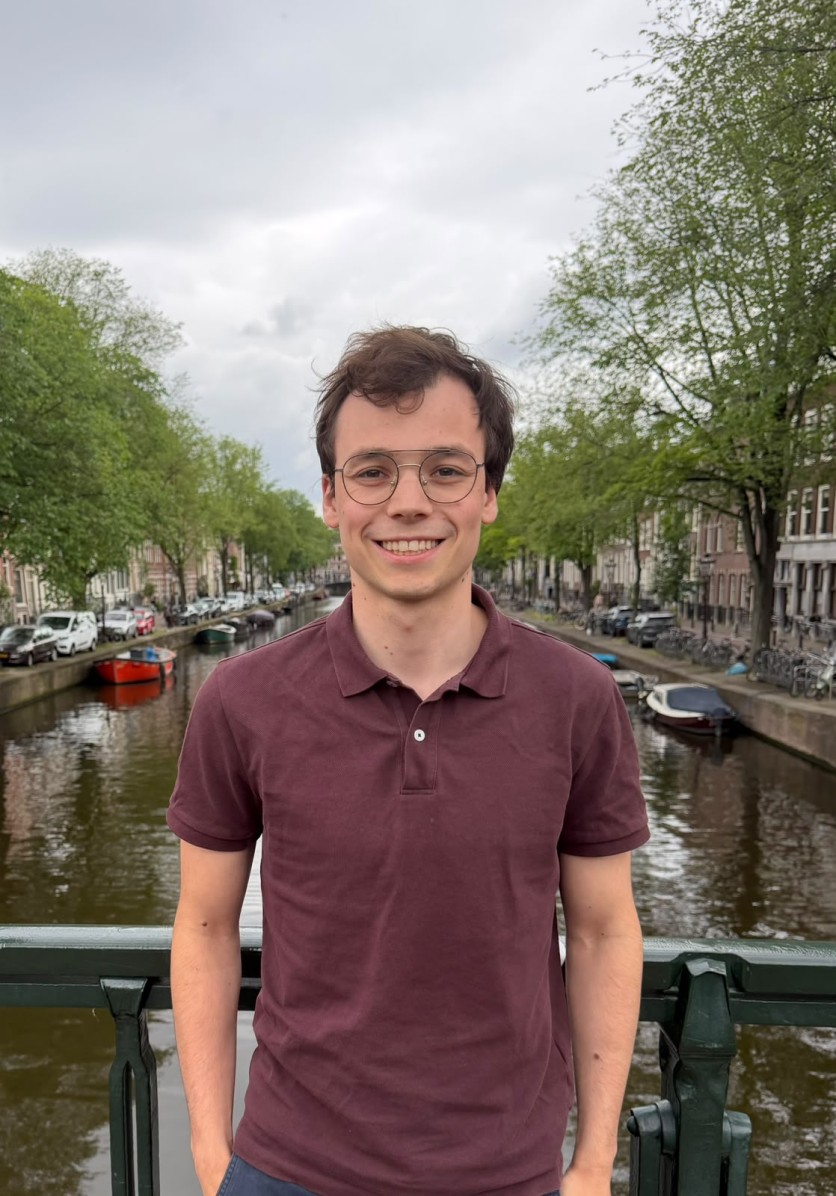
There is a particular kind of decision that looks, from the outside, like it doesn't add up. Luc Feron has made several of them, and each time, the logic has been cleaner than it appears.
As a final-year undergraduate at Maastricht University, Feron was already spending half his week in Amsterdam. The commute was 180 kilometres each way. He would work part-time at Optiver, sleep in a hotel, return to Maastricht for exams, and repeat. It was not the path any academic advisor would have drawn up, and it was not the most comfortable way to complete a degree. But Feron was willing to absorb the inconvenience to get both the degree and the experience most graduates spend years waiting for.
That willingness to act on a conviction, even when the conventional path is easier and the outcome is uncertain, is something that recurs throughout his career.
The Academic Foundation
Feron studied Econometrics and Operations Research at Maastricht University, a programme that sits at the intersection of advanced mathematics, probability theory, and applied modelling. The coursework is technically demanding, attracting those who seek clean, logical solutions yet have the patience to work through complex, ill-defined problems.
Feron graduated summa cum laude with a 9.5 GPA. His bachelor's thesis focused on optimal stopping problems with partial observations, a branch of mathematics concerned with when to act under incomplete information. The work earned him the department's annual prize for best thesis.
When he finished, the obvious next step was a master's degree. For a student with his results, the doors would have been open. He chose not to go through them. For Feron, the goal was the application of theory, not its continued refinement in a classroom. Optiver, where he had already been working part-time, was offering the faster and more direct route to what he actually wanted to learn.
The Firm
Optiver sits in a small tier of market-making firms alongside Jane Street and Citadel Securities. These firms are known for recruiting almost exclusively from top quantitative programmes, running candidates through multiple rounds of probability problems, mental arithmetic, and live trading simulations, and trading exclusively with their own capital, no client mandates, no management fees.
The work inside these firms is defined by applied probability. Traders operate under conditions where information is incomplete, outcomes are uncertain, and decisions carry immediate financial consequences. Performance is visible in real time. There is no ambiguity about whether a call was right or wrong, and adjustments have to follow quickly. It is an environment that builds a specific kind of thinking: disciplined, probabilistic, and oriented toward making good decisions with whatever information is currently available.
Feron spent over three years on the European single stock options desk. He had a direct impact on the desk's performance, both through his own judgment calls and through contributions to the systems and processes around him.
The Turn
Roles at firms like Optiver are not ones people typically leave on a whim. The work is substantive, the environment is competitive, and for most who earn a place there, the natural move is to stay and build.
Feron stayed long enough to know the work well. But over time, his attention began shifting toward a different set of questions. He had developed a growing conviction about the trajectory of artificial intelligence, not as a passing trend, but as a shift he believed would have consequences well beyond the technology sector. The more he looked at it, the more he felt his background gave him a perspective on it that was worth acting on rather than observing from a distance. That framing, direct, unadorned, focused on action rather than theorising, is consistent with the decisions that preceded it.
He is planning to leave Amsterdam and relocate to San Francisco, where he is co-founding a new fund with a former quantitative researcher.
The Pattern
What connects the student commuting across the Netherlands, the graduate who turned down a master's degree, and the trader who left one of the world's most selective firms to build something new? In each case, the conventional option was available, and the unconventional one was chosen, not out of restlessness, but because the better opportunity was somewhere else.
To Feron, the thread running through these decisions is straightforward: if the opportunity is real and you have the ability to pursue it, you pursue it. San Francisco is the latest version of that logic playing out.
ⓒ 2026 TECHTIMES.com All rights reserved. Do not reproduce without permission.


