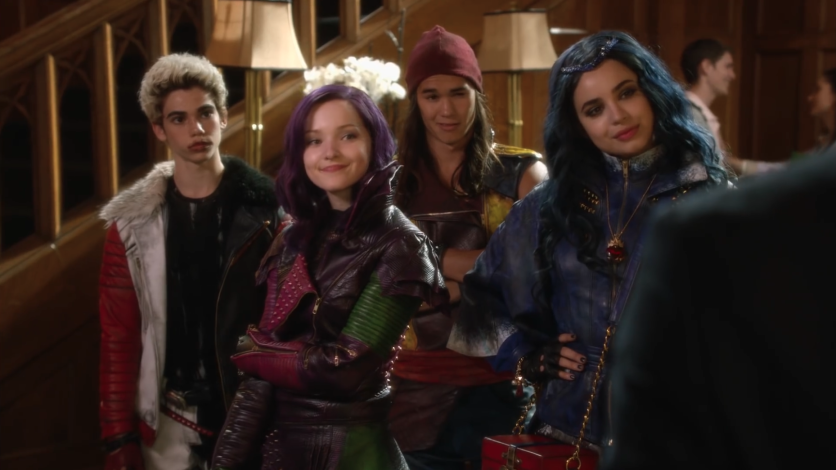
Disney confirmed on June 8, 2026 that Descendants: Wicked Wonderland will premiere on Thursday, July 16, on Disney Channel — with streaming beginning the following day on Disney+. The announcement came packaged with the franchise's first teaser trailer, a surprise casting reveal for Awkwafina, and the introduction of Pink, a brand-new character whose very existence resolves a question that has divided physicists for decades: when you change the past, do you get a self-consistent loop, or a genuinely new branch of reality? Wicked Wonderland has already answered that question, and its answer is more scientifically sophisticated than most Hollywood blockbusters bother to attempt.
Pink (played by Liamani Segura) is Red's younger sister — a person who did not exist before Red and Chloe traveled back in time in Descendants: The Rise of Red (2024) to prevent the Queen of Hearts from becoming a villain. She is not a version of someone who might have been born anyway. She is an entirely new individual created by the time-travel intervention, and her presence onscreen is a worldbuilding commitment with specific physics implications that hold up under examination.
Pink Rules Out Novikov: Why One New Character Changes Everything
Two dominant physical frameworks govern how theorists treat time travel in spacetimes that permit what general relativity calls closed timelike curves — paths through spacetime that loop back to an earlier moment in a traveler's own history.
The first is the Novikov self-consistency principle, developed by Russian astrophysicist Igor Novikov in the mid-1980s. Under Novikov's model, any event that would cause a paradox has zero probability of occurring. The laws of physics select only globally consistent outcomes — meaning Red and Chloe's intervention was always part of the timeline, their actions were always baked in, and nothing genuinely new can emerge from a trip to the past. This is the "always was" model used by films like the original Terminator and, in certain readings, Harry Potter and the Prisoner of Azkaban: the time traveler cannot change anything, because everything they did was already done.
Pink rules that model out entirely. A person who did not previously exist cannot be explained by a self-consistent loop. Under Novikov's framework, the probability of the event that created her — an intervention that introduced a genuinely new individual into the timeline — would be zero. The fact that she is there, walking around Wonderland as a fully realized character with her own story arc, commits the franchise to the competing framework: the many-worlds interpretation, first proposed by physicist Hugh Everett in his 1957 Princeton dissertation.
Under the many-worlds model, time travel does not change the original timeline — it spawns a new branch. The original past is not erased; it persists in an inaccessible fork. In the new branch, Pink simply exists, because the causal conditions that brought her into being are real in that branch. The franchise does not treat her as an anomaly. She is just real now, and the film's conflict flows from that reality rather than from an attempt to undo it.
This makes Wicked Wonderland the rare family franchise that operates under a branching-timeline model rather than the tidier Novikov loop — an internally consistent choice, and a more physically honest one.
Butterfly Effect Physics: Classical Chaos, Not Quantum Mechanics
Disney's official description of Wicked Wonderland states the film revolves around the butterfly effect — the principle formalized by meteorologist Edward Lorenz after he discovered in 1961 that rounding a single decimal in a weather simulation produced completely divergent forecasts. The term entered popular culture through Ray Bradbury's 1952 story "A Sound of Thunder," in which stepping on a single prehistoric butterfly rewrites all of civilization — a story Los Alamos National Laboratory explicitly cited when publishing its own butterfly-effect research in 2020.
The franchise's causal logic maps directly onto classical chaos theory: a pinpoint intervention at castlecoming, where Red and Chloe prevented a prank from occurring, has cascaded into a new villain, a new person, and a transformed Wonderland. Small cause, large irreversible consequences. In classical deterministic systems, this is exactly what the physics predicts.
What makes the franchise's physics choice interesting is that quantum mechanics tells a counterintuitive opposite story. In 2020, theoretical physicist Nikolai Sinitsyn and postdoctoral researcher Bin Yan at Los Alamos National Laboratory used an IBM-Q quantum processor to simulate what happens when information "travels" back in time and is then damaged — the quantum equivalent of stepping on a butterfly. Their finding, published in Physical Review Letters, was striking: the quantum system largely restored itself when returned to the present. As Sinitsyn put it, "We found that our world survives, which means there's no butterfly effect in quantum mechanics."
The distinction is structural. Classical systems amplify small perturbations exponentially. Quantum systems distribute information across entangled correlations that are difficult to permanently damage — the further back in time the interference, and the larger the quantum system, the more resilient the future becomes. Wicked Wonderland operates in the classical register, where interventions are fragile and consequences are real.
Maddox Hatter's Goal Is Causal Sovereignty, Not Simple Villainy
The villain of Wicked Wonderland is Maddox Hatter (Leonardo Nam), Red's former mentor turned antagonist. His goal is to locate the pocket watch — a device that enables travel to specific moments in time — and use it to bend time and Wonderland to his will.
Under a branching-timeline model, this has a specific and coherent physics meaning. A precise time-travel device does not merely transport its user to the past; in a many-worlds framework, it allows the user to selectively cultivate favorable future branches. Maddox is not revisiting an old moment for nostalgic reasons. He is attempting to acquire an instrument that confers causal sovereignty — the ability to choose which branch of reality one inhabits and to shape the selection criteria.
This also makes Maddox Hatter a structurally coherent descendant of Lewis Carroll's original Mad Hatter. Carroll — whose real name was Charles Lutwidge Dodgson, a mathematician and logician who spent his career at Christ Church, Oxford — built the original Hatter's defining tragedy around time: his tea party is frozen permanently at 6 o'clock as punishment from Time itself, leaving him unable to move through it. Where Carroll's Hatter was enslaved by time and could not navigate it, Maddox Hatter's ambition is to master it entirely. The villain motivation is not borrowed from the source material — it is its structural inversion.
Awkwafina, New Cast, and Disney's Record-Breaking Fifth Film
The June 8 announcement confirmed Awkwafina (The Farewell) as the voice of Chessy the Cat, a new character joining the Wonderland ensemble. Kylie Cantrall and Malia Baker reprise their roles as Red and Chloe, respectively. Leonardo Nam returns as Maddox Hatter alongside Liamani Segura (Pink), Melanie Paxson (Fairy Godmother), Paolo Montalban (King Charming), Rita Ora (Queen of Hearts), and Brandy Norwood as Cinderella.
New cast members expand the Disney universe crossovers that define the franchise: Brendon Tremblay plays Max Hatter, Maddox's son; Alexandro Byrd plays Luis Madrigal, son of Luisa Madrigal from Encanto; Kiara Romero plays Hazel Hook, Captain Hook's daughter; Joel Oulette plays Robbie Hood, Robin Hood's son; Zavien Garrett plays Felix Facilier, son of Dr. Facilier from The Princess and the Frog; and Ryan McEwen and Dayton Paradis play the Smee twins.
Wicked Wonderland is the fifth installment in the Descendants franchise, which began on Disney Channel in 2015 under director Kenny Ortega. With five films, it becomes the Disney Channel Original Movie franchise with the most entries in history, surpassing the tie previously held by Halloweentown, High School Musical, and Zombies at four films each. According to The Walt Disney Company, the franchise's music catalog has accumulated more than 15 billion audio and video streams, and its consumer products line has moved nearly 7 million dolls and 9 million books, including four New York Times bestsellers.
Descendants: The Rise of Red premiered on Disney+ on July 12, 2024, setting the all-time viewership record for a Disney Branded Television original film on that platform. Director Kimmy Gatewood, working from a screenplay by Tamara Chestna, Dan Frey, and Ru Sommer, leads the production for this installment. Executive producers Suzanne Todd and Gary Marsh return from Rise of Red. The original soundtrack, distributed by Walt Disney Records, will be available beginning July 17, 2026.
Where to Watch Descendants: Wicked Wonderland
Descendants: Wicked Wonderland premieres Thursday, July 16, 2026, on Disney Channel. It becomes available for streaming on Disney+ beginning Friday, July 17, 2026. The original soundtrack releases the same day via Walt Disney Records.
Frequently Asked Questions
When does Descendants: Wicked Wonderland premiere?
Descendants: Wicked Wonderland premieres on Thursday, July 16, 2026, on Disney Channel. It becomes available to stream on Disney+ on Friday, July 17, 2026, the day after the Disney Channel broadcast.
Who voices Chessy the Cat in Descendants: Wicked Wonderland?
Awkwafina (The Farewell) voices Chessy the Cat in Descendants: Wicked Wonderland. The character joins the ensemble alongside returning leads Kylie Cantrall and Malia Baker and several new additions expanding the Disney universe into Encanto, Peter Pan, Robin Hood, and The Princess and the Frog.
What is the butterfly effect in Descendants, and does the science check out?
The franchise uses the butterfly effect in its classical physics sense: a small change to the past — preventing a prank at castlecoming — cascades into large, irreversible consequences, including a new villain and an entirely new person (Pink). This is consistent with Edward Lorenz's chaos theory. Notably, quantum physics tells a different story: a 2020 Los Alamos National Laboratory study found that quantum systems largely recover from past interference, suggesting reality would be self-healing at the quantum level — the opposite of what the franchise dramatizes.
Does Pink's existence mean Descendants uses the many-worlds interpretation?
Pink is a person who did not exist in the original timeline. Her existence after the time-travel intervention rules out the Novikov self-consistency principle, which holds that paradox-inducing events have zero probability. The only consistent physical framework that accommodates a genuinely new individual emerging from a past intervention is the many-worlds interpretation, in which the intervention spawns a new causal branch rather than altering the original. The franchise is effectively operating under a branching-timeline model, and Pink is its clearest evidence.
ⓒ 2026 TECHTIMES.com All rights reserved. Do not reproduce without permission.


