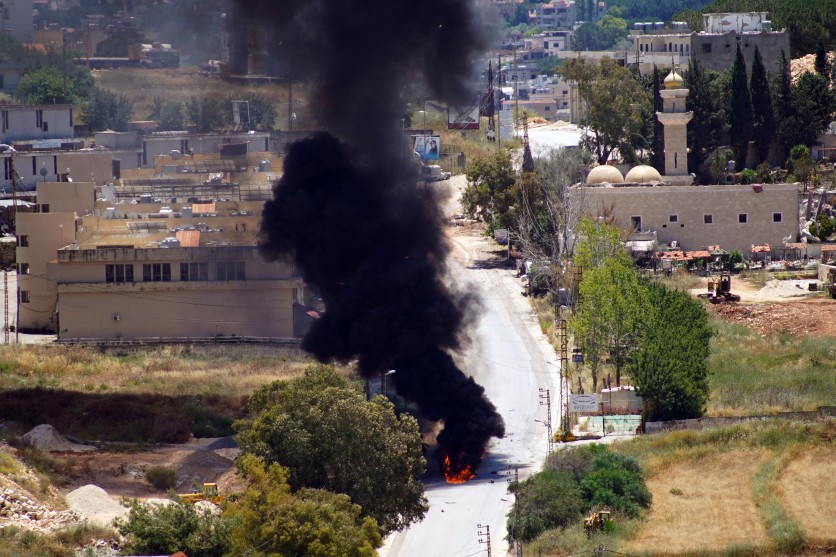
Iran's Islamic Revolutionary Guard Corps claimed responsibility early Wednesday for a drone strike against the US Navy's Fifth Fleet headquarters in Bahrain — the latest escalation in a fragile ceasefire environment now fraying on multiple fronts — and the attack landed on the same morning that Europe's largest aerospace show opened in Berlin with counter-drone procurement dominating its agenda. The confluence illuminates a gap that defense engineers have spent three months rushing to close: low-cost loitering munitions are reaching hardened command facilities faster than affordable intercept technology has reached the bases that need it.
The IRGC announced the strike took place at approximately 2:30 a.m. local time in Bahrain (7:30 p.m. ET Tuesday) against Naval Support Activity Bahrain in Manama's Juffair district, where the Fifth Fleet oversees American naval operations across the Persian Gulf, Red Sea, and Arabian Sea. The Guards framed the attack as retaliation for fresh US airstrikes on Jask, Sirik, and Qeshm in southern Iran, stating that US forces had damaged a telecommunications mast and destroyed water tanks. Bahrain's Interior Ministry confirmed the attack's reality within minutes, activating nationwide air raid sirens twice within an hour and urging citizens to "remain calm and head to the nearest safe place."
No US casualty figures or official damage assessments from the Bahrain strike had been released as of this article's publication. The Pentagon and US Central Command had not issued public statements acknowledging the attack, a pattern consistent with the administration's posture throughout the conflict.
"Heavier Responses" Threatened as Cycle Continues
The Bahrain strike was part of a broader IRGC salvo. The Guards simultaneously claimed attacks on US air bases in Kuwait and Jordan, including — though without independent verification — F-35 fighter jet hangars at Al Azraq Air Base in Jordan and the downing of an MQ-9 Reaper drone over the city of Jam. The Guards said their forces carried out 21 attacks against American air and naval facilities across the region, though CENTCOM had not confirmed those specific damage claims at publication time.
The IRGC's statement warned explicitly: "In the event of continued hostility, heavier responses are on the way." The trigger for this round was the downing of a US Apache helicopter by Iranian forces — an incident that prompted President Trump to state the US "must" respond, initiating the latest exchange that preceded the Bahrain strike.
Since Operation Epic Fury began on February 28, when the United States and Israel launched coordinated strikes on Iran that killed Supreme Leader Ali Khamenei, US Central Command has confirmed approximately 303 American service members wounded and at least 13 killed across the theater. The Fifth Fleet compound in Bahrain's Juffair district was among the first targets struck in Iranian retaliation on February 28 itself, and the facility has been targeted repeatedly since.
An April 8 ceasefire brokered by Pakistan officially remains nominally in place — but has been described by President Trump as on "life support," and fighting has persisted intermittently since May 4. Secretary of State Marco Rubio said earlier this month that the US-Iran war is "over," even as US and Iranian forces continued exchanging strikes. Wednesday's attack is the most significant direct targeting of the Fifth Fleet command facility since the ceasefire period began.
ILA Berlin Opens Same Morning: Counter-Drone Hardware Fills the Gap
The timing is not incidental to the procurement conversation playing out in Berlin. ILA Berlin 2026, the continent's premier aerospace and defense exhibition, opened Wednesday at Berlin ExpoCentre Airport with counter-drone systems as the centerpiece of the ground defense portfolio.
The day before ILA opened, MBDA Germany unveiled the Combined DefendAir–DEWS-L Asset Protection System — a palletized turret integrating 24 DefendAir short-range counter-UAS missiles alongside a high-energy directed-energy weapon system on a single platform. Also on June 9, Diehl Defence unveiled the IRIS-T SLS MK 4, which packages radar, command-and-control, and eight IRIS-T interceptors onto a single Mercedes-Benz Zetros 6x6 vehicle and is compatible with the lower-cost CICADA eMissile for engaging smaller UAVs. Rheinmetall is exhibiting the Skyranger 30 turret, integrated onto a Boxer 8x8 armored vehicle and paired with MBDA's DefendAir guided missiles, specifically designed to counter drone swarms and loitering munitions in mobile formations.
How Loitering Munitions Broke Base Defense Economics
Understanding why today's strike matters to defense engineers — not just to military planners — requires understanding what the Shahed-class drone is and is not.
A loitering munition sits in the design niche between a cruise missile and an unmanned combat aerial vehicle. Unlike a cruise missile, which is optimized for high-speed transit to a fixed target, a loitering munition is designed to circle a target area for hours using electro-optical sensors, identify and track a specific asset, and then dive into it. Unlike a full UCAV, it is expendable by design: built-in warhead, one-way mission, no recovery.
The Shahed-136, the most deployed variant in the IRGC's arsenal, weighs approximately 200 kilograms, carries a 23-kilogram warhead, and cruises at roughly 190 kilometers per hour using a 37-horsepower Wankel rotary engine. That combination produces a radar cross-section small enough to challenge lower-band acquisition radars, a flight profile that can exploit terrain masking, and a per-unit cost estimated between $20,000 and $50,000. The adversary economics are unambiguous: a single Patriot interceptor missile costs roughly $4 million; a standard Advanced Medium-Range Air-to-Air Missile runs approximately $1 million. Defending a command compound against a dozen Shahed-class drones with traditional kinetic intercept would require spending $12 million to $48 million to defeat a $240,000 to $600,000 attack.
That arithmetic is the structural problem every counter-drone procurement decision at ILA Berlin is trying to solve. The MBDA hybrid system addresses it through a two-tier cost structure: the laser weapon handles small, low-value targets at near-zero marginal cost per shot, while the 24 missile interceptors are reserved for higher-value threats. Diehl's CICADA eMissile for the IRIS-T SLS MK 4 fills the same role — a lower-cost interceptor dedicated to the commercial and tactical UAV threat tier, freeing the expensive IRIS-T missiles for more capable targets.
How Iran Drone Attacks Are Reshaping Base Defense Doctrine
The challenge is not purely economic. The IRGC has demonstrated throughout the 2026 conflict that Shahed-class drones can be launched in coordinated multi-axis salvos — what analysts call "swarm-style" employment even when individual units are not autonomous — saturating point-defense systems that were designed for a smaller number of higher-speed, higher-altitude incoming threats. When the drone launch rate exceeds the intercept reload cycle, any gap in coverage becomes a potential path to a hardened facility.
Ukraine's experience defending against Shahed drones deployed by Russia since 2022 has become the primary operational laboratory for counter-UAS doctrine in the Gulf. Over 200 Ukrainian drone warfare specialists were deployed to the Middle East at US request in March 2026 to transfer hard-won knowledge. The core lesson Ukraine transmitted: electronic warfare alone — GPS jamming, radio-frequency spoofing — is insufficient against a sufficiently large and diverse launch. Layered systems combining detection, electronic warfare, kinetic intercept, and directed-energy engagement are required, and the layer must be present at the individual base level, not only at the theater-level integrated air defense network.
That is precisely what the ILA Berlin exhibits are engineered to provide. What the Gulf conflict has clarified — and what the Bahrain strike underscores again this morning — is that the timeline for deploying those systems to US and allied bases in the theater has not kept pace with the IRGC's rate of attack.
Gulf Chokepoint Remains Closed, Off-Ramp Remains Absent
The Strait of Hormuz — through which roughly 20 percent of global oil supply transits — remains closed under Iranian control, with a US naval blockade of Iranian shipping in parallel operation. EU sanctions on the IRGC over the strait's closure add diplomatic pressure, but neither sanctions nor ceasefire language has interrupted the exchange of drone strikes.
With the April 8 ceasefire described as on "life support" and the June 7 round of escalation producing the worst Iran-Israel exchange in months before a partial mutual suspension, the structural driver of Wednesday's attack is unchanged: the cycle of US airstrikes on Iranian territory and IRGC retaliation against Gulf bases hosting US forces has no agreed off-ramp. Iran's Foreign Minister Seyed Abbas Araghchi posted on X earlier this week: "Leave our region if you want to be safe."
For defense planners leaving ILA Berlin's counter-drone exhibits this week, the morning's events confirm that the procurement requirement is not hypothetical. The market being addressed by MBDA, Diehl, and Rheinmetall on the Berlin show floor is the same threat that reached the Fifth Fleet's command compound at 2:30 a.m. Bahrain time — and the gap between what is now on display in Berlin and what is deployed at the bases in Manama, Kuwait, and Jordan is a gap that Wednesday's strikes measured in real time.
Frequently Asked Questions
What did Iran's IRGC target in the June 10, 2026 Bahrain drone strike?
Iran's Islamic Revolutionary Guard Corps claimed a drone attack against the US Navy's Fifth Fleet headquarters at Naval Support Activity Bahrain in Manama, launched at approximately 2:30 a.m. local time. Bahrain's Interior Ministry confirmed the attack and activated nationwide air raid sirens twice within an hour. The US military had not publicly confirmed damage or casualties at publication time.
How do Shahed-class loitering munitions defeat base air defenses?
Shahed-class drones fly at roughly 190 kilometers per hour using a small Wankel rotary engine, producing a radar cross-section that challenges lower-band acquisition radars. At an estimated $20,000–$50,000 per unit, they impose a severe cost asymmetry: each standard Western missile interceptor costs $1–4 million, making kinetic-only defense economically unsustainable against swarm-style launches. New hybrid systems at ILA Berlin 2026 pair directed-energy lasers with missile interceptors specifically to address this tradeoff.
Is the US-Iran ceasefire still in effect after the Bahrain strike?
An April 8, 2026 ceasefire brokered by Pakistan nominally remains in place, but President Trump has described it as on "life support." Intermittent exchanges of US and Iranian strikes have continued since May 4, and June 2026 has seen some of the worst escalation since the ceasefire, including the June 7 Iran-Israel exchange and now the June 10 Fifth Fleet strike.
What counter-drone systems debuted at ILA Berlin 2026?
MBDA Germany unveiled the Combined DefendAir–DEWS-L system, pairing 24 short-range counter-UAS missiles with a high-energy laser on one turret. Diehl Defence unveiled the IRIS-T SLS MK 4, which integrates radar, command-and-control, and eight interceptors on a single vehicle and supports the lower-cost CICADA eMissile for small-drone threats. Rheinmetall is showing the Skyranger 30, a mobile armored air-defense turret paired with guided missiles to counter drone swarms in moving formations.
ⓒ 2026 TECHTIMES.com All rights reserved. Do not reproduce without permission.


