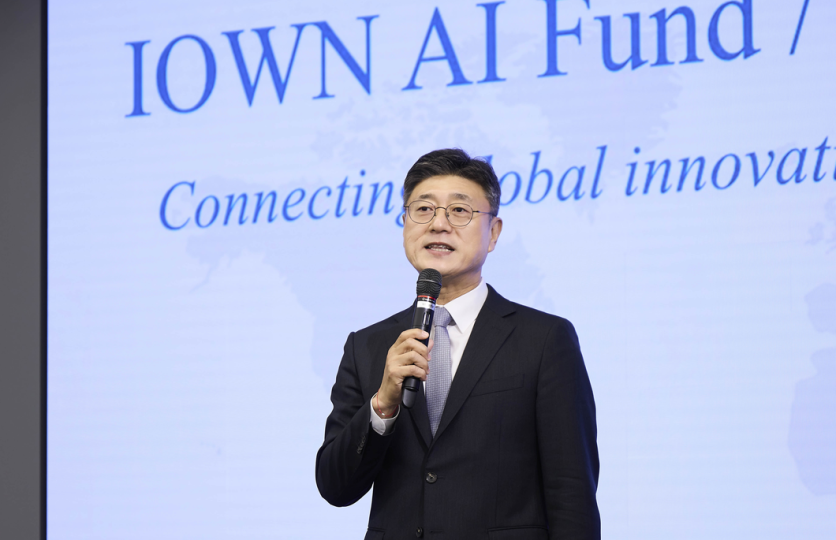
Three of East Asia's largest telecom operators — South Korea's SK Telecom, Japan's NTT, and Taiwan's Chunghwa Telecom — are jointly launching a $500 million fund to invest in next-generation AI technology, a cross-border push to build out the regional AI ecosystem. The choice of name signals the strategy: it is called the IOWN AI Fund, after NTT's Innovative Optical and Wireless Network, the optical-networking platform the three carriers are betting can ease the biggest constraint on AI's growth — power.
The companies announced the fund at a joint press conference at NTT's headquarters in Tokyo's Otemachi district on June 10. It will be managed by Catalight Capital, a newly created firm with operations in Silicon Valley and Tokyo, set up to give the fund a global footprint. Alongside SK Telecom's SK Group, NTT, and Chunghwa Telecom, the founding partners include the Development Bank of Japan and Young Sohn, the former Samsung Electronics chief strategy officer and founding managing partner of Walden Catalyst Ventures, who joins as an operating partner.
The fund will back startups across the AI value chain: data-center infrastructure such as power-efficiency tools and liquid cooling; AI chips including accelerators, GPUs, and NPUs; AI applications for industries from healthcare and manufacturing to finance; software for cloud distributed systems and inference optimization; and optical communications to boost data-transmission performance and energy efficiency. Target companies span North America, Asia, and Europe. Beyond capital, the partners say they will help startups with technology validation, service development, and customer access.
Why an Optical Network Sits at the Center of an AI Fund
The anchor to IOWN is the part worth understanding, because it explains why telecom operators — not chipmakers — are the ones writing these checks. AI data centers are colliding with a power wall: the International Energy Agency's executive director has warned that data centers' worldwide electricity use could rival that of all of Japan by 2030. Moving and processing the torrents of data that AI requires is increasingly an energy problem, not just a compute one.
IOWN's All-Photonics Network is NTT's answer. Conventional long-distance networks repeatedly convert signals between optical and electrical form to regenerate and route them, and each of those conversions burns power and adds delay. IOWN keeps the data as light from end to end, eliminating those optical-electrical-optical conversions. NTT says the approach can cut network power consumption toward one-hundredth of today's levels, raise capacity more than a hundredfold, and slash latency to a fraction of a percent of current figures. For carriers whose core business is moving data efficiently, photonics is a way to turn that expertise into an AI-infrastructure advantage.
Read more: Nvidia and SK Group Sign First Multi-Platform AI Alliance: Memory, Cloud, Fab Design Under One Deal
The thesis is not just theory. In August 2024, NTT and Chunghwa Telecom activated the world's first international IOWN optical link, connecting Chunghwa's site in Taiwan with NTT's Musashino R&D Center near Tokyo and carrying data across roughly 3,000 kilometers with a one-way latency of 17 milliseconds. That deployment is the proof point the fund is built on.
The Backers Lining Up
Interest is building beyond the three founders. NTT said more than 20 companies worldwide have signaled they may invest, with Japanese reporting naming Sony, Toshiba, and Fujitsu, along with the country's three megabanks; chipmaker SK hynix is also preparing to join. The fund is due to be formally established by the end of June.
For SK Telecom, the fund extends a wider AI-infrastructure strategy. The carrier has been positioning itself as a provider of AI data centers and the integration layer above raw compute, and it said it plans to keep expanding Korea-Japan economic and technology cooperation — in AI data centers and in both business and consumer AI services — using the fund as a foundation. NTT, for its part, gains a vehicle to spread IOWN adoption globally, while Chunghwa Telecom said it would use its telecom expertise to help startups expand across borders.
Read more: Nvidia Names SK Telecom Key Physical AI Partner: Joint Committee Targets Chip Fab Autonomy
The press conference drew senior leaders from all three companies, including SK Telecom CEO Jung Jae-heon, NTT CEO Akira Shimada, and Chunghwa Telecom President Lin Rong-Shy, with Young Sohn taking part in the signing. The fund is one of the clearest signs yet that East Asia's big carriers see the AI buildout not as a market to buy into, but as one to build — starting with the networks that move the data.
Frequently Asked Questions
What is the IOWN AI Fund?
The IOWN AI Fund is a roughly $500 million investment fund launched by SK Telecom, NTT, and Chunghwa Telecom, with the Development Bank of Japan and investor Young Sohn, to back AI startups in data-center infrastructure, chips, optical communications, software, and applications. It is named after NTT's IOWN optical-networking initiative and managed by a new firm, Catalight Capital.
What is IOWN?
IOWN, or the Innovative Optical and Wireless Network, is NTT's initiative to build networks around photonics — keeping data in optical form rather than repeatedly converting it to electrical signals. NTT says the approach can sharply cut power use and latency while greatly increasing capacity, which it argues is well suited to the demands of AI data centers.
How much power do AI data centers use?
A lot, and rising fast. The International Energy Agency's executive director has said that data centers' global electricity consumption could rival that of all of Japan by 2030, which is a central reason the fund's backers are targeting power-efficient infrastructure and optical networking.
Who is managing the IOWN AI Fund?
The fund will be managed by Catalight Capital, a newly created fund-management firm with operations in Silicon Valley and Tokyo. Young Sohn, founding managing partner of Walden Catalyst Ventures and a former Samsung Electronics chief strategy officer, is an operating partner alongside the telecom founders and the Development Bank of Japan.
ⓒ 2026 TECHTIMES.com All rights reserved. Do not reproduce without permission.


