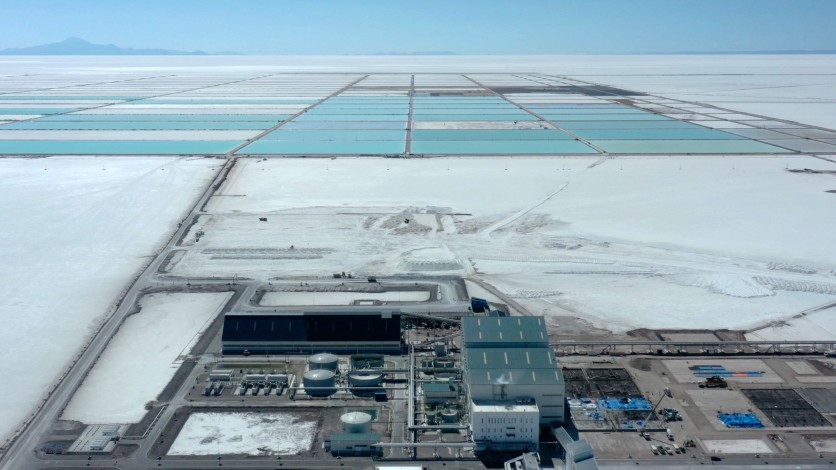
POSCO Holdings will demonstrate its direct lithium extraction (DLE) technology in the United States — the first Korean company to do so, according to the company — under a cooperation agreement with Australian developer Anson Resources to build and run a demonstration plant in Utah. POSCO said on June 10 that it had signed the agreement for a DLE demo plant at Anson's Green River lithium project, in Utah's Paradox Basin, with the plant targeted to begin operating in 2027 and the demonstration program running through 2028.
The reason the project matters goes beyond one plant. It is a test of whether a specific technology can unlock lithium the United States badly wants to produce at home but mostly cannot — and of whether a Korean industrial group can plant itself at the front of that effort.
What Direct Lithium Extraction Actually Does
The conventional way to get lithium from brine is to pump it into vast ponds and let the sun evaporate the water for a year or more, leaving concentrated lithium salts behind. That works, but it is slow and wasteful: evaporation takes 18 to 24 months and recovers only about half the lithium in the brine, demands enormous land and water, and is economical only where brine is unusually concentrated and the climate is dry, as in South America's high-altitude salt flats.
DLE takes a different route. Instead of waiting on evaporation, it runs the brine through an engineered material — typically a sorbent or resin — that selectively grabs lithium and lets the rest pass; the loaded material is then washed to release a concentrated lithium solution, while the spent brine, still carrying most of its water and impurities, is reinjected. The payoff is speed and reach: recovery in hours or days rather than months, recovery rates often in the 70-to-90% range, a far smaller land and water footprint, and — crucially — the ability to make economic sense of low-concentration brine that ponds could never justify. It also avoids the large evaporation ponds that carry significant permitting and environmental risk, particularly in water-stressed regions.
That last point is the whole game for the United States. Most accessible American brine — in oilfields, geothermal fields, and basins like Utah's Paradox — is too low-grade for evaporation ponds. DLE is the technology that can turn those resources into supply.
Why the United States Wants This at Home
The strategic backdrop is a supply chain heavily tilted toward one country. The U.S. produces only a tiny share of the world's lithium, and processing of battery minerals leans heavily on China, which handles a majority of the world's lithium refining. Washington has been pushing to onshore and "friendshore" that supply through sourcing rules and mineral-production initiatives that favor material from the United States or its free-trade partners. A Korean company — from a U.S. free-trade-agreement partner — demonstrating extraction technology on a domestic resource fits that policy logic neatly, and the collaboration positions Green River as a potential cornerstone in the emerging U.S. critical-minerals and battery supply chain.
How the Deal Is Structured
Under the agreement, POSCO will fund, design, build, and operate the non-commercial facility at its own expense, drawing brine from Anson's Bosydaba #1 well, while Anson provides the site, infrastructure, brine supply, and permitting and retains ownership of the resource. POSCO will pay Anson a facilitation fee of about AUD 7.2 million, roughly $5.2 million, and the partners will evaluate broader commercial opportunities — including possible joint investment — as the plant runs. The demonstration is meant to validate the technology on real brine at near-commercial scale and lay the groundwork for commercialization.
This is not POSCO's first run at DLE. The company has been developing the technology since 2016, running pilot tests on brine from regions including Argentina, where it built a demonstration plant in 2020 and went on to establish commercial lithium operations. The Utah project extends that track record from South America into North America.
Lee Ju-tae, president of POSCO Holdings, called the project a strategic investment to secure next-generation technology early and gain a head start in the global lithium market, adding that it would strengthen the company's lithium business in North America and beyond. For POSCO, validating the technology on U.S. soil is as much about positioning in a policy-shaped market as it is about the chemistry — though, as the demonstration through 2028 is meant to prove, the chemistry has to work first.
Frequently Asked Questions
What is direct lithium extraction?
Direct lithium extraction (DLE) is a group of technologies that pull lithium directly from brine using an engineered material — such as a sorbent, resin, or membrane — that selectively captures lithium ions. The material is then washed to release a concentrated lithium solution, and the spent brine is reinjected, avoiding the long evaporation step used in conventional brine production.
How is DLE different from evaporation ponds?
Evaporation ponds pump brine into large basins and rely on the sun to concentrate lithium over 18 to 24 months, recovering only about half of it and requiring lots of land and water. DLE recovers lithium in hours or days at higher rates, uses a much smaller footprint, and can economically process low-concentration brine that ponds cannot.
Where does US lithium come from?
The United States currently produces only a small fraction of global lithium and imports most of what it uses, while China dominates the processing and refining of battery minerals. That dependence is why U.S. policy favors onshoring and sourcing from free-trade partners, and why technologies like DLE that can unlock low-grade domestic brine are strategically important.
What is the POSCO Green River project?
It is a DLE demonstration plant POSCO Holdings will build and operate at Anson Resources' Green River lithium project in Utah's Paradox Basin, using brine from Anson's Bosydaba #1 well. POSCO funds and runs the plant and pays Anson a facilitation fee of about AUD 7.2 million; the plant is targeted to begin operating in 2027, with validation running through 2028.
ⓒ 2026 TECHTIMES.com All rights reserved. Do not reproduce without permission.


