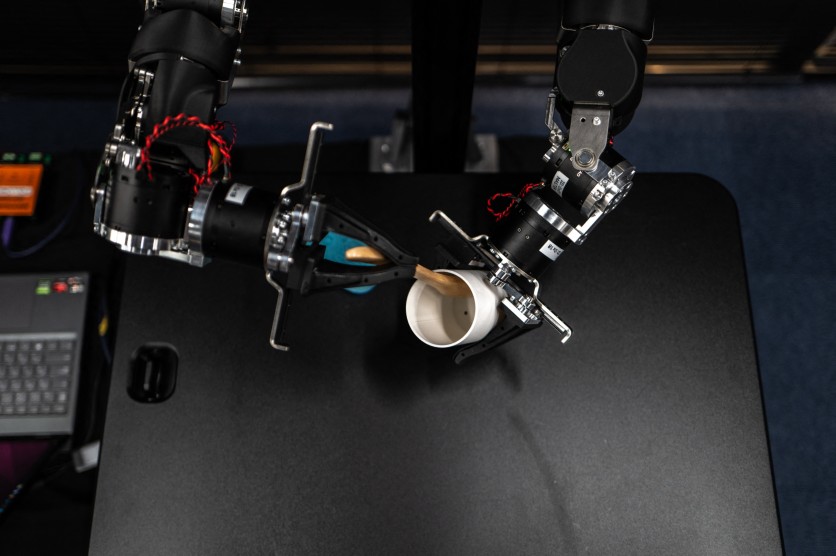
The hardest problem in robotics is not walking or seeing; it is the hand. At ICRA 2026, the field's flagship robotics conference in Vienna, the company TARS made the international debut of its DexHand platform, a robotic hand built to close the gap between machines that can move and machines that can manipulate. TARS chief scientist and co-founder Dr. Ding delivered a plenary keynote, and the demonstration drew attention from both industry and academia.
For readers tracking when robots will do genuinely useful physical work, dexterity is the metric that matters. A robot that can walk into a warehouse or a kitchen is only valuable if its hands can pick up, orient and handle the varied, delicate objects the real world is full of. DexHand is a bid at exactly that capability.
What was shown
The headline demonstration was tactile and immediate: the hand signed all 26 letters of the English sign-language alphabet and invited real-time mirror-control interaction, mimicking a person's hand movements live. Signing the full alphabet is a stringent test because each letter demands a distinct, precise configuration of fingers and thumb, the kind of fine coordination that has eluded robotic hands for decades.
Behind the demo are three specific engineering choices. The hand uses a 21-degree-of-freedom architecture modeled one-to-one on the human metacarpal and phalangeal topology, meaning its joints map directly onto the bones of a human hand rather than approximating with fewer motors. Its fingertips integrate ultra-high-resolution miniature camera modules that capture surface textures as fine as 0.05 millimeters at more than 240 hertz. And it runs an embodied foundation model the company calls AWE 3.0, which lets the hand interpret physical properties such as hardness, roughness and slip risk.
Why fingertip cameras and an embodied model matter
The technical story worth understanding is how DexHand senses touch. Rather than relying solely on pressure sensors, it places cameras inside the fingertips, an approach in the lineage of camera-based tactile sensing, where a small camera watches a deformable surface and infers contact, texture and force from how that surface changes. Capturing detail down to 0.05 millimeters at 240 hertz gives the hand a high-bandwidth stream of what it is touching, far richer than a simple on/off contact signal.
That raw sensing only becomes useful when something interprets it, which is the role of the AWE 3.0 embodied foundation model. "Embodied" means the model is trained to connect perception to physical action, fusing the tactile and visual streams into judgments a manipulation task needs: is this object hard or soft, smooth or rough, about to slip from my grasp? A hand that can answer those questions in real time can modulate its grip, the difference between crushing an egg and dropping it. Pairing a near-human-DoF mechanical hand with a model that reasons about touch is the combination researchers have long argued is required for general manipulation.
Read more: Humanoid Robots Reach Production Scale: Robotics Summit Opens on ROS vs. Proprietary Physical AI
Where it sits in the field
ICRA is the premier venue for this kind of work, and DexHand arrived amid a broader 2026 surge in "physical AI," the effort to give robots the bodies and the models to act in the real world. Dexterous hands are a recognized chokepoint: humanoid robots reaching factory floors and quadrupeds gaining payload capacity still struggle with the manipulation that human workers perform without thinking. A hand that signs the alphabet and senses texture at microscopic resolution is a marker of progress on that specific, stubborn problem.
The honest caveats
A keynote demonstration is a proof of capability, not a shipped product. Signing letters and mirroring a human hand under controlled conditions is impressive, but the questions that determine real-world value remain open: how durable the fingertip cameras and 21 joints are under repeated industrial use, what the hand costs, how much it can do autonomously rather than under tele-operated mirror control, and how well the AWE 3.0 model generalizes to objects and tasks it was not shown. These are vendor demonstrations and vendor claims until independent testing and real deployments confirm them, which is the standard any robotics milestone should be held to.
Bottom line
TARS used ICRA 2026 to debut DexHand, a 21-degree-of-freedom robotic hand with in-fingertip cameras sensing texture to 0.05 millimeters and an embodied AI model that reads hardness, roughness and slip, demonstrated by signing all 26 letters of the alphabet. It targets the field's central unsolved problem, dexterous manipulation, and represents real progress on tactile sensing and hand design. Whether it becomes a deployable tool depends on durability, cost and autonomy that a conference demo cannot yet prove.
Frequently Asked Questions
What is TARS DexHand?
A robotic hand unveiled at ICRA 2026 with a 21-degree-of-freedom design modeled on the human hand, fingertip cameras that sense texture as fine as 0.05 millimeters at over 240 hertz, and an embodied AI model that judges hardness, roughness and slip.
Why is robotic dexterity such a hard problem?
Manipulating varied, delicate objects requires fine coordination and a sense of touch that machines have long lacked. Many robots can move and see but cannot reliably grasp and handle real-world objects, which limits their usefulness.
How does the hand sense touch?
It uses cameras inside the fingertips that infer contact, texture and force from how a surface deforms, a camera-based tactile approach, and fuses that with vision through its embodied foundation model to guide its grip in real time.
Is DexHand a finished product?
No. It was a conference demonstration. Its durability, cost, degree of autonomy, and how well its model generalizes to new tasks remain to be proven through independent testing and real deployments.
ⓒ 2026 TECHTIMES.com All rights reserved. Do not reproduce without permission.


