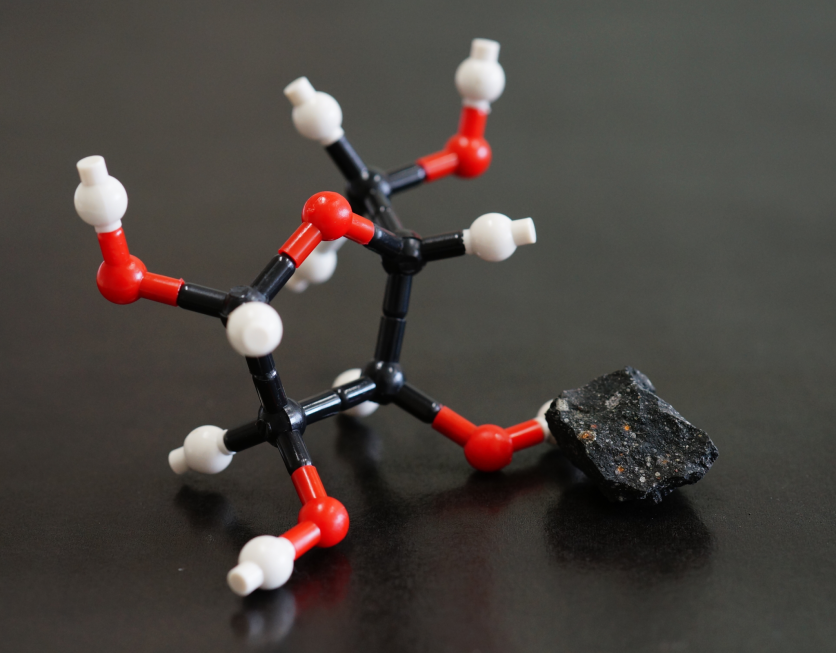
Astronomers have detected the first true sugar molecule in the space between stars — a four-carbon compound called erythrulose — and its presence narrows one of origin-of-life research's most persistent gaps. An international team led by astrochemist Izaskun Jiménez-Serra of Spain's Centro de Astrobiología submitted a preprint to arXiv on June 2, 2026, reporting the discovery inside a molecular cloud at the center of our galaxy, roughly 26,000 light-years from Earth. Universe Today published its analysis today, June 10, bringing the finding to wider public attention. The discovery matters specifically because erythrulose is a direct chemical precursor to the backbone of Threose Nucleic Acid (TNA), the leading scientific candidate for the genetic polymer that preceded RNA and DNA in the earliest life on Earth — meaning that for the first time, the TNA hypothesis has a confirmed interstellar supply chain for one of its core ingredients.
Prior reports of "sugar in space" referred to glycolaldehyde, a two-carbon aldehyde that can react toward ribose but is not itself a carbohydrate sugar. Erythrulose is a genuine monosaccharide — the same category of molecule as glucose and ribose — making this the first detection of an actual sugar in the interstellar medium (ISM).
Erythrulose Interstellar Space Detection: How Astronomers Found It
The team trained two of the world's most sensitive radio telescopes on the molecular cloud G+0.693-0.027: the Yebes 40-meter telescope in Spain and the IRAM 30-meter telescope on Pico Veleta, also in Spain's Sierra Nevada. Together they swept through more than 91 gigahertz of frequency space across three atmospheric windows, hunting for the microwave fingerprint that identifies erythrulose. Every molecule rotates at frequencies determined by its mass distribution and bond geometry; by scanning the radio spectrum of G+0.693-0.027 and matching what they saw against laboratory measurements, the team identified 17 individual spectral transitions consistent with erythrulose. The false-detection probability stood at 0.2%, and the researchers analyzed the signal using Madcuba-SLIM software under the assumption of local thermodynamic equilibrium. As of this writing, the paper remains a preprint and has not yet completed peer review. The 2021 search by Insausti et al. using the same rotational-spectroscopy technique found nothing — underscoring how much sensitivity the new survey required.
How Erythrulose Forms Without Three-Carbon Precursors
The most chemically striking result was what the researchers did not find. Three-carbon sugars such as glyceraldehyde — the logical stepping stones toward a four-carbon molecule under simple carbon-by-carbon assembly — were at least eight times scarcer than erythrulose itself. Their absence forced a rethink of the formation pathway.
Using quantum chemical calculations and Kinetic Monte Carlo simulations, the team modeled how individual molecules and radicals behave on the surface of icy interstellar dust grains over astronomical timescales. The simulations showed that erythrulose most likely forms not by adding one carbon at a time but when two two-carbon molecules — glycolaldehyde and ethylene glycol — combine on grain surfaces. The constant bombardment of those grains by cosmic rays and atomic hydrogen generates reactive radical fragments that catalyze the reaction. The result is a four-carbon sugar assembled in a single bond-forming step, bypassing any three-carbon intermediate entirely. It is a chemistry that could not operate in the near-vacuum of the gas phase; it requires the solid surface of a dust grain as a reaction scaffold.
The abundance anomaly — erythrulose present, three-carbon precursors absent — is itself a validation of this pathway. If the molecule were building up stepwise, the three-carbon intermediates would be detectable. They are not.
TNA Gets an Interstellar Precursor: What the Discovery Upgrades
Modern biology stores and transmits genetic information using DNA and RNA, both built on a backbone of ribose, a five-carbon sugar. Ribose is notoriously difficult to synthesize under the chemical conditions available on the early Earth, which has long troubled origin-of-life researchers. One leading solution is Threose Nucleic Acid, first synthesized by chemist Albert Eschenmoser and studied extensively by John Chaput's group at the University of Arizona. TNA replaces ribose with threose, a four-carbon sugar, and retains the ability to store genetic information and base-pair with DNA and RNA.
The detection of erythrulose in the ISM elevates TNA from chemically plausible hypothesis to hypothesis-with-supply-chain. Ketose sugars like erythrulose readily convert to aldose sugars like threose in the presence of liquid water through a well-characterized reaction called isomerization. In other words, a planet with a liquid-water ocean that also received interstellar erythrulose — delivered by the meteoritic bombardment already documented in the geologic record — would have had threose available as a raw material for TNA assembly without requiring any local synthesis from scratch.
This does not prove TNA was life's first genetic polymer. It does mean that a molecule capable of supplying TNA's backbone was present in the galactic chemistry toolkit billions of years before the first cell existed.
Read more: Interstellar Comet 3I/ATLAS: Webb Detects Methane in First Alien Star System Chemical Fingerprint
Prebiotic Chemistry Interstellar Medium: Delivery Was Already Documented
The discovery would mean nothing without a delivery mechanism — and one already exists in the geologic record. The Late Heavy Bombardment, a period roughly 4.1 to 3.8 billion years ago when the inner solar system experienced a surge of asteroid and comet impacts, already transported organic molecules to the early Earth. Ribose, glucose, and other monosaccharides have been recovered from meteorites and from asteroid samples, with NASA documenting sugar detection in meteorites as direct evidence that sugars survive the journey from space to planetary surface.
Monte Carlo simulations of Earth's impact history suggest that around 10⁹ kilograms — approximately one billion kilograms — of erythrulose and related compounds could have been delivered during that bombardment window alone. The paper notes that the extent and intensity of the Late Heavy Bombardment itself remains actively debated in planetary science, and that biopoiesis — the emergence of living matter from non-living organic chemistry — could plausibly have occurred across a broader timeline between 4.45 and 3.9 billion years ago, with at least a 16% probability according to some impact-history models. Since laboratory experiments and simulations confirm that small sugars can survive meteoritic impact at moderate velocities, the supply chain from interstellar space to planetary surface is physically plausible.
Abundance Gap and Open Questions in Prebiotic Chemistry
The detection is not without uncertainties. The observed abundance of erythrulose in G+0.693-0.027 is substantially lower than what the KMC formation models predict. The team attributes this partly to line blending — G+0.693-0.027 is one of the chemically richest molecular clouds known, with hundreds of overlapping spectral lines that can partially obscure a target molecule's signal — and partly to gaps in the destruction-rate modeling for erythrulose under ISM radiation environments.
The paper also identifies erythrulose as the largest non-cyclic molecule ever detected in the ISM, with 14 atoms, and the first ISM molecule found to contain four oxygen atoms. It is only the second chiral molecule detected in interstellar space. Additional surveys of other molecular clouds will be needed to establish how widespread erythrulose is across the ISM. The current detection covers one source — G+0.693-0.027 — and the field has a documented history of detections that did not replicate in other cloud environments. The 2021 attempt to find erythrulose with less sensitive equipment returned nothing; the current detection required ultrasensitive broadband surveys that represent relatively recent capabilities.
Richest Known Astrochemistry Source Has Produced 20-Plus First Detections
G+0.693-0.027 has emerged over the past decade as the galaxy's most productive single source of prebiotic chemistry detections. Jiménez-Serra's team and collaborators have previously reported the detection of urea, a range of nitrogen-bearing nitriles, and multiple sugar precursors from this cloud. The paper notes more than 20 first-ISM detections achieved at G+0.693-0.027, making it a benchmark source for astrochemical complexity research. The cloud sits near the center of the Milky Way, where elevated cosmic-ray densities and shock-driven chemistry create conditions favorable for complex organic synthesis on grain surfaces — precisely the mechanism the team proposes for erythrulose formation itself.
Frequently Asked Questions
Has sugar ever been found in space before?
Molecules sometimes described as "sugar" had been detected in the interstellar medium before, but erythrulose is the first true monosaccharide — the same category of molecule as glucose and ribose — confirmed in interstellar space. Earlier reports, starting in 2000, described glycolaldehyde, a two-carbon aldehyde that is a precursor in sugar synthesis but is not itself a carbohydrate. Erythrulose is a genuine four-carbon sugar and the largest non-cyclic molecule ever detected in the ISM.
What is Threose Nucleic Acid (TNA) and why does the discovery matter for it?
Threose Nucleic Acid is a synthetic genetic polymer that uses a four-carbon sugar called threose instead of the five-carbon ribose found in RNA. It has received serious scientific attention as a candidate for the genetic material that preceded RNA and DNA in early life, because it is chemically simpler to synthesize under prebiotic conditions. Erythrulose, the newly detected interstellar sugar, converts readily into threose in liquid water — meaning the ISM can now supply a direct chemical precursor to TNA's backbone, giving the TNA hypothesis an interstellar supply chain it previously lacked.
Does finding a sugar in interstellar space prove that life exists elsewhere?
No. The discovery closes one chemical step in the supply chain between interstellar chemistry and early life, but it does not confirm that life formed elsewhere or that it formed on Earth via this pathway. It strengthens the case that at least one category of biomolecule — monosaccharide sugars — can form and survive in the space between stars and reach planetary surfaces via asteroid and comet impacts. Whether those sugars participated in the emergence of life remains an open question.
How do astronomers detect a molecule 26,000 light-years away?
Every molecule has a unique rotational fingerprint: it rotates at microwave frequencies determined by its mass distribution and bond geometry. Radio telescopes detect the radio waves emitted when a molecule drops from a higher to a lower rotation state. By scanning the radio spectrum of a molecular cloud and matching the emission-line pattern against laboratory measurements, astronomers can identify a specific molecule from across galactic distances. The Jiménez-Serra team found 17 spectral transitions consistent with erythrulose, with only a 0.2% probability the pattern appeared by chance.
ⓒ 2026 TECHTIMES.com All rights reserved. Do not reproduce without permission.


