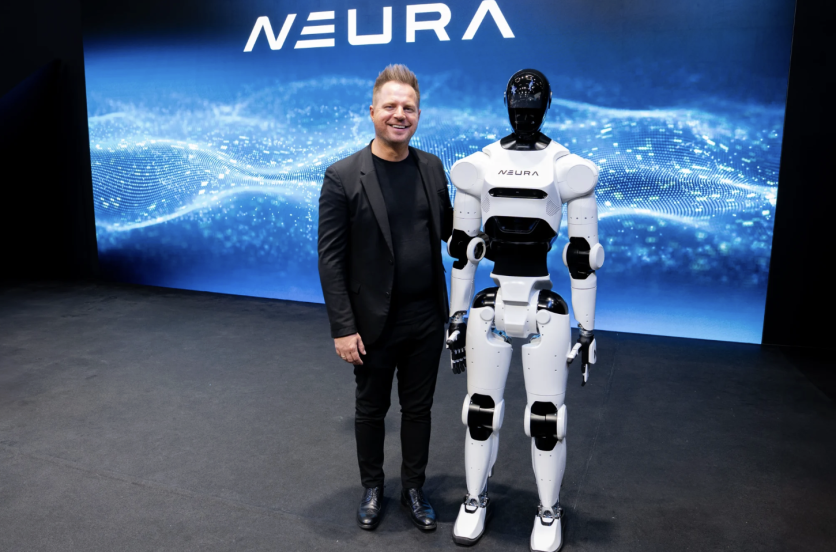
Neura Robotics, the German maker of "cognitive robots," has raised a Series C of up to $1.4 billion at a $7 billion valuation, the company announced on June 10, 2026 , a haul it calls the largest funding round ever for a full-stack robotics company and one that makes it Europe's most-funded humanoid-robot maker. The round was led by the stablecoin issuer Tether, with a striking roster of strategic backers behind it: Qualcomm, Amazon, Nvidia, Bosch, and Schaeffler, alongside the European Investment Bank and several venture funds.
For a reader trying to read the signal, the investor list matters more than the dollar figure. A humanoid-robot company has drawn capital from the leading AI chipmaker, two of the world's largest industrial-component suppliers, a hyperscale logistics giant, and a crypto company — a syndicate that maps almost exactly onto the supply chain a humanoid business needs to exist.
What Does Neura Build, and Where Is the Money Going?
Founded by chief executive David Reger and based in Metzingen, Germany, Neura builds what it calls cognitive robots — machines, including its 4NE-1 humanoid, designed to perceive, reason, and act in unstructured human environments rather than repeat fixed motions on a factory line. The company positions itself in the fast-emerging field of "physical AI," the effort to give artificial intelligence a body that can operate in the real world.
Neura says it will use the capital to ramp toward mass production of millions of cognitive robots by 2030 and to expand "Neura Gyms," which it describes as the world's first real-world training environments for cognitive robots and physical AI. Its order backlog and strategic deployment pipeline, the company says, already exceed $1 billion. One caveat sits in the wording, though: the figure is "up to" $1.4 billion, and the full amount is contingent on Neura hitting performance milestones. The headline number is a ceiling tied to execution, not a lump sum already banked — worth remembering when stacking it against other robotics raises.
Why Did These Specific Investors Sign On?
The composition of the syndicate is more revealing than the size, because each strategic backer occupies a different layer of what a humanoid company has to assemble.
Nvidia supplies the compute and simulation tooling at the center of modern robotics, including its Isaac and GR00T platforms for training and running humanoid robots. Qualcomm brings low-power, on-device inference — the efficient edge computing a battery-powered robot needs to think without tethering to a data center. Bosch and Schaeffler are industrial giants whose strengths in sensors, actuators, bearings, and high-volume manufacturing are exactly what it takes to build robots reliably and at scale. Amazon represents the demand side, a logistics and fulfillment operation that is among the most plausible early buyers of capable humanoids. And the European Investment Bank's presence signals that European institutions see Neura as a strategic asset in a field so far dominated by the United States and China.
Tether leading the round is the outlier — a sign of how far the stablecoin issuer's enormous cash reserves are flowing into frontier technology beyond crypto. A digital-dollar company bankrolling Europe's flagship humanoid maker is the kind of crossover that would have read as implausible two years ago.
Why Is Physical AI Attracting So Much Capital?
Neura's round lands in the middle of a funding frenzy around humanoids. More than $6 billion poured into the category in 2025, and Goldman Sachs has sharply raised its long-term forecast for the market. Tesla is pushing its Optimus robot toward production, Boston Dynamics' electric Atlas has begun commercial shipments, and Chinese players such as Unitree are driving prices down and heading for public markets. The thesis behind all of it: after large language models conquered the digital world, the next vast opportunity is embodied AI that can act in the physical one.
That thesis also exposes the field's hardest problem — and explains why Neura is spending on Gyms, not just on robots. Unlike a language model, which can train on the internet's text, a robot cannot learn dexterity, balance, and real-world manipulation by reading; it has to practice, physically, generating its own training data through interaction. This "data drought" is the central bottleneck in physical AI, and real-world training environments are one of the few ways to attack it. By framing Gyms as core infrastructure, Neura is betting that whoever solves the embodied-data problem — not just whoever builds the best chassis — will lead the category.
What Should You Watch Next?
For all the eye-catching numbers, the milestones are where this story gets decided. The "up to $1.4 billion" structure makes execution the key variable: whether Neura can convert its backlog into delivered, working robots and unlock the full commitment. The second test is production — moving from impressive demos to reliable manufacturing at volume is the step that has humbled many robotics companies before it. The third is whether the strategic investors become strategic customers; an Amazon or a Bosch deploying Neura robots at scale would validate the bet far more than the funding round itself.
What is already clear is the signal. The largest-ever raise for a full-stack robotics company, assembled from the AI, industrial, logistics, and crypto worlds at once, marks physical AI as the arena where serious capital is now concentrating — and stakes Europe's claim to a seat at a table that has, until now, been set mostly in Silicon Valley and Shenzhen.
Read more: NVIDIA Isaac GR00T Reference Robot Brings Full-Stack Humanoid Platform to University Labs
This article is not investment advice.
Frequently Asked Questions
How much did Neura Robotics raise?
Neura Robotics announced a Series C of up to $1.4 billion at a $7 billion valuation on June 10, 2026. It calls it the largest funding round ever for a full-stack robotics company, but the full amount is tied to performance milestones, so it is a ceiling rather than a single upfront sum.
Who invested in Neura Robotics?
The round was led by stablecoin issuer Tether, with participation from Qualcomm, Amazon, Nvidia, Bosch, Schaeffler, the European Investment Bank, and venture funds including imec.xpand, Lingotto Horizon, and InterAlpen Partners. The strategic backers span AI chips, industrial manufacturing, and logistics.
What does Neura Robotics make?
The German company, founded by David Reger, builds "cognitive robots" — including its 4NE-1 humanoid — designed to perceive, reason, and act in everyday human environments. It works in "physical AI" and is funding mass production toward millions of robots by 2030, plus real-world training environments it calls Neura Gyms.
Why is physical AI considered the next big thing?
After AI mastered text and images, investors see embodied AI — robots that act in the real world — as the next major opportunity, with over $6 billion invested in humanoids in 2025. The hardest challenge is the "data drought": robots must generate training data by physically practicing, since they cannot learn manipulation from the internet alone.
ⓒ 2026 TECHTIMES.com All rights reserved. Do not reproduce without permission.


