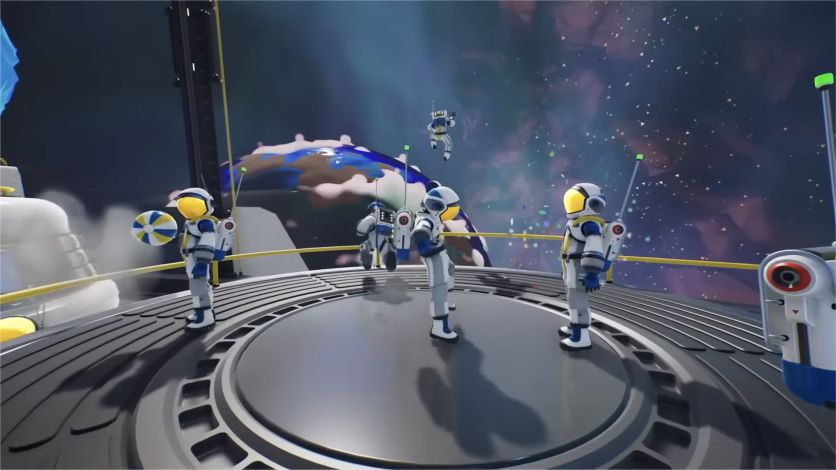
System Era Softworks and publisher Devolver Digital are launching Starseeker: Astroneer Expeditions into Early Access today, June 11, at 1:00 p.m. ET (10:00 a.m. PT). The cooperative space-exploration spinoff of Astroneer — which has drawn more than 11 million players since its 2019 full release — arrives simultaneously on Steam, Xbox Series X|S, PlayStation 5, and Nintendo Switch 2 at $29.99, and is included day one with Xbox Game Pass at no additional cost.
The launch represents a specific design pivot rather than a sequel. Where Astroneer built its audience on unhurried sandbox exploration, Starseeker is structured around short, cooperative expeditions with a hard time limit — and the original game's oxygen management system has been retooled into the mechanism that enforces it. Players who wander too far or linger too long will find themselves racing back to their dropship before they suffocate, taking whatever they managed to collect and leaving behind anything they didn't. It is the same molecule, deployed for an entirely different purpose.
Starseeker Early Access Launches Today on All Major Platforms
For players still deciding whether to spend $29.99 on an Early Access title, System Era has confirmed two facts that affect that calculation. First, all progress earned during the June 4–7 public playtest and network test carries over directly into the Early Access build — players who participated are not starting from scratch. Second, the price will increase when the game exits Early Access, which the studio estimates will take roughly one year. Buying now locks in the lower price for all future updates, with the studio noting the launch price covers every future content update.
System Era has also confirmed that Starseeker will have no microtransactions and no premium currency — a notable stance for a game with live-service structure and monthly content updates. Cosmetic supporter packs will be available on some storefronts, but the developer has described the base model as "one price for everything," which stands in contrast to the monetization norms common in both the extraction shooter genre and in live-service cooperative games broadly.
How Starseeker's Oxygen Timer Turns Astroneer's Safety Mechanic Into an Extraction Loop
In the original Astroneer, oxygen was a logistical management system: players extended their range by chaining tethers across the landscape, and the oxygen tank on their backpack ticked down only if they moved too far from a tether anchor. The system rewarded methodical exploration and allowed players to roam almost indefinitely once they had laid sufficient infrastructure. There was no session clock.
Starseeker replaces that logic entirely. Each expedition begins when the player's dropship lands on a planet and ends — with potential gear loss — when the oxygen tank runs dry. Hands-on previews ahead of launch confirmed a roughly 30-minute window per expedition, during which players must plan their route, ping resources and creatures on the map, complete objectives, and return to a designated landing site before time expires. Gear can be lost if the player is downed or fails to extract in time.
The terrain deformation tool that defined Astroneer's feel is present — players can still dig, reshape, and sculpt the landscape — but the open-ended exploration loop it enabled is gone. The same toolset now operates under deadline. As one pre-launch preview described it, Starseeker trades long-term tinkering for short, structured excursions that begin and end with purpose.
Sessions support up to 16 players on a planet simultaneously, though cooperative squads cap at four. The ESS Starseeker space station serves as the persistent hub between expeditions — a shared social space where players upgrade equipment, craft gear, accept narrative missions from station crew members, and track reputation progress.
Cross-Platform Play Works at Launch, Unlike the Original Astroneer
The original Astroneer's multiplayer was technically cross-platform but operationally awkward: Steam and PlayStation players required a third-party dedicated server to play together, and Nintendo Switch had no cross-play at all. Starseeker ships with native cross-play and cross-progression across all four platforms from day one in Early Access. A player on Nintendo Switch 2 can join a squad with a Steam PC player and an Xbox Series X player without additional setup, and progress — reputation, gear unlocks, crafted items — follows the account across platforms.
Steam Deck verification is planned during the Early Access period. The developer has confirmed that achieving verification will make the game Linux-compatible, though Linux is not officially supported beyond Steam Deck.
Xbox Game Pass Day One Means Millions Can Play at No Extra Cost
The Game Pass day-one inclusion puts Starseeker in front of a subscriber base spanning Xbox console and PC. For players already paying for Game Pass, the decision is effectively zero-incremental-cost access to a new cooperative multiplayer title on launch day. The official developer FAQ confirms Game Pass access is live from Early Access launch. The $29.99 purchase price remains the route for players on platforms not covered by Game Pass — Steam, PlayStation 5, and Nintendo Switch 2.
Monthly Updates Planned Through Early Access Year
System Era's published roadmap for the Early Access period commits to monthly updates of varying scope, organized around several content priorities: adding endgame encounters for squads that have completed the current expedition structure; expanding narrative content as players gain reputation with the station's crew; adding new planetary regions and eventually new planets beyond Tephra, the first world in the game; and working to make the ESS Starseeker station more central to the loop between expeditions.
The studio has been explicit that the Early Access period is intended as an active collaborative development phase rather than a soft launch. System Era drew on its experience with Astroneer — which spent approximately two years in Early Access before its 2019 full release — in structuring Starseeker's development timeline. The estimate for reaching full 1.0 release is approximately one year.
Frequently Asked Questions
Is Starseeker: Astroneer Expeditions on Xbox Game Pass?
Yes. Starseeker: Astroneer Expeditions is available through Xbox Game Pass on day one of its Early Access launch, covering both Xbox console and PC Game Pass subscribers at no additional cost. Players on Steam, PlayStation 5, and Nintendo Switch 2 can purchase the game separately for $29.99.
Does Starseeker have cross-platform play with all consoles?
Yes. Unlike the original Astroneer, which required third-party dedicated servers for cross-play between Steam, PlayStation, and Xbox, Starseeker ships with native cross-play and cross-progression across all four platforms — Steam, Xbox Series X|S, PlayStation 5, and Nintendo Switch 2 — from day one. Progress carries over between platforms through a shared account system.
How is Starseeker different from Astroneer?
Starseeker replaces Astroneer's freeform sandbox exploration with structured cooperative expeditions that run on a time limit enforced by oxygen. In Astroneer, oxygen was a management resource extended by laying tethers across the landscape. In Starseeker, it functions as an extraction timer: players have roughly 30 minutes per expedition to gather resources and return to their dropship before their oxygen runs out, or risk losing gear. The game retains Astroneer's terrain deformation tools, aesthetic, and universe but operates as a fundamentally different gameplay experience.
Will Starseeker's price increase after Early Access?
Yes. System Era has confirmed the $29.99 Early Access price will increase when the game reaches its 1.0 full release, which the studio estimates is approximately one year away. All future content updates are included in the base price — there are no microtransactions or premium currencies.
ⓒ 2026 TECHTIMES.com All rights reserved. Do not reproduce without permission.


