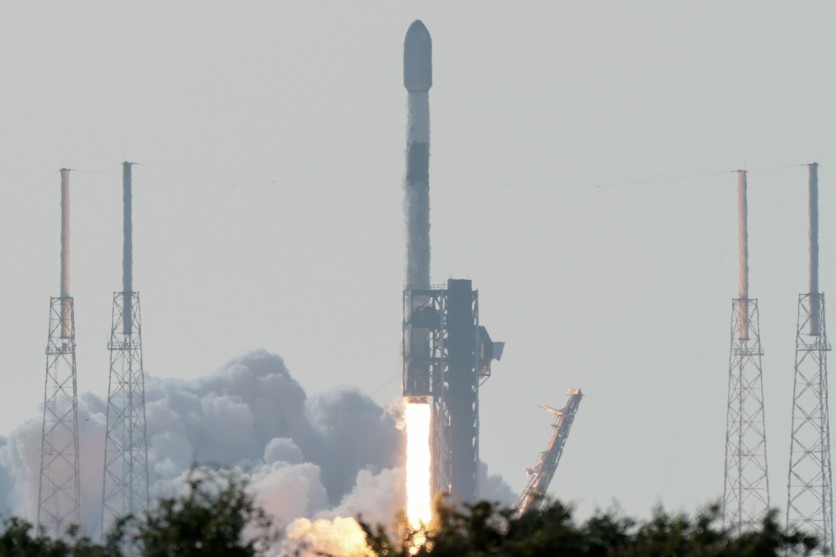
A Falcon 9 Block 5 rocket lifted off from Space Launch Complex 40 at Cape Canaveral Space Force Station at 8:37 a.m. ET Friday, carrying 29 Starlink V2 Mini Optimized satellites to low Earth orbit — and in doing so pushed the program past a threshold no other launch vehicle has reached. Spaceflight Now confirmed the Starlink 10-54 mission was the 650th flight of the Falcon 9, a program that began in June 2010 with a rocket that could not land itself and had to be thrown away after every use.
The first stage booster on Friday's flight, designated B1080, completed its 27th individual launch and landing. That figure would have looked fictional as recently as 2020. It also sits above the 25-flight threshold at which SpaceX writes down its boosters to zero in its financial statements — a detail disclosed in the company's S-1 prospectus filed ahead of its Nasdaq debut Friday and covered in TechTimes' reporting earlier this week. The gap between the accounting model and the operational reality is not a rounding error. Fleet leader B1067 flew for the 35th time on June 8, setting a new all-time reuse record for any orbital rocket booster in history.
How Falcon 9 Reusability Works: Boostback, Grid Fins, Landing Burn
The propulsive landing sequence that B1080 performed for the 27th time Friday is a four-phase chain. About 162 seconds after liftoff, the first stage separates from the expendable upper stage and executes a boostback burn — three of its nine Merlin 1D+ engines reignite to reverse the booster's trajectory. The booster then coasts upward to roughly 200 kilometers before descending. At approximately 70 kilometers altitude, four titanium grid fins unfold from the interstage, generating aerodynamic authority over the falling vehicle as it passes through the thickening atmosphere; the titanium fins withstand entry heating above 1,000°C without replacement, unlike the aluminum versions on earlier Falcon 9 variants that partially melted on reentry. A three-engine entry burn at about 55 kilometers slows the booster further. The final event is a single-engine landing burn from the center Merlin, which decelerates B1080 from several hundred kilometers per hour to a near-standstill before four carbon-fiber landing legs deploy and the vehicle touches down on the drone ship.
Friday's touchdown on A Shortfall of Gravitas in the Atlantic Ocean was the drone ship's 155th booster recovery and SpaceX's 623rd successful first-stage landing overall.
Falcon 9 Block 5: Built to Exceed Its Design Limits
The Block 5 variant that has powered all Falcon 9 flights since June 2018 was specifically engineered for reusability in a way its predecessors were not. When Musk announced Block 5, he described a design target of 10 or more flights with no refurbishment and potentially up to 100 flights with periodic maintenance. The fleet has now demonstrated that 27 flights on a single airframe is operationally achievable, and B1067's 35 flights approaches the 39-mission record held by NASA's Space Shuttle orbiters — a mark that took each orbiter roughly a decade to accumulate, compared to the roughly five years B1067 needed.
Block 5 incorporated a titanium heat shield at the base of the octaweb structure housing the nine Merlin engines, replacing a composite structure that had required more frequent maintenance. The interstage between the first and second stages received a hydrophobic thermal-protection coating that needs no repainting between flights. SpaceX also added latching mechanisms to the landing legs to eliminate the need for external clamps on drone-ship landings. The result is a first stage that requires minimal hands-on intervention beyond inspection and propellant loading for the first several flights.
What Does Reusability Actually Cost?
The economic engine behind this cadence is the gap between what it costs to build a Falcon 9 first stage and what it costs to fly one again. Building a new booster costs roughly $30 million; refurbishing a recovered one costs under $300,000 — less than one percent of the original manufacturing cost. That cost structure changes the math on the entire launch business. Before propulsive landing became routine, the cost to put a kilogram of payload into low Earth orbit ran from roughly $9,000 to $10,000. SpaceX's current estimated cost per kilogram to low Earth orbit sits at approximately $2,500 to $2,700 — a reduction of more than 70 percent.
The refurbishment process that produces those economics is methodical rather than glamorous. After each landing, the booster is transported horizontally to SpaceX's processing facility, where the nine Merlin engines are individually inspected and tested. Ultrasonic and X-ray inspections check the propellant tank welds and pressure vessels for microcracks. Turbine wheels are replaced as a precaution; occasionally a full engine is swapped. Only soot that interferes with weld inspection gets cleaned. The booster then undergoes a static fire of all nine engines before being cleared for its next mission. SpaceX has brought average turnaround time to roughly 40 days, with some missions turning around in under three weeks.
The S-1 prospectus SpaceX filed with the Securities and Exchange Commission disclosed that the company depreciates Falcon 9 first-stage boosters over 25 flights for accounting purposes, while acknowledging an engineering target of up to 40. Of the 165 Falcon 9 missions SpaceX flew in 2025, 157 used a previously flown booster. Reuse has stopped being a distinction; it is the default operating mode.
B1080 Résumé: Astronauts, a Space Telescope, and 29 More Starlinks
B1080's career spans the full range of what a Falcon 9 carries. Its previous 26 missions included two crewed flights to the International Space Station for Axiom Space, two cargo resupply missions to the station, and the launch of the European Space Agency's Euclid space telescope. The remaining missions were Starlink deployments. The versatility of a single booster airframe carrying astronauts, a scientific instrument, and commercial broadband satellites interchangeably reflects how far SpaceX's confidence in its hardware has grown since the first Falcon 9 reuse in March 2017.
The 29 Starlink V2 Mini Optimized satellites deployed Friday bring the active constellation past 10,500 spacecraft. Friday was the 55th dedicated Starlink launch of 2026 and the 68th Falcon 9 flight of the year — a cadence that no other launch provider approaches.
How Long Can a Falcon 9 Booster Keep Flying?
That question is now entering empirical territory it has never occupied before. SpaceX has not published detailed structural fatigue data for individual booster airframes — the inspection protocol described above is the primary means of tracking accumulated damage. The company's stated confidence is reflected in its decisions: B1080 has been trusted with two crew missions, a certification that requires NASA's human-rated approval for the specific booster. That B1080 carried astronauts and is still flying routine Starlink missions at flight 27 tells the structural story more concisely than any press release.
The B1067 record of 35 flights means Falcon 9 now has at least one airframe that has flown 40 percent more times than the Space Shuttle's best individual orbiter ever managed — in roughly one-seventh of the time. SpaceX has said it believes the Block 5 design can support 40 flights, a ceiling the program has not yet reached. The 650th program-wide flight on Friday morning, conducted before Wall Street opened, suggests it may not be long before it does.
Frequently Asked Questions
How does Falcon 9 reusability work?
After stage separation, the Falcon 9 first stage fires its Merlin engines in a boostback burn to reverse course, then deploys four titanium grid fins at roughly 70 kilometers altitude for aerodynamic control during descent. A three-engine entry burn slows the booster through the upper atmosphere, and a final single-engine landing burn brings it to a vertical touchdown on a drone ship or land pad. The booster then undergoes ultrasonic weld inspection, individual engine tests, and a full nine-engine static fire before being cleared to fly again — typically within about 40 days.
How many times has a Falcon 9 booster been reused?
Booster B1067 holds the record at 35 flights after its June 8, 2026 mission — more individual flights than any orbital rocket booster in history. Booster B1080 completed its 27th mission on June 12. SpaceX's Falcon 9 Block 5 is engineered for a target of up to 40 flights per booster, while the company's financial filings depreciate each booster over 25 flights for accounting purposes — meaning the fleet is routinely flying past the point at which SpaceX has already written the hardware off its books.
Why does Falcon 9 cost less than other rockets?
Refurbishing a recovered Falcon 9 first stage costs roughly $300,000, compared to approximately $30 million to build a new one — less than one percent of the original manufacturing cost. Combined with the booster making up roughly 60 to 75 percent of total launch cost, this drives the price to put a kilogram of payload into low Earth orbit from roughly $9,000–$10,000 on expendable rockets to approximately $2,500–$2,700 on a reused Falcon 9. Of the 165 Falcon 9 missions SpaceX flew in 2025, 157 used a previously flown booster.
What satellites did SpaceX launch on Friday?
The Starlink 10-54 mission deployed 29 Starlink V2 Mini Optimized satellites into low Earth orbit from Space Launch Complex 40 at Cape Canaveral Space Force Station. The V2 Mini Optimized is SpaceX's current production-standard satellite, delivering significantly greater user-serving capacity than its predecessors via more powerful phased-array antennas and E-band backhaul frequencies. The launch brought the active Starlink constellation past 10,500 spacecraft.
ⓒ 2026 TECHTIMES.com All rights reserved. Do not reproduce without permission.


