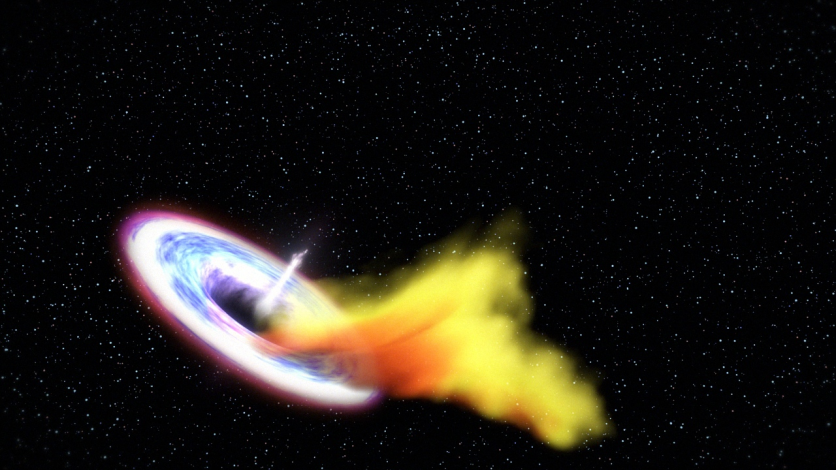
Tidal disruption events — the brief, violent episodes in which a star wanders too close to a dormant supermassive black hole and is pulled apart by tidal forces — are messier and more varied than astronomers had assumed. Results from the first systematic radio survey ever dedicated to these phenomena, presented Monday afternoon at the 248th meeting of the American Astronomical Society in Pasadena, overturn a tidy two-category model that the field had been working with for years and point instead to the black hole's accretion flow as the key variable governing what a star-shredding event looks like in radio wavelengths.
Kate Alexander of the University of Arizona will present results from the NSF Karl G. Jansky Very Large Array Large Program on tidal disruption events (program 20B-377) at a press conference running 2:15–3:15 PM PDT Monday as part of the ongoing AAS 248 conference. The program, which was awarded 300 hours of telescope time on the VLA in Socorro, New Mexico, is the first radio monitoring campaign to apply a uniform, systematic observing strategy to an entire population of these events — replacing the patchwork of ad hoc follow-up observations that had characterized the field before.
The core finding: TDE outflows and jets are far more diverse in their radio behavior than prior data had suggested. Some events show delayed radio brightening that emerges months or even years after the initial stellar disruption. Others appear bright and rapidly evolving from the outset. Still others evolve quietly and would not have been detected without the systematic monitoring the Large Program provides. Across all of them, a pattern has emerged that prior, heterogeneous datasets could not resolve: the evolution of a TDE's radio emission tracks its behavior at optical and X-ray wavelengths, pointing to the physics of accretion — how material spirals onto the black hole — as the driver of whether and how a jet or outflow forms.
What Is a Tidal Disruption Event?
When a star drifts within the tidal radius of a supermassive black hole — the distance at which the black hole's gravitational gradient overwhelms the star's own self-gravity — the star is stretched and shredded into a stream of debris. Roughly half of that debris falls back onto the black hole, generating a luminous accretion flare that can outshine its host galaxy for weeks to months, visible across optical, ultraviolet, X-ray, and radio wavelengths. In a small fraction of cases — historically estimated at around 1% — the infalling material also powers a relativistic jet that plows outward through the surrounding gas and glows in radio wavelengths through synchrotron emission.
Tidal disruption events were first theorized by Jack G. Hills in 1975 and first predicted to produce observable flares by Martin Rees in 1988, but they remained rare curiosities observed on a case-by-case basis for decades. Roughly 100 are now known, discovered primarily by wide-field optical transient surveys including the Zwicky Transient Facility and the All Sky Automated Survey for SuperNovae. Of those, only a few dozen have detailed radio characterization — and most of that radio data accumulated through one-off follow-up programs, not systematic monitoring.
TDEs matter not just as spectacles, but as tools. Because they briefly switch on a supermassive black hole that would otherwise be invisible, they expose conditions in the galaxy nucleus at parsec scales — regions too small and too dim to study any other way. No other phenomenon offers this observational window.
Why Radio Wavelengths Unlock What Other Telescopes Cannot
Optical and X-ray observations capture the accretion flare itself — the light emitted as infalling stellar debris heats up near the black hole. Radio observations capture something different: the shock wave produced where TDE-driven outflows slam into the surrounding circumnuclear medium, the gas and dust enveloping the black hole at distances of roughly one parsec.
That shock produces synchrotron radiation — electromagnetic emission generated when relativistic electrons spiral through magnetic fields. The resulting radio signal has a characteristic spectrum that shifts predictably as the outflow expands, making it a precision diagnostic tool that no other wavelength band can replicate.
How the VLA Large Program Works: Synchrotron Mapping at Scale
The physical technique at the heart of the VLA Large Program is called equipartition analysis. At each observing epoch, the team simultaneously records the radio spectral energy distribution of a TDE across multiple frequency bands — from roughly 1 GHz to 26.5 GHz — capturing the complete shape of the synchrotron spectrum. A key feature of that spectrum is the synchrotron self-absorption frequency: the frequency below which the emitting region becomes opaque to its own radiation, creating a spectral turnover. As the outflow expands and the emitting region grows, that turnover frequency shifts downward in a predictable way.
By modeling how the synchrotron spectrum evolves from epoch to epoch, the team can extract three physical quantities that would otherwise be inaccessible: the total kinetic energy of the outflow, its physical size, and its expansion velocity. Crucially, the density structure of the circumnuclear medium imprints itself on the observed light curve — as the outflow sweeps through denser or sparser material, the rate of radio brightening and fading changes detectably. Each TDE effectively becomes a probe of its host black hole's local environment.
The Very Large Array consists of 27 parabolic dishes, each 25 meters in diameter, arranged in a Y-shaped formation across the New Mexico desert. By combining signals from all 27 antennas through aperture synthesis interferometry, the array achieves the resolving power of a single dish up to 36 kilometers across — comparable to the Hubble Space Telescope's angular resolution at optical wavelengths. The 300 hours of time awarded to Alexander's program represents a significant commitment of a facility that is shared competitively among researchers worldwide.
What prior programs lacked was not sensitivity but consistency. Without a uniform cadence applied to a defined sample of events, the heterogeneity of earlier datasets — different telescopes, different frequencies, different time baselines — made it impossible to determine whether apparent differences between TDEs reflected genuine source diversity or simply differences in how they were observed. The Large Program eliminates that ambiguity.
What the Data Show: Diversity Beyond the Two-Category Model
Before this program, the dominant framework in TDE radio astronomy was essentially binary: a small fraction of events — historically around 1% — produce powerful relativistic jets that radiate brightly at radio wavelengths, while the remainder produce either slower, quasi-spherical non-relativistic outflows or no detectable radio emission at all. That framework was built on a fragmentary sample observed inconsistently over years.
The VLA Large Program data tell a more complex story. Radio evolution in TDEs spans a broader range of trajectories than the two-category model captured, with some events following neither of the standard templates cleanly. Among the most striking features: delayed radio brightening is widespread, with radio flares emerging hundreds of days or even years after the initial optical event. Research by Alexander and collaborators published in The Astrophysical Journal in early 2026 (Alexander et al. 2026, ApJ 1000, 139) found evidence that such delayed emission appears in a substantial fraction of optically discovered TDEs — events that had shown no radio signal at earlier epochs. Some of these delayed flares reflect outflows encountering unusually dense circumnuclear environments; others may signal a genuine state transition in the accretion disk, launching a new outflow long after the initial disruption.
The multi-wavelength correlations are the dataset's sharpest result. TDE radio behavior tracks optical and X-ray behavior in ways the prior, patchwork data could not reveal — establishing that the radio emission is not decoupled from accretion-disk physics but intimately connected to it.
The Accretion Flow Connection
The implication is significant. For years, the question of whether a TDE launches a jet or merely a slower outflow was treated as a largely random property of the event — something that depended on the star's approach angle, the black hole's spin, or some other poorly constrained initial condition. The VLA Large Program data suggest otherwise: the accretion flow is the common thread.
How material spirals onto the black hole — the rate at which it falls in, the geometry of the disk it forms, and whether that disk enters a particular accretion state — appears to govern what happens at radio wavelengths. That connection between the inner accretion disk and the large-scale outflow, now traceable across a population of TDEs for the first time, is what makes this dataset valuable beyond its immediate descriptive power.
What This Means for Gravitational Wave Astronomy
The circumnuclear medium mapping enabled by this dataset has implications well beyond TDE science. The density profiles Alexander's team can now measure around dormant supermassive black holes — at the parsec scales only TDE synchrotron observations can reach — feed directly into a different and urgent scientific problem: predicting how many extreme mass-ratio inspirals (EMRIs) will be detectable by future space-based gravitational wave observatories.
An EMRI occurs when a stellar-mass compact object — a black hole or neutron star — spirals into a supermassive black hole over thousands of orbits, emitting gravitational waves throughout. These signals are expected to be among the primary sources for the Laser Interferometer Space Antenna (LISA), the planned European Space Agency space-based gravitational wave detector. The number of EMRIs that LISA will detect depends critically on the density and structure of the stellar environment surrounding the supermassive black hole — precisely the quantity that TDE radio observations now probe. EMRI rate predictions currently span three orders of magnitude, in large part because the relevant nuclear stellar environments are so poorly characterized. The VLA Large Program's circumnuclear density profiles are among the first systematic observational data that can begin to narrow that uncertainty.
Rubin Observatory Opens a New Statistical Frontier
The AAS 248 results establish a foundation, not a ceiling. The Vera C. Rubin Observatory's Legacy Survey of Space and Time — which began issuing real-time discovery alerts in February 2026 and is now generating approximately 10 terabytes of sky data per night from its site on Cerro Pachón in Chile — is expected to expand the known TDE sample dramatically over the coming decade. Where a few dozen well-characterized radio TDEs currently exist, a sustained program of radio follow-up of Rubin-discovered events could push that number into the hundreds, enabling the kind of statistical studies of black hole outflows that have not previously been possible.
Alexander's VLA Large Program establishes the observational benchmarks — the uniform measurement standards, the population-level correlations, the technical framework — against which that expanded sample will be measured. What the program has produced is not merely new data but a new methodology for treating TDEs as a statistical population rather than a collection of curiosities.
Frequently Asked Questions
What is a tidal disruption event?
A tidal disruption event is what happens when a star passes too close to a supermassive black hole and is torn apart by the difference in gravitational pull across its diameter — a process called spaghettification. Roughly half of the debris falls back onto the black hole, generating a flare of radiation that can briefly outshine the star's entire host galaxy. The event provides a rare opportunity to study a supermassive black hole that is otherwise completely dormant and invisible.
Why does the accretion flow matter for whether a black hole launches a jet?
The accretion flow is the disk of infalling material that forms as stellar debris spirals onto the black hole. Its geometry, rate of infall, and physical state — whether it is thick or thin, hot or cold, magnetized in a particular way — appear to determine whether the black hole launches a narrow relativistic jet or a slower, broader outflow. The VLA Large Program's finding that radio behavior tracks optical and X-ray behavior across a population of TDEs for the first time suggests that the inner accretion disk and the large-scale radio outflow are far more tightly coupled than the two-category model implied.
What do tidal disruption events have to do with gravitational wave astronomy?
TDEs probe the density of gas and stars in the parsec-scale environment surrounding supermassive black holes — the same environment that determines how often stellar-mass compact objects spiral into the black hole and emit gravitational waves, a class of event called an extreme mass-ratio inspiral (EMRI). Future space-based gravitational wave detectors like LISA are expected to detect EMRIs in large numbers, but predictions for how many vary by a factor of a thousand because nuclear stellar environments are poorly characterized. The circumnuclear density profiles that TDE radio observations can now measure systematically are among the first direct observational data that can constrain those predictions.
What is the significance of the VLA Large Program compared to earlier TDE studies?
Earlier radio observations of tidal disruption events were largely opportunistic: individual events were followed up with whatever telescope time was available, at varying frequencies and cadences, with no uniform strategy across the sample. That heterogeneity made it impossible to distinguish genuine differences between events from differences in how they were observed. The VLA Large Program applied a consistent, systematic monitoring cadence across a defined population of TDEs, producing the first dataset capable of genuine population-level analysis — and revealing patterns in accretion-radio correlations that the patchwork prior data had concealed.
ⓒ 2026 TECHTIMES.com All rights reserved. Do not reproduce without permission.


