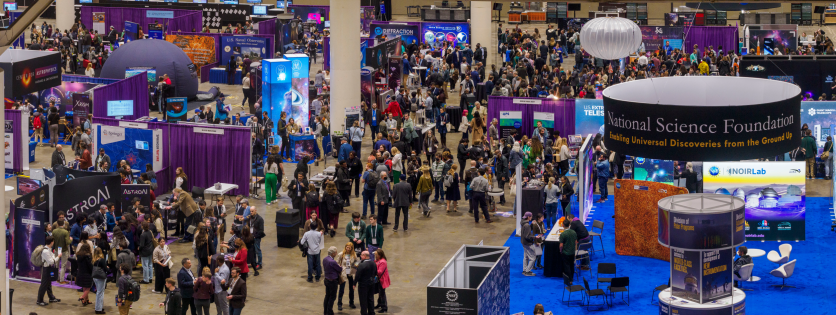
The 248th meeting of the American Astronomical Society opens Sunday in Pasadena — and the five days of science that follow will do more than present new findings. They are, in a real sense, a planning session for the future of US astronomy. Sessions throughout the week will shape the community input that feeds directly into NASA's ASTRA initiative, which is selecting the flagship and probe-class missions that will dominate astrophysics budgets in the 2030s. The Ad ASTRA Community Science Workshop, where those input threads converge, is scheduled for September 1–3, 2026 — just ten weeks away.
The meeting runs June 14–18 at the Pasadena Convention Center, jointly held with the High Energy Astrophysics Division and the Laboratory Astrophysics Division. The Pasadena location is consequential: Caltech and NASA's Jet Propulsion Laboratory sit minutes away, and researchers from both institutions are presenting results throughout the week from missions they operate. Press conferences are livestreamed on the AAS Press Office YouTube channel.
With the Nancy Grace Roman Space Telescope confirmed for an August 30 launch — 78 days from today, eight months ahead of schedule — this meeting opens at a moment when the community is simultaneously closing out the planning era and beginning to absorb the implications of what Roman, the Rubin Observatory's ongoing Legacy Survey of Space and Time, and the eROSITA all-sky X-ray catalog will demand from astronomers over the next decade.
Sunday, June 14: Data Infrastructure Comes First
The meeting opens Sunday with three workshops that reflect one of the discipline's central technical challenges: the volume of data modern observatories generate has outgrown the methods astronomers use to analyze it.
The morning's Euclid Data in the Cloud workshop (10:00–11:30 am, Room 101) introduces participants to accessing and analyzing data from the European Space Agency's dark energy mission, which has NASA participation and recently completed its first major cosmology survey pass. At the same time, the High Energy Science Analysis with HEASARC Services workshop (10:00 am–12:00 pm, Room 102) walks early-career scientists through the High Energy Astrophysics Science Archive Research Center's tools for working with X-ray and gamma-ray datasets.
The afternoon workshop — An Introduction to Fornax: Scalable Data and Compute for Scientific Analysis (2:00–4:00 pm, Room 101) — is perhaps the most forward-looking. NASA's new Astrophysics Science Platform is designed to let researchers run analysis in the cloud rather than downloading enormous datasets to local machines. The Rubin Observatory's Legacy Survey of Space and Time, now generating up to 20 terabytes of sky data per night, makes cloud-based infrastructure not a convenience but a prerequisite.
Sunday evening's exhibit hall opening reception offers a first look at booths from major facilities, including the NSF's National Radio Astronomy Observatory at Booth 100 — the organization presenting results at six press conferences over the course of the week.
Monday, June 15: Planet-Forming Disks and Stellar-Mass Black Holes
The formal scientific program opens Monday with the Fred Kavli Plenary Lecture, delivered by Richard Teague of MIT (11:40 am–12:30 pm, Ballroom DE). Teague built the technique that turned the ALMA radio telescope array into a planet detector.
The method works by measuring the rotation velocity of gas inside planet-forming disks with sub-percent precision relative to ideal Keplerian motion. Planets embedded in the disk perturb the local gas pressure, creating systematic deviations in the rotation curve — deviations ALMA can detect as Doppler shifts of just a few meters per second in gas moving at roughly five kilometers per second. Teague's work with the exoALMA collaboration extended this into the first submillimeter planet-hunting campaign, mapping the three-dimensional velocity structure of protoplanetary disks in enough detail to locate worlds still in the process of forming. The technique has reshaped the field's understanding of how and where planetary systems emerge.
The AI-and-astronomy intersection surfaces early Monday, when Sanmi (Oluwasanmi) Koyejo of Stanford University delivers a plenary lecture titled "The Measurement Gap: What AI Can Get Wrong and Why Astronomers Are the Fix." Koyejo, who leads the Stanford Trustworthy AI Research lab, will argue that astronomers' disciplined approach to measurement science — where systematic uncertainty quantification is not optional — could improve how the broader machine learning field evaluates model performance.
Monday morning also opens the first NASA Cosmic Origins Special Session (10:00–11:30 am): "Everything but Exoplanets: The Transformative General Astrophysics of the Habitable Worlds Observatory." Presenters from Johns Hopkins University, the University of Louisville, Arizona State University, and Caltech/IPAC will lay out the scientific case for the observatory across ultraviolet spectroscopy, near-infrared discovery space, and the study of the diffuse gas ecosystem that threads between galaxies.
Monday afternoon brings the week's first major press conference: Tidal Disruption Events and Black Hole Outflows (2:15–3:15 pm). Kate Alexander of the University of Arizona will present results from the first NSF Very Large Array Large Program dedicated entirely to tidal disruption events — the episodes in which a star passes within the tidal radius of a supermassive black hole, is pulled apart by tidal forces, and accretes onto the black hole in a months-long flare. By monitoring the synchrotron emission produced where TDE-driven outflows collide with the surrounding interstellar medium, Alexander's team measured energy, size, and expansion velocity for a population of TDEs and found wider diversity in jet and outflow behavior than prior observations had captured. The key finding is mechanistic: radio evolution in these events correlates with behavior at optical and X-ray wavelengths, pointing to the accretion flow — how material spirals onto the black hole — as the driver of whether and how a jet forms.
Tuesday, June 16: The Milky Way's Missing Star Factory and Europa's Icy Surface
Tuesday opens with a press conference whose subject has puzzled astronomers for more than a decade: why is the center of the Milky Way so bad at forming stars?
The Central Molecular Zone — the innermost 100 parsecs around the galaxy's central supermassive black hole — contains some of the densest molecular gas in the Milky Way. By standard dense-gas scaling relations, it should be producing stars at a substantial rate. Instead, its star formation rate is more than ten times lower than those relations predict. The gas is there; the stars are not being born.
Rojita Buddhacharya of the Center for Astrophysics at Harvard & Smithsonian will present results from ACES, the ALMA CMZ Exploration Survey, which maps the physical and kinematic structure of gas in this region at multiple spatial scales. The suppression is thought to arise from a combination of factors specific to the galactic center environment: turbulence driven by gas inflow along the Milky Way's bar is roughly five to ten times higher than in the galactic disk; cosmic ray ionization rates are elevated; strong magnetic fields resist gravitational collapse; and the gas may cycle episodically through bursts of star formation separated by long quiescent phases. The Central Molecular Zone is not just a Milky Way puzzle — it is a template for understanding star formation in the extreme environments of starburst galaxies throughout the universe.
Tuesday afternoon brings a second press conference: Io's Volcanic Plumes and Europa's Icy Shell (2:15–3:15 pm). Neal Turner of JPL/Caltech will present models predicting the mid-infrared and millimeter-wave signatures of solid particles in Io's volcanic plumes — signatures that could reveal the magma's composition and the moon's interior structure, with implications for how tidal heating drives Io's violent resurfacing.
Tunhui Xie of UCLA will follow with the most comprehensive radar dataset ever assembled for Europa. The observations used Goldstone's 3.5-cm radar system and the NSF Green Bank Telescope in bistatic configuration — Goldstone transmits and GBT receives the reflected signal — collected across 2011 to 2024. Bistatic radar allows researchers to measure circular polarization ratios in the reflected signal, a diagnostic of subsurface structure that single-antenna radar cannot access. The resulting disk-integrated albedo values add a new layer to the community's understanding of Europa's ice shell ahead of NASA's Europa Clipper mission.
Tuesday afternoon's AI-Driven Science in the Survey Era Special Session (2:00–3:30 pm, Ballroom F) ties the week's technical thread together. With Rubin generating up to 10 million alerts per night about changing objects in the sky, and Roman's wide-field infrared survey beginning in 78 days, the volume of astrophysical data arriving over the next decade cannot be processed by human inspection. Machine learning has already produced breakthroughs across transient detection, galaxy morphology classification, and gravitational lens identification — the session will survey where those advances stand and what the survey era requires next.
Wednesday, June 17: Star Clusters in Disguise and the Origins of Heavy Elements
Wednesday opens with a press conference on star clusters hidden in the dust-shrouded star-forming rings of nearby galaxies (10:15–11:15 am). Sajia Shahrin Neha of the University of Kentucky will present combined ALMA and VLA imaging of young massive cluster candidates in barred spiral galaxies NGC 3351 and NGC 1097. Identifying these clusters requires decomposing the radio spectral energy distribution into its components — free-free emission from ionized gas, synchrotron radiation from accelerated electrons, and thermal emission from cold dust — to extract the star formation activity buried inside.
Debosmita Pathak of The Ohio State University will present the first direct pressure measurements of stellar feedback in roughly 1,600 young clusters within NGC 3256, the nearest luminous infrared galaxy, using a combination of JWST, Hubble, the VLT MUSE spectrograph, and ALMA. The measurements distinguish contributions from radiation pressure, warm ionized gas, and stellar winds — providing the most detailed picture yet of how massive stars regulate further star formation in a merging galaxy.
Two plenary lectures anchor the day. Cara Battersby of the University of Connecticut will expand on the galactic center star formation theme, drawing on her leadership of major ALMA and Submillimeter Array programs targeting star formation in extreme environments where the galactic bar, magnetic fields, and cosmic ray heating create conditions unlike anything in the disk. Esra Bulbul of the Max Planck Institute for Extraterrestrial Physics will present on galaxy clusters and dark energy from the SRG/eROSITA all-sky X-ray survey, which catalogued hundreds of thousands of galaxy clusters for the first time and placed new constraints on the total matter content of the universe.
Ian Roederer of North Carolina State University delivers a plenary on nuclear astrophysics and near-field cosmology, using the chemical fingerprints of ancient metal-poor stars observed in the ultraviolet to reconstruct the earliest nucleosynthetic events in the universe — the neutron-star mergers and other explosions that seeded the periodic table with gold, platinum, and uranium.
Thursday, June 18: Solar System Fossils, Compact Objects, and the Vote on What Comes Next
Thursday's plenary schedule runs from the smallest solid bodies in the solar system to the densest environments in stellar physics.
David Jewitt of UCLA — recipient of the Shaw Prize in Astronomy and the Kavli Prize in Astrophysics — will present on asteroids, comets, and trans-Neptunian objects: the oldest preserved solids from the Sun's protoplanetary disk. Mario Juric of the University of Washington, principal investigator of UW's contribution to the Vera C. Rubin Observatory, will speak to what the LSST is now delivering in its first full operational year — a real-time solar system inventory and Milky Way structural survey at a scale and cadence no prior facility has achieved.
Kyle Kremer of UC San Diego delivers the Helen B. Warner Prize for Astronomy plenary on the dynamics of compact objects in dense stellar systems. His N-body simulations of globular clusters generate specific, testable predictions for binary black hole merger rates, tidal disruption events, fast radio bursts, and other transients now being detected simultaneously by gravitational wave observatories and wide-field electromagnetic surveys.
Yi-Ming Wang of the Naval Research Laboratory receives the George Ellery Hale Prize for four decades of foundational contributions to solar wind modeling and coronal physics, with direct applications to operational space weather forecasting. Eliza Kempton of the University of Chicago will present on JWST exoplanet atmosphere observations, where her theoretical work on atmospheric chemistry and thermal structure provides the modeling framework that turns transmission spectra into inferences about temperature, molecular composition, and cloud structure. George Helou of Caltech/IPAC, who oversaw science operations for a dozen space telescopes during his tenure as Executive Director of IPAC, contributes a career-spanning perspective on galaxy physics and the infrastructure underpinning modern survey astronomy.
Carolyn Kierans of NASA Goddard Space Flight Center delivers the HEAD Early Career Prize Plenary, recognized for her work as principal investigator of the ComPair balloon mission and data pipeline scientist for the Compton Spectrometer and Imager. Her research targets gamma-ray imaging and the origin of the positrons pervading the galactic center — one of the field's most persistent open questions.
NASA ASTRA Session: Where the Community Sets the Agenda for the 2030s
Thursday afternoon's NASA ASTRA Special Session: Planning for the Future of Astrophysics (10:00–11:30 am) is the meeting's most consequential policy moment, and the one most readers outside the astronomical community are least likely to know about.
NASA's Astrophysics Strategic Technology and Research Accelerator — ASTRA — is the initiative that will determine which major observatory concepts proceed to detailed study, technology development, and eventually formal project proposals. The Habitable Worlds Observatory remains central to NASA's strategy, but ASTRA's mandate is broader: it is identifying flagship and probe-class mission concepts exceeding one billion dollars in cost for the decade after Roman, drawing community input through exactly the kind of sessions taking place this week.
NASA Astrophysics Division Director Shawn Domagal-Goldman will open the session. Subsequent presentations will cover ASTRA's overview and path forward, findings from a recent innovation workshop, and plans for the September Ad ASTRA Community Science Workshop. That September gathering — September 1–3, 2026 — is where the community's concept priorities will be formalized into a document that shapes NASA mission planning for years. The sessions this week in Pasadena are, in effect, the last major structured community input before that deadline. No remote participation is available for Thursday's ASTRA session.
How to Follow the AAS 248 Meeting
Press conferences run throughout the week and are livestreamed on the AAS Press Office YouTube channel. The NSF's National Radio Astronomy Observatory will staff Exhibit Booth 100 and is presenting results at six press conferences, spanning black hole outflows, galactic center gas, hidden star clusters, and planetary science. ASTRA Office Hours run at 9:00 am PT Monday through Wednesday for researchers interested in mission concept planning.
The full schedule, abstracts, and registration information are at aas.org/meetings/aas248.
Frequently Asked Questions
What is the AAS 248 meeting and who attends?
The American Astronomical Society holds two major meetings each year, drawing thousands of professional astronomers, early-career researchers, educators, and science writers. The 248th meeting is the summer gathering, co-hosted this year with the High Energy Astrophysics Division and the Laboratory Astrophysics Division. It runs June 14–18, 2026, at the Pasadena Convention Center, with Caltech and NASA's Jet Propulsion Laboratory nearby.
What new scientific results are being announced at AAS 248?
Six press conferences organized by the NSF's National Radio Astronomy Observatory will unveil findings from ALMA, the Very Large Array, and the Green Bank Telescope, covering tidal disruption events around supermassive black holes, gas dynamics in the Milky Way's central 100 parsecs, hidden star clusters in nearby galaxies, and the most comprehensive radar characterization of Europa and Io yet assembled. All press conferences are livestreamed on the AAS Press Office YouTube channel.
What does the ASTRA special session mean for the future of space astronomy?
NASA's ASTRA initiative is selecting the mission concepts — billion-dollar flagship and probe-class observatories — that will define US astrophysics after the Nancy Grace Roman Space Telescope. The Thursday ASTRA session at AAS 248 is one of the last major structured community input events before the September 1–3 Ad ASTRA Workshop, where those priorities are formalized. What gets discussed in Pasadena this week shapes what NASA builds in the 2030s.
When does the Nancy Grace Roman Space Telescope launch?
Roman's confirmed launch date is August 30, 2026 — 78 days from the opening of AAS 248, and eight months ahead of the agency's original required schedule. It will lift off on a SpaceX Falcon Heavy from Kennedy Space Center's Launch Complex 39A. Roman's 2.4-meter mirror covers a field of view 100 times wider than Hubble's infrared instrument, designed to survey a billion galaxies and address fundamental questions about dark energy and exoplanet demographics.
ⓒ 2026 TECHTIMES.com All rights reserved. Do not reproduce without permission.


